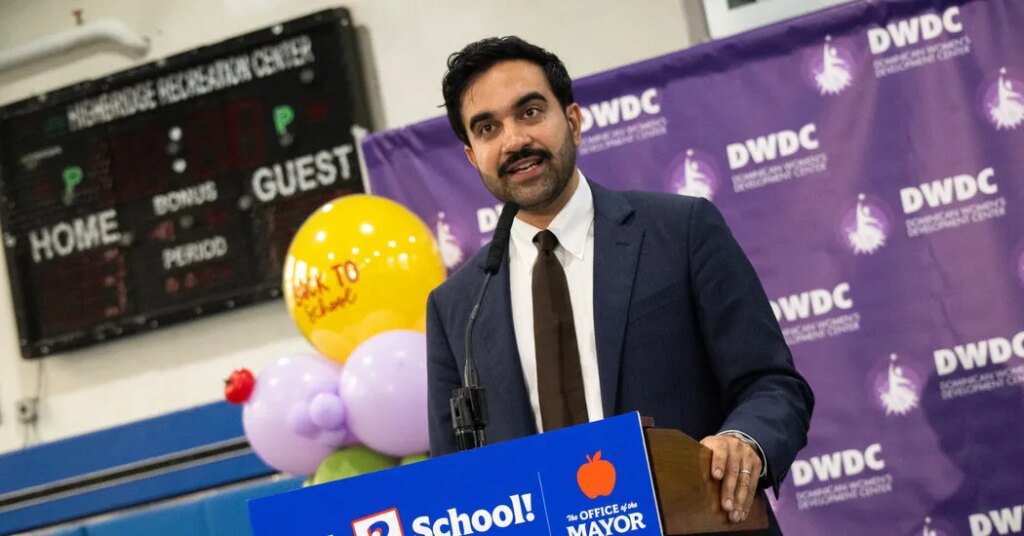
Mayor Zohran Mamdani’s child care plan promises to offer a free seat to every 2-year-old in New York City by the end of his first term, and then to expand the program to include babies.
A new survey of parents, released on Thursday, shows why reaching younger children could be difficult.
More than 60 percent of families would prefer to have a parent or relative care for children under the age of 2, according to the survey of roughly 4,300 New York City parents by New America and Robin Hood, two nonprofits that worked with the city on a report about what parents want from child care.
The report’s authors recommend strengthening paid parental leave and considering direct financial support for parents or relatives of younger children.
New York City has led the nation in offering free preschool to 3- and 4-year-olds and added 2,000 seats for 2-year-olds, known as 2-K, in September, with the ambitious goal of eventually making the program available to all children from 6 weeks to 5 years old.
But there has been a national debate over whether the government should also pay parents to stay home. The Trump administration is moving to allow married couples with a stay-at-home spouse to collect subsidies, diverting funds from a program for working parents.
Here is what the survey found:
Some families are spending $28,000 per year on child care.
Parents are struggling to pay for child care, and it affects their career decisions, the survey found.
A mother in Manhattan quoted in the report said she was staying home with her children, ages 1 and 3, because child care cost more than her income. “I don’t feel I had a choice,” she said.
Child care is more expensive for the youngest children. Parents who have a child younger than 1 reported spending an average of $2,395 per month on child care, or more than $28,000 per year. The cost falls to under $1,000 per month for families whose youngest child is 4.
The report urged the city to consider offering direct financial support to parents, relatives, friends or neighbors who care for children.
Two-thirds of parents want to care for their babies themselves.
During a child’s first year, 69 percent of families would like for a parent to be able to provide care, the survey found.
Other options were less popular: 13 percent preferred a relative, 6 percent want a child-care center and 5 percent preferred a friend or nanny.
For older children, parents expressed more comfort with formal settings. For a 1-year-old, about 28 percent of parents said they wanted to use a center, a family day care or school-based care. That figure grew to 70 percent for a 3-year-old.
Parents want more parental leave.
New York State’s paid leave laws allow many parents to take up to 12 weeks off at up to two-thirds of their pay. Some parents took less than that, the survey found.
More than 40 percent of parents said they would prefer to take six months or more, if money and job security were not concerns.
The report said that improving parental leave was “responsive and efficient” and could reduce demand for licensed programs for babies, which are more expensive.
Elliot Haspel, a senior fellow at the think tank Capita who wrote a book about child care policy, said the United States was a “massive outlier” globally in providing parental leave.
“These two things can go together: strong, lengthy paid parental leave and a well-funded, free formal child care system,” he said.
Different neighborhoods want different options.
The city’s free preschool program for 3- and 4-year-olds has relied on programs inside schools and at child care centers, which are frequently favored by higher-income families.
The 2-K expansion leans more on day cares inside people’s homes, which tend to be more affordable and flexible and are often preferred in working-class communities.
The survey found that those patterns hold true. In parts of the Bronx, the poorest borough, only 18 percent of parents said they wanted a program based in a school or center for a 2-year-old. In Williamsburg, an affluent Brooklyn neighborhood, 52 percent of parents wanted those options.
Emmy Liss, the director of the city’s child care office, said in a video call with reporters and the authors of the report that the city would use the information to shape its strategy.
“As we serve younger children, what makes families feel most comfortable?” Ms. Liss said officials were asking.
Trust is the most important factor.
When choosing a child care provider, parents cared most about trust, the report said: Roughly 47 percent listed it as a top factor.
Convenience and cost also ranked high. And parents wanted staff members to have degrees in early childhood education and to provide outdoor play opportunities for children.
Two fathers in Brooklyn said that trust was even more important for parents with children under 3 who are too young to communicate about any problems that arise at child care programs.
A successful system “has to earn families’ confidence, not just expand seats,” the report said.
The post Could Mamdani’s Child Care Push Include Expanding Parental Leave? appeared first on New York Times.