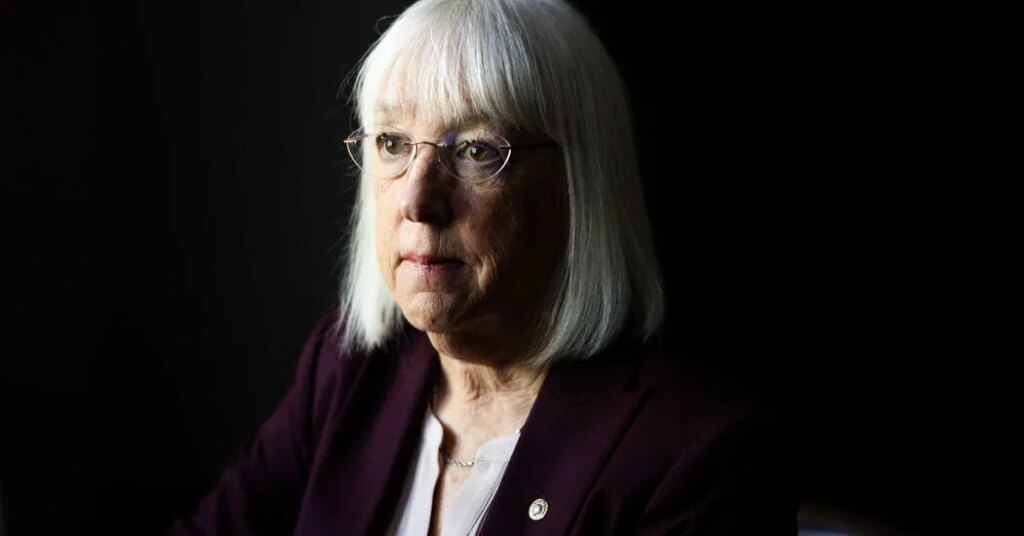
Senator Patty Murray, a Washington State Democrat who chaired the Senate health committee during the coronavirus pandemic, called the new director of the Centers for Disease Control and Prevention last week to ask why the agency had refused to report several measles deaths in Pennsylvania.
The outbreak has landed the nation’s public health agency in the middle of a political feud. Gov. Josh Shapiro, a Democrat, said in August that measles had killed two people in his state. Health Secretary Robert F. Kennedy Jr., who oversees the C.D.C., suggested that the governor’s staff might have “fabricated” the deaths, and that patients had died in Pennsylvania with measles — but not from it.
The agency’s director, Dr. Erica Schwartz, told Ms. Murray that the C.D.C. was working with state epidemiologists to draft a more precise definition of a measles death, the senator said.
Ms. Murray was appalled, she said in an interview. “What is the goal of that?” she recalled asking Dr. Schwartz. “In my mind it’s to obscure how many people are dying.”
Dr. Schwartz declined to comment on the exchange. A spokeswoman for the Department of Health and Human Services said that the C.D.C. wants to “ensure measles deaths are classified and reported consistently” across the country.
To Ms. Murray, the conversation was another example of how the C.D.C., once regarded as the world’s “gold standard” for public health agencies, has been hobbled by partisan politics. Now, she and public health leaders are charting strategies to repair the damage once Mr. Kennedy and Mr. Trump leave office.
On Wednesday, Ms. Murray plans to announce that she is forming the “Public Health for America Working Group” to draft a legislative blueprint for insulating the C.D.C. from political pressure. The group, composed of five people, includes a pulmonologist, a former Food and Drug Administration official and a nurse who chairs a state health board. There are no politicians, though some members have worked for Democratic administrations.
In an interview in her office on Capitol Hill, Ms. Murray said she expected the group to be nonpartisan and to talk to people on all sides of the fractious debate over public health.
“My direction to them, and they understand it and agree with it,” she said, “is that we need to hear from people that we may think may not agree with me.”
The C.D.C. made what Dr. Rochelle Walensky, its first director during the Biden administration, called “some pretty dramatic, pretty public mistakes” during the pandemic, including botched Covid-19 tests and shifting mask recommendations, which led Dr. Walensky to recommend an overhaul. But the Trump administration and Mr. Kennedy, suspicious of scientific expertise, have shattered old norms.
Dr. Mandy Cohen, who succeeded Dr. Walensky, said in an interview that when she first became director in 2023, her staff discouraged her from discussing her priorities with the Advisory Committee on Immunization Practices, an independent panel of outside experts who guide the agency on vaccine policy.
“They were like, ‘No, no, no, that would make them feel like you were pressuring them to do something,” Dr. Cohen said. So she introduced herself, but did not get involved in their policy discussions.
Mr. Kennedy, by contrast, fired the entire committee after he became secretary, installed his own people, then set the panel’s agenda himself. A White House official later said Mr. Kennedy dismissed the panel in part because its members had been appointed by Mr. Biden, a Democrat, and some had donated to the Democratic Party.
One of the fired appointees, Dr. Helen Chu, is part of Ms. Murray’s new working group.
Dr. Chu, a physician and epidemiologist at the University of Washington, said she learned after her dismissal that the secretary had the power to revise the panel’s charter. She thinks that needs to change.
“The guardrails were not there to be able to keep one single person, a political appointee, from dissolving the entire committee that was supposed to be apolitical,” he said.
Another member of the new group, Dr. Joshua Sharfstein, a top F.D.A. official in the Obama administration and an expert in public health communications at the Johns Hopkins University Bloomberg School of Public Health, said the federal government already has laws and regulations that guard against political interference in decisions made by scientific agencies, but they are not being enforced.
“I think that it’s important to look at the laws that underlie integrity in decision making and to see whether they should be strengthened,” he said.
The other members are Patty Hayes, a nurse who chairs the Washington State Board of Health; Jeffrey Levi, who worked on AIDS policy during the Clinton administration and later taught health policy at George Washington University; and Dr. Vin Gupta, a pulmonologist affiliated with the University of Washington and a major in the Air Force Reserve Medical Corps.
“Public health is just sort of this background thing in all of our lives that we don’t really know is there, but it’s such a critical part of safety,” Ms. Murray said, adding, “There is a lot of common ground across the political spectrum of many, many public health issues. People want clean air and clean water. People don’t want measles surging to their community.”
The current measles outbreak suggests that is true. Parents of children with newborns are suddenly worried, because babies must be at least six months old to get vaccinated. Their protection depends on high vaccination rates among others in their community to prevent the disease from circulating. Some Amish families that have traditionally resisted vaccination are rethinking their opposition.
So far, Pennsylvania health officials have reported five measles deaths in their state. The C.D.C. lists just two measles deaths, with an asterisk saying the number is “subject to change” as “additional information becomes available.”
Ms. Murray says she is concerned that leaders of the country’s health agencies, including Dr. Schwartz, are “acting out of fear, rather than acting out of scientific information.”
But Dr. Sandro Galea, the dean of the School of Public Health at Washington University in St. Louis, who is not a member of Ms. Murray’s group, said that “we should always have precise definitions, as much as possible” for deaths from diseases including measles, which was declared eliminated in the United States in 2000 and caused no deaths in the decade before 2025. He lamented that the effort had been caught up in the “politics of the moment.”
Ms. Murray, who ran for office in 1992 describing herself as “just a mom in tennis shoes,” is now the longest-serving female senator in U.S. history and the top Democrat on the Senate Appropriations Committee. She would run that panel — the most prized chairmanship in the Senate — if Democrats retake the chamber in November. She remains on the health committee.
The ranking member on the health panel, Senator Bernie Sanders, Independent of Vermont, has sharply criticized Mr. Kennedy for his vaccine skepticism, and recently released a trove of internal C.D.C. emails showing how the agency had bent to the secretary’s will. He has also called on Mr. Kennedy to resign.
Mr. Sanders said Americans want “scientists, not political appointees, in charge of vaccine policy.” But his core focus has always been lowering drug prices and expanding access to care by enacting a government-backed health plan, Medicare for All, to “make certain that our health care system meets the needs of working families,” he said.
So Ms. Murray is forging ahead.
“I see a big vacuum,” Ms. Murray said, “and it frightens me as a mom.”
If Democrats win majorities in the House or Senate next month, there will likely be investigations of Mr. Trump and Mr. Kennedy. Ms. Murray does not think elections are the answer.
“We can’t just say to people, ‘Go, let’s have an election and return us to where we were,’” she said.
“I don’t think we were at a great place where we were,” she explained. “So now we have an opportunity where these institutions have been ripped apart. We have to rebuild them. How do we rebuild them in a way that is lasting and trustworthy?”
The post A Public Health-Minded Senator Asks: What Comes After Trump and Kennedy? appeared first on New York Times.