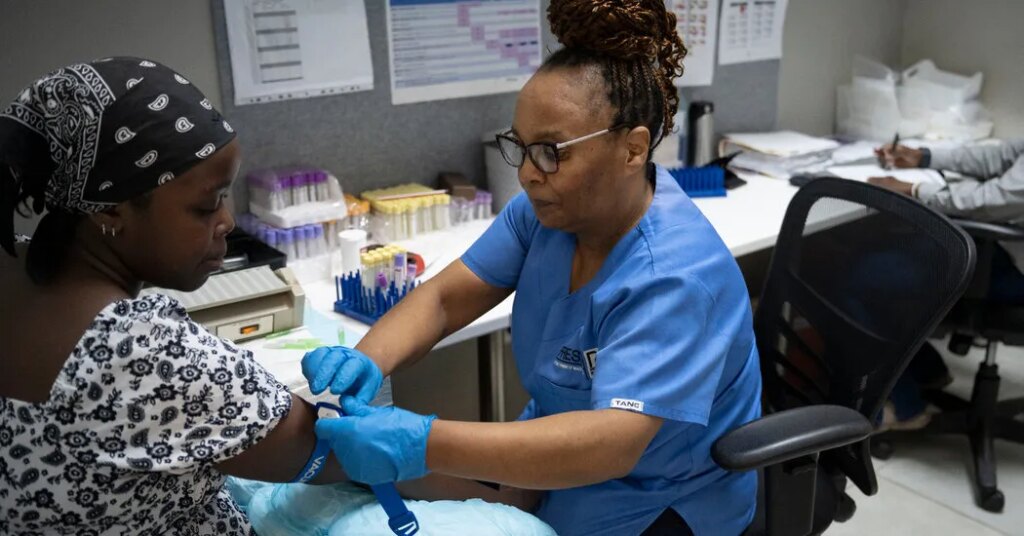
The future of four large research networks that test vaccines and treatments for H.I.V., tuberculosis and emerging infectious diseases is in limbo after weeks of delays from the Trump administration in launching the process to renew their funding.
Scientists are worried that the delays could foreshadow the end of the networks, at least in their current form.
H.I.V. researchers grew more concerned on Friday when they received word from the National Institutes of Health that they should temporarily hold off on launching new studies that had not yet enrolled participants and that would not be complete by Nov. 30, 2027, when their current funding is set to expire.
Delays to medical research spending have become a chronic issue during the second Trump administration, and funding for the networks may yet be renewed. But some scientists warned that any delays could jeopardize the safety of participants in clinical trials, derail time-sensitive studies and disrupt staffing and resources.
“Just the loss of momentum that will happen when you don’t have funding is enormous,” said Dr. Emily Erbelding, who led an infectious disease division at the N.I.H. before she was ousted from the agency in 2025. “I don’t know whether the powers that be are understanding that these days,” she added.
The Department of Health and Human Services did not answer questions about whether or when the N.I.H. would kick off the process to renew the networks’ funding beyond next year.
A department spokeswoman, Grace Davis Jamison, instead sent an emailed statement that said the administration was planning continued investment in H.I.V. research that delivers “meaningful results.”
The networks’ leaders said their worries stemmed from the Trump administration’s cuts to H.I.V. work generally. The administration has made sharp reductions to foreign aid dedicated to fighting H.I.V. It has overhauled the work of a landmark global H.I.V. program and has fired roughly a third of staff from the Centers for Disease Control and Prevention’s division for H.I.V. prevention. It has proposed steep budget cuts to H.I.V. surveillance and prevention nationwide.
Last year, the N.I.H. ended a $258 million multisite program whose work was instrumental to the search for an H.I.V. vaccine. Health Secretary Robert F. Kennedy Jr. has been heavily critical of the hunt for a vaccine, writing in a 2021 book about Dr. Anthony S. Fauci’s “vain obsession to develop an H.I.V. vaccine” and testifying before a House panel last year that federal spending on the goal “accomplishes nothing.”
The current funding delay affects Advancing Clinical Therapeutics Globally, a network that formed 40 years ago, as well as the H.I.V. Prevention Trials Network, the H.I.V. Vaccine Trials Network and the International Maternal Pediatric Adolescent AIDS Clinical Trials Network, which were formed years later. Together, the four networks work in dozens of countries and have conducted hundreds of clinical trials. They total more than $300 million each year, most of which comes from the federal government, although the exact amounts vary as studies begin and end at various times.
The programs’ large footprint has enabled them to develop tools to prevent and treat H.I.V., including in marginalized or rare populations such as pregnant women, adolescents and people who are resistant to multiple available drugs.
Having a ready base of researchers, data systems and communities of participants has also helped in other health crises. The networks were used during the coronavirus pandemic to quickly enroll tens of thousands of participants to test vaccines and treatments — including a monoclonal antibody treatment used on President Trump.
Funding for the networks and their research sites is renewed every seven years. But questions over their future have grown since the Trump administration delayed publishing so-called notices of funding opportunities, a formal signal to scientists that the renewal process would begin. The federal government had said it expected to post the notices by Aug. 25. As of Wednesday, they still had not gone out.
A federal official said that the notices were under review by H.H.S., which is led by Mr. Kennedy, who has overseen vast cuts to many federal health programs. The official spoke on the condition of anonymity to describe the review process.
The second Trump administration has significantly pared back the release of funding opportunities across medical research topics and left many such notices in limbo. It has also subjected the notices to new layers of political review, slowing their release.
Dr. Jay Bhattacharya, the N.I.H. director, has alarmed some scientists by pushing to steer federal spending away from basic research on new H.I.V. vaccines and treatments and toward studies of how to deploy existing tools for fighting the disease.
“We have the tools we need — the technological tools,” Dr. Bhattacharya told a Senate panel in May. “We just need to understand how to use them to end the H.I.V. epidemic.”
Dr. Bhattacharya has been a staunch supporter of lenacapavir, an injection taken twice a year that prevents H.I.V. infection. But many H.I.V. experts note that only a vaccine or cure can stop the epidemic, which still affects more than 40 million people worldwide and kills more than 500,000 people each year.
Sudden disruptions to clinical trials will halt progress toward ending the epidemic, they warn, and undermine carefully cultivated trust with communities, particularly those that tend to avoid engaging with the health care system.
“It’s hard work and it’s very fragile,” said Dr. Wafaa El-Sadr, who helped lead the H.I.V. Prevention Trials Network until last year and leads studies in Harlem and the Bronx. “What took 40 years to build on here could just collapse in a minute without continued investment and commitment.”
November 2027 may seem a long way away, but the large, complicated projects require at least that much planning time, said Dr. Chris Beyrer, the director of the Duke Global Health Institute and the leader of a study funded by one of the networks.
“You have to lay out the laboratory plans, the statistical and data management plans, the organizational structures and most importantly the scientific agenda for the next seven years,” he said. Without continuity in grants, “you start to see implications early, much earlier than the actual day that funding expires.”
Until now, the granting cycles had rolled along predictably since the networks began. N.I.H. program officers would in fact solicit feedback from researchers involved in the networks even before creating the funding notices. None of that happened this time, according to the leaders of the networks, and even many of their contacts at the N.I.H. were unsure whether and when the documents would be released.
Some experts said they worried the N.I.H. might dismantle the networks and fund individual grants instead.
Trials for the Covid vaccines relied heavily on the infrastructure and highly trained work force of the H.I.V. networks. That sort of effort “would be very difficult to do if you were just funding protocol by protocol,” said Dr. Erbelding, who was one of the leaders of the effort.
Some scientists said they were concerned the administration might limit research to sites within the United States, ending international collaborations. H.I.V. and other infectious diseases are far more prevalent elsewhere in the world, they noted.
In the early 1990s, Dr. Myron Cohen set out to study the influence of sexually transmitted diseases like syphilis on H.I.V. transmission. “If I tried to do that in the United States, it would have taken me 1,000 years,” said Dr. Cohen, a former leader of one of the networks and a professor at the University of North Carolina, Chapel Hill.
Instead, “by working in Africa, we were able in maybe six months to answer some really very fundamental questions,” he said.
The post H.I.V. Research Networks Face Uncertain Future Amid Funding Delays appeared first on New York Times.