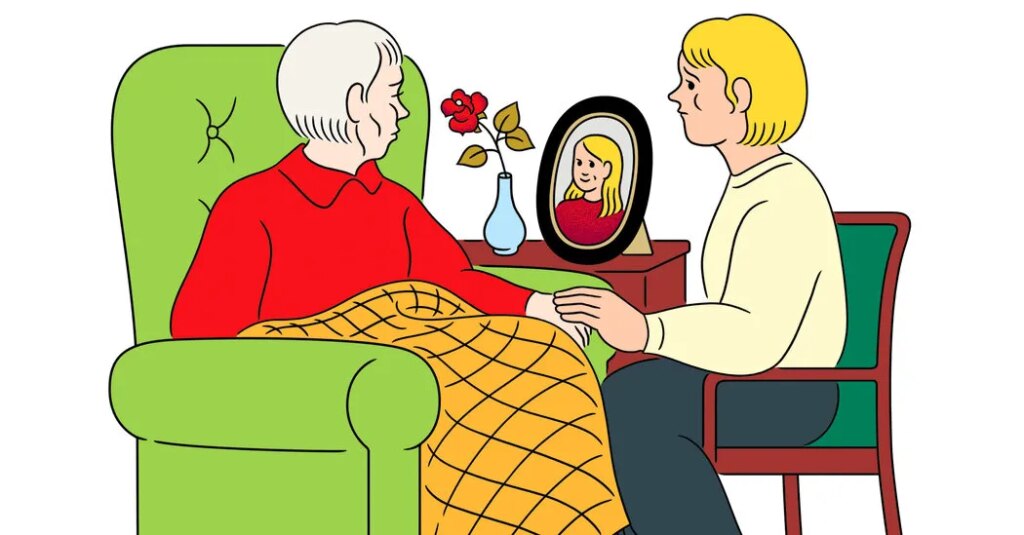
My mother just died at age 69. She had been divorced from my father for more than 20 years, lived alone and had been estranged from me, my sister and her own mother, her only remaining family, for about a decade. She also had serious, undiagnosed mental health issues.
My grandmother is 94 and has dementia. Her short-term memory is very limited, though some recent events, like the death of a cousin, have stayed with her and still upset her.
I’m torn about whether to tell her that her daughter has died. The news could cause her real anguish and possibly affect her physical health. I also worry that she might forget and then have to learn, and grieve, the loss repeatedly. At the same time, despite their estrangement, it feels as if she has a right to know.
My mother was a recluse, and we aren’t holding a memorial service. By the time she was found, her body had deteriorated so badly that our funeral director advised my sister and me not to view her before cremation. So withholding the news wouldn’t deprive my grandmother of a funeral or a chance to see her daughter.
Is there a best course of action here? — Name Withheld
From the Ethicist:
I’d talk to the clinicians and caregivers who deal with your grandmother every day, and try to assess whether you could give her the news without that looping effect that you fear. If they think you could, there’s a good case for telling her, once. It’s possible that your grandmother retains what the philosopher Agnieszka Jaworska calls the capacity to value, which, she argues, can persist even when dementia has eroded the ability to reason and come to rational decisions. The point is that a daughter’s life and death may still have significance for your grandmother. Respect for a person with dementia can involve attending to those remaining attachments as well as to her cognitive limitations.
But if your grandmother is unable to hold onto the news, it would be unkind to keep telling her. She may still be capable of grief in the moment, but repeated disclosure could subject her to the shock of bereavement again and again without her being able to move through it. Your mother and grandmother haven’t seen each other in a long time, and your grandmother isn’t expecting to see her daughter again. In those circumstances, it may be more respectful of her to protect her from a loss she can no longer meaningfully absorb than to repeatedly confront her with a truth she cannot retain.
A Bonus Question
My son married his high school sweetheart a couple of years ago, and they are both now in their mid-20s. They live about 1,500 miles from us and from her parents.
My concern is that she is very mean to him. I talk to my son daily, sometimes twice a day, usually when he is driving, and she is often in the car. When she is, she is constantly berating or correcting him. He’ll say, “It rained a lot today, heavy downpours.” And she’ll say, “No it didn’t, it was barely a sprinkle!” in a very indignant tone.
The same thing happens in person. She seems to be constantly correcting him, yelling at him and putting him down.
Maybe she resents moving away from her parents and friends and is taking it out on him. Or maybe she takes him for granted and is simply rude and nasty.
How much of this is my business? I know it’s his marriage. But he is my son, and I hate seeing him treated this way. Is there anything I can say or do? — Name Withheld
From the Ethicist:
It’s reasonable to tell your son that you’re troubled by the way his wife speaks to him, and to ask him how he feels about it. He may experience their exchanges differently from the way you do. Or they may trouble him too. You can tell him that you love him and that you’re there if he wants to talk; you can encourage couples counseling. But, of course, it’s for him to decide what, if anything, he wants to do about the relationship.
Readers Respond
The previous question was from a reader who received an unusual request from a caregiver to her father. She wrote:
My 93-year-old father moved into assisted living this past January. … He requires round-the-clock personal care, which his income fortunately allows us to provide. My sister and I manage his caregivers through an agency that has been excellent. For the past four years, it has sent us good people who are paid fairly. We also give generous holiday bonuses, which are scaled to reflect how long each caregiver has worked for us, the longest being four years. Recently, one caregiver, who joined the team late last year, texted to ask whether we would “sponsor” him for an advanced course that would help him further his career in health care. This caregiver has been excellent and is often available when others are sick or on vacation. The cost of the course is just under $3,000, and we could certainly afford it. … Our initial thought was to offer half the amount and ask him to consider it an early holiday bonus. — Name Withheld
In his response, the Ethicist noted:
I understand why you’d want to give a leg up to an excellent caregiver. At the same time, there’s a reason that agencies generally prohibit employees from asking clients for money in this way. … yours may restrict direct payments to caregivers. As for calling your contribution an early holiday bonus? Relabeling wouldn’t necessarily obviate the fairness issue with respect to the other caregivers. … Would $1,500 be on a par with what you pay others who have been with you for less than 12 months? … You should be wary of making a substantial private payment that appears to violate the agency’s rules. You can continue to recognize his excellent work through the generous bonus system you already use, including taking his unusual reliability into account when you decide on the amount. You could also ask the agency whether it offers tuition assistance or would let clients contribute to caregiver training. If it does, you can help him openly. If it doesn’t, and having weighed all the considerations you still decide to contribute, pay the school directly; that will give you a record of where the money went. Whatever you do, let him know how much his reliability has meant to your family, and wish him well with his certification.
(Reread the full question and answer here.)
⬥
I think the Ethicist is taking a naïve approach to the letter writer’s concern. The request for money is clearly inappropriate and reeks of a scam. I think the responsible course of action is to have this person removed from the care team and to report the request for money to the agency. Patients and their families are particularly susceptible to this type of exploitation and predatory behavior by bad actors. — Stuart
⬥
Having worked in health care myself, I know that agencies very often will pay for any additional educational costs. That usually comes with an agreement that the recipients will stay on for five continuous years of service in the field, or similar. Be skeptical and ask for confirmation on the proposed educational course. — Nancy
⬥
I am a male caregiver. Caregiving is a labor of love, any way you look at it. I believe privately offering to directly contribute to this man’s education is logical, and certainly a reasonable solution. The vast majority of caregivers are greatly underpaid, because agencies take a large percentage of what they are paid by clients. It’s really not sustainable employment. Excellent caregiving is not recognized as professional employment for the most part, even by the government agencies that contract the work under Medicare. I would offer to contribute directly as best as you can. Staying mum is the best policy. — Gene
⬥
The reader says that the family could “easily” afford the $3,000 for the course. The underlying reality is that this illustrates the big gap between rich and poor. Why couldn’t the money be a gift? I usually agree with the Ethicist, but as a person of privilege myself, I’ve become acutely aware — and concerned — about this huge gap, and have given large amounts to several longtime workers who needed help that only money with no strings could resolve. — Elizabeth
⬥
Since the family can seemingly easily afford caregivers, they may want to spend their way out of this sticky dilemma by giving an extra $1,500 to each caregiver for the next bonus. And they should clearly state that this is a one-time special bonus. Yes, that’s less than the $3,000 requested by the one caregiver, but as the cliché goes, a half loaf is better than no loaf, and the needy caregiver will respect you for the savvy and classy way you handled the request. And the family can be sure that Dad will receive an even higher level of special care going forward. — Dom
The post My Grandmother Has Dementia. Do I Have to Tell Her That Her Daughter Died? appeared first on New York Times.