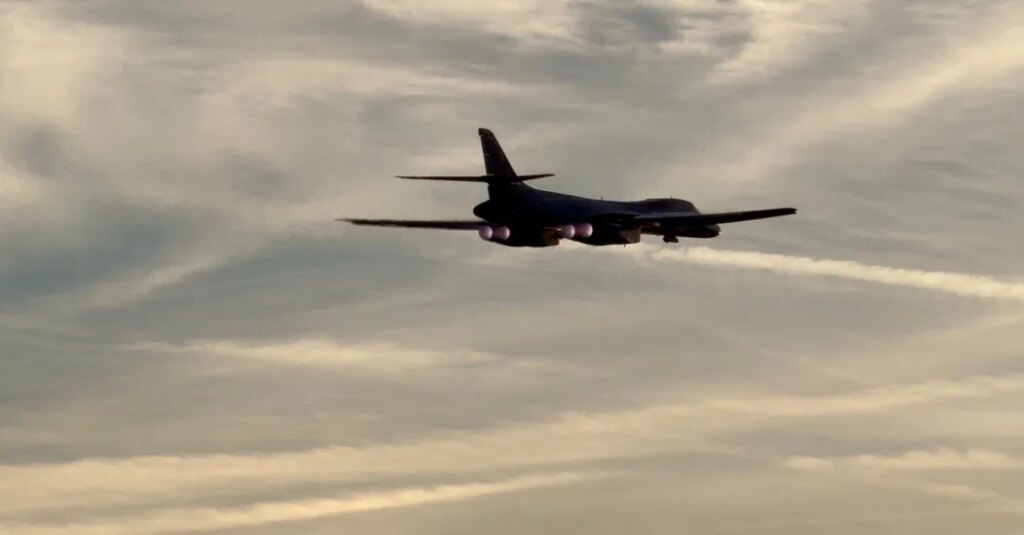
To hear President Trump and his aides describe it, the rush to withdraw 12 B-1 bombers from an air base in Britain over the weekend was a prudent precaution, in response to a threat they refused to describe.
It was no big deal, Mr. Trump insisted, and his secretary of state, Marco Rubio, tried to wave it away by noting that the Pentagon is “constantly reallocating resources where they need to be.”
But to anyone watching the deployment of American power around the globe in the seven months since Mr. Trump decided to attack Iran, it was another glaring example of how, time after time, Mr. Trump and his defense secretary, Pete Hegseth, have been forced into retreat, pulling back military forces that had been deployed to the Middle East and Britain as a deterrent.
Over the past several months, as the conflict has dragged on, the Iran war has come to reveal enormous new American vulnerabilities, forcing changes that the Pentagon was not contemplating a year ago. But it has also proved a bitter lesson in the unintended consequences that have flowed from Mr. Trump’s war of choice.
Mr. Trump intended the attack on Iran as another demonstration of the American military’s extraordinary power, following the successful bombing raid on three Iranian nuclear sites in June 2025 and the seizure of President Nicolás Maduro of Venezuela from his bed in Caracas in January.
But rather than enhance American power, the war has constrained it. The closing of bases in the Middle East and limiting the use of one in Britain have, at a minimum, vastly complicated the logistics of projecting power. American bombers can still reach their targets, of course, but only by flying from the United States, requiring more time and refueling. American carrier groups can still patrol in the Arabian Sea, outside the Persian Gulf, but now they must be resupplied from Diego Garcia, an island in the Indian Ocean 2,200 miles away, requiring additional weeks and huge costs.
But most importantly, the rapid withdrawals have taught a lesson to the Iranians — and potentially to other adversaries — that they hold the power to chase out a superpower. In Europe, Mr. Trump and Mr. Hegseth are thinking of reducing American forces on their terms and their schedule. In the Middle East and Britain, their hand was forced.
American and British officials said on Monday that the bombers were rushed out of the British base after commanders received specific, credible information that Iran-backed operatives were planning to launch drone strikes against the aircraft and U.S. troops from right outside the fence.
The suspected plotters may have been inspired in part by an audacious attack that Ukraine launched against Russia last year when it smuggled drones deep into the Russian heartland and launched them from semi trucks. The strikes damaged or destroyed at least a dozen aircraft.
That and other attacks have recalibrated the Pentagon’s understanding of military vulnerabilities. Suddenly, keeping forces out of missile range is not enough. Drones and cyberweapons have reshaped the battlefield.
The president rightly says that Iran’s entire navy was sunk in the initial military action, and its decrepit air force is out of business. And the country is teetering on the economic edge, crippled by the naval blockade that has brought its oil exports to a trickle.
But that has not stopped the Iranians from forcing American aircraft and personnel to flee their once-secure bases — farther and farther from Iran. American personnel were evacuated from bases in Bahrain, Kuwait, the United Arab Emirates and Qatar, all of which were within Iranian missile and drone range. Some of those bases were so badly damaged that inside the Pentagon there is little interest in rebuilding them; they will be moved farther away, if Congress grants the funding.
The waterways are a more complex story. But the United States has been unable to guarantee “freedom of navigation” through the Strait of Hormuz or parts of the Red Sea. And for the past half-century, that was one central American justification for a continued presence in the Middle East.
Dana Stroul, the Pentagon’s top Mideast policy official during the Biden administration, said the abrupt transfer of the dozen bombers back to the United States could have internal and external ramifications.
“Such a hasty decision is intensely disruptive to operational planning and force morale,” said Ms. Stroul, now at the Washington Institute for Near East Policy.
“The more concerning issue is at the strategic level, the Iranians are likely to internalize a dangerous lesson — that by demonstrating the ability to get close to U.S. military bases far beyond the Middle East, Trump can be pushed around,” she said.
Mr. Trump and his defenders have a very different narrative of events. On the campaign trail for the midterm elections, he has portrayed Iran as on the brink of collapse, its currency plummeting. The naval blockade on all shipments in and out of Iran, he insists, is choking the country, and will force it to make a deal. Any description of Iranian progress, he insists, is “fake news,” promulgated by news organizations that are writing about munitions shortages and other setbacks because they are disloyal to the country.
For the first time, Iranian officials have acknowledged the economic pain. Treasury Secretary Scott Bessent noted this week that Iran has a new oil minister, and then asked on social media, “Considering Iran has not loaded a single barrel of crude onto a vessel since August 25th, what is the oil minister managing?”
Moreover, administration officials describe the evacuations as prudent, short-term measures. And it is possible that the rushed-away B-1 bombers may return to the R.A.F. Fairford air base, which has been a mainstay of U.S.-British military cooperation since it was built in preparation for the D-Day invasion in 1944. Even if the threat precludes return, Air Force officials insist they can carry out their long-range missions from bases in the United States.
The Pentagon wants to think about new bases in Israel and Jordan, but those would require congressional approval and take years to upgrade or build anew. When Mr. Hegseth spoke to troops last Thursday, he did not mention the destruction at the Mideast bases. Instead, he talked about putting states in competition for a new, vast base inside the United States.
This was not the plan when Mr. Trump announced the attack on Iran on Feb. 28. Mr. Trump was looking for a victory in a few days, then five or six weeks. Mr. Trump demanded “unconditional surrender,” and three weeks into the conflict declared Iran’s total defeat. Last Thursday, he said Iran would fold “right after the election.”
Instead, Iran bombed U.S. bases across the Middle East in retaliation, forcing many American troops to relocate to hotels and office spaces throughout the region, raising questions about the Trump administration’s preparations for the war.
Iran figured out where many of the troops were staying, some in unprotected hotels, and began to target them as well. It wasn’t only military targets: the C.I.A. station in Saudi Arabia was also hit, though it is still unclear whether the Iranians targeted it, or got lucky striking a diplomatic compound.
Many of the 13 main military bases in the region used by American troops were quickly rendered uninhabitable, with the ones in Kuwait, which is next door to Iran, suffering perhaps the most damage.
Six U.S. service members were killed in a strike on Port Shuaiba that destroyed an Army tactical operations center. Iranian drones and missiles also targeted Ali Al Salem Air Base, damaging aircraft structures and injuring personnel, and Camp Buehring, damaging maintenance and fuel facilities.
In Qatar, Iran struck Al Udeid Air Base, the regional air headquarters of U.S. Central Command, damaging an early-warning radar system. In Bahrain, a one-way Iranian attack drone struck communications equipment at the headquarters of the U.S. Fifth Fleet. At Prince Sultan Air Base in Saudi Arabia, Iranian missiles and drones damaged communications equipment and several refueling tankers.
Now Iran “is adopting a strategy toward the United States defined by escalation and continuous offense,” Mohammad Ayatollahi Tabaar, an associate professor of international affairs at Texas A&M’s Bush School of Government and Public Service, wrote in Foreign Affairs earlier this month.
“That means it will neither stay the course nor compromise with Washington,” he added. “Instead, it will start doing even more to hurt the economies of the United States’ regional partners and to decimate global energy markets, as well as expand its attacks on U.S. military infrastructure.” He predicted it could attempt to seize some of the largely abandoned U.S. bases in Gulf Arab countries, though so far it has avoided any such ground actions.
Senator Christopher S. Murphy, Democrat of Connecticut and a member of the Foreign Relations Committee, visited the Persian Gulf region this week to see the damage and said on social media that he had been denied entry to the Al Udeid base. A Pentagon spokesperson said Mr. Murphy had been warned before his trip that he would not have access to the base, under restrictions Mr. Hegseth had imposed at the start of the war.
The subject of the bases is such a sore one for the Pentagon that it has refused to provide Congress with cost estimates to repair or rebuild the facilities, which lawmakers said could run tens of billions of dollars. It is unclear what is motivating the refusal to discuss the topic, though a price tag that big could become political fodder for candidates opposing the war.
Instead, there is now is serious planning at Central Command, which oversees military operations in the Middle East, to reposition and reshape its facilities in the region.
“The financial costs have continued to climb by billions each month, even as the administration refuses to acknowledge the munitions crisis we face or admit the costs to rebuild bases heavily damaged by Iran,” Senator Jack Reed of Rhode Island, the ranking Democrat on the Armed Services Committee, said last month.
The post Trump’s Retreat: From the Gulf to Britain, American Forces Pull Back appeared first on New York Times.