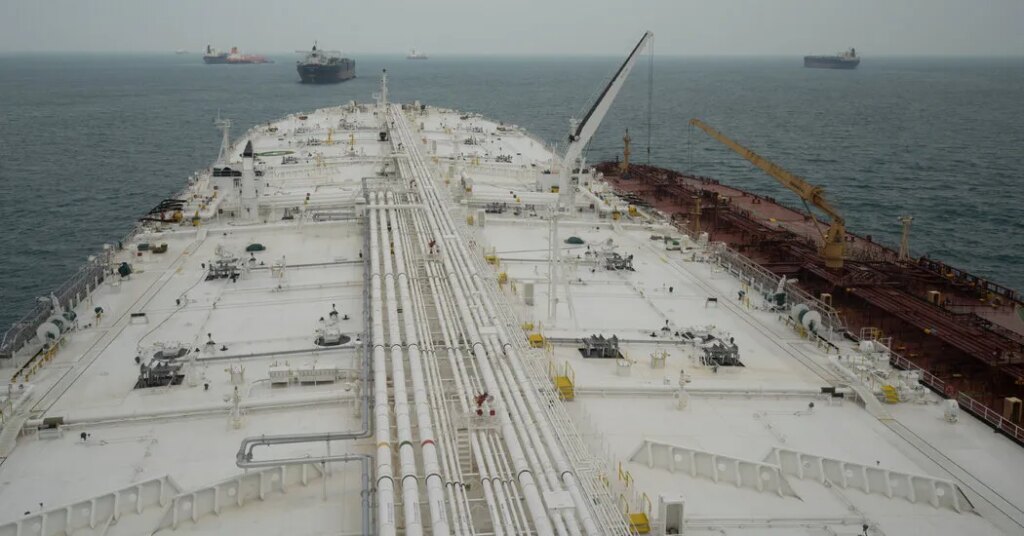
Blacklisted Iranian oil has long been a source of perilous competition for Jeffrey Soh, whose job sometimes takes him on a supertanker moored in a corner of the South China Sea.
His ship, the 1,264-foot-long Europe, is so cumbersomely large that it is semipermanently anchored for use as floating storage off the southwestern coast of Malaysia. On a recent Wednesday, a tanker named the Dubai Beauty was parked against it, pumping in marine fuel from Oman via thick, black hoses.
“Up to 4,000 metric tons per hour,” Mr. Soh said. The sickly sweet smell of oil hung in the air. “But a transfer can take up to 72 hours.”
These ship-to-ship, or S.T.S., transfers are a common practice in the petroleum industry, and a routine part of business for Mr. Soh’s firm, Contemporary Logistics, which has clients like Chevron. But in recent years, an Iranian shadow fleet has also used such transfers to illegally transport and sell millions of barrels of Iranian crude oil in the waters around Malaysia in evasion of American sanctions.
The shadow fleet’s illicit cargo has flooded the global oil market at heavy discounts, suppressing prices for Mr. Soh’s clients. Its vessels, which are often old and dubiously insured, threaten to raise premiums for the rest of the industry whenever they are involved in an accident. And a few years ago, one of its tankers used one of his company’s storage units to deliver what turned out to be Iranian oil.
“It’s very easy to get into trouble, too easy to get exposed,” he said. “And these days, if you say S.T.S. transfer and Malaysia, people group you with the dodgy ones.”
This unsavory reputation has invited scrutiny from U.S. officials, who for decades have tried to stanch the flow of Iranian oil by going after the dark fleet of tankers as well as their operators and financiers. Now, more than seven months into the war with Iran, Washington is increasingly taking aim at another target: maritime services providers in countries like Malaysia and Singapore, which it says are helping the Iranian vessels.
“The shadow fleets can’t function without them,” said Charlie Brown, a senior adviser to United Against Nuclear Iran, an advocacy group that tracks Iranian ships.
Millions of barrels of Iranian oil slipped through the Strait of Hormuz before the United States blockaded Iranian ports. In August, Treasury Secretary Scott Bessent announced sweeping new sanctions that also targeted the companies that enabled the Iranian tankers, such as vessel brokers, bunkering service providers and financial intermediaries.
“We are enforcing a zero-leakage approach,” Mr. Bessent said.
U.S. sanctions can be debilitating for foreign companies by excluding them from dollar transactions, which can leave them unable to pay suppliers or retrieve dollar-denominated assets. Other businesses and even banks will shun them.
Still, Washington has been trying unsuccessfully to stop the flow of Iranian oil for decades, and analysts said it is far from clear whether the more extreme measures will do any better. “So far, those efforts do not appear to have had a significant impact on the flow of Iranian oil through these networks,” said Dalga Khatinoglu, an Azerbaijan-based expert on Iran’s oil trade.
Nearly all the Iranian oil that is exported today is bought by small Chinese refineries known as “teapots.” And to hand off their cargo to the vessels that will ship it there, Iranian tankers have increasingly congregated in the Malaysian Eastern Outer Port Limits, or E.O.P.L., a patch of ocean 45 miles off the eastern coast of the Malaysian state of Johor.
The trade in Iranian oil has continued to thrive in this area, which is located outside Malaysia’s territorial waters just past the Strait of Malacca, a critical shipping lane that connects Middle Eastern oil to East Asian buyers.
While it does lie within Malaysia’s more expansive offshore Exclusive Economic Zone, the nation’s authorities rarely clamp down on the trade, saying they face jurisdictional challenges and practical difficulties in policing the area.
To evade detection from U.S. authorities tracking them, vessels conducting ship-to-ship transfers often operate under false flags and manipulate their transponders, a transmitter that large ships must use at all times under international maritime law to reveal their location. Some also paint over ship names and hide other visual identifiers.
But even the dark fleet requires the same goods and services as other ships: crew supplies, repairs, fuel and fenders — gigantic floating bobbers that stop two tankers from bumping into each other during a fuel transfer. And Johor, which has two major ports and an extensive maritime industry, is home to a gray market that is happy to supply them.
The companies do it because the work commands a premium and is often paid in cash, according to the manager of a local ship chandler who spoke on condition of anonymity out of fear of drawing American reprisals. His company only accepted work from known or suspected Iranian tankers if they could ensure no record tying them to the transaction would remain, he said.
Local captains who are familiar with the E.O.P.L.’s currents are in particularly high demand. Since many Iranian ships conduct S.T.S. transfers while still moving in order to avoid detection, they are needed to serve as mooring masters, piloting the massive tankers as they maneuver into precise alignment.
“Malaysian, Singaporean and Indonesian master mariners are highly sought for these operations,” said Eddie Effendi, a mooring master for a company that specializes in these operations.
He said his company always turns down the requests it gets from Iranian ships, which are sent via their agents and sometimes come with offers of payment in cryptocurrency. But he is not surprised to see others enticed by the prospect of bigger profits.
“The E.O.P.L. has become a parallel economy,” he said. “They’re being offered good money for pilotage services.”
It is not illegal for businesses to work with Iranian ships in Malaysia, which does not consider the U.S. sanctions to be legitimate. And though they have at times projected a tougher stance against Iranian tankers in response to pressure from the U.S., the local authorities have largely turned a blind eye.
It is up to the individual businesses to decide whether to take the risk of being cut off from the dollar system or not, said a former official in the Ministry of Transport’s maritime division, adding that operators of the ports where these companies do business also oppose more regulatory oversight. The former official, who now works in the private maritime sector, spoke on condition of anonymity out of fear of jeopardizing their relationship with these ports.
Though it has critical economic ties with Washington, Malaysia also keeps friendly relations with Iran and China, the biggest buyer of Iranian oil. Malaysia, which is predominantly Muslim, has a longstanding policy of nonalignment, and has been one of the most vocal international critics of the war in Iran. Beijing is its biggest trading partner.
“Malaysia’s stand is crystal clear. It is a friend to everyone and an enemy to none,” said Nazery Khalid, a maritime expert and visiting fellow at Universiti Malaya’s department of Southeast Asian studies. “It should not be put in the position of having to choose sides.”
But as Washington increasingly demands that nations make such a choice, it is unlikely to find much support for its crackdown among Malaysians, said Joshua Kurlantzick, a senior fellow for Southeast Asia and South Asia at the Council on Foreign Relations.
“The U.S. is extremely unpopular in Malaysia, and has been since the beginning of the war in Gaza,” he said. “It has only gotten more unpopular in Malaysia since the Iran war.”
Such sentiments are shared among maritime professionals like Mr. Effendi, the captain, who sees the crews of Iranian vessels — who are often not Iranian themselves — as fellow mariners just trying to do their jobs. He questions whether it is moral to refuse them services like fresh water or food.
“Those seafarers onboard are just working to feed their families at home,” he said.
Unlike the oil tankers themselves, which are extensively monitored via satellite imagery, identifying the supporting companies is not so easy. For one, they use smaller boats to deliver supplies. “In satellite imagery, they’re barely a smudge,” said Mr. Brown of the group that tracks Iranian ships.
The companies also often hide themselves by using shell companies, said Mr. Soh of Contemporary Logistics. “They can just start another company,” he said. “Once you start sanctioning marine service providers, it will never end.”
On the bridge of the Europe, he watched distant oil tankers silently glide down the Strait of Malacca. The ocean was a vast place with plenty of space to escape watchful eyes, he said. Even if the United States does succeed in cracking down on the E.O.P.L., the Iranian tankers can just relocate.
“They’re moving elsewhere to Penang or Malacca. There are also transfers in Indonesian waters, wherever the eyes are not looking at them,” he said. “They are, honestly, everywhere.”
Zunaira Saieed contributed reporting.
The post How a Shadow Economy in Asia Is Keeping Iranian Oil Flowing appeared first on New York Times.