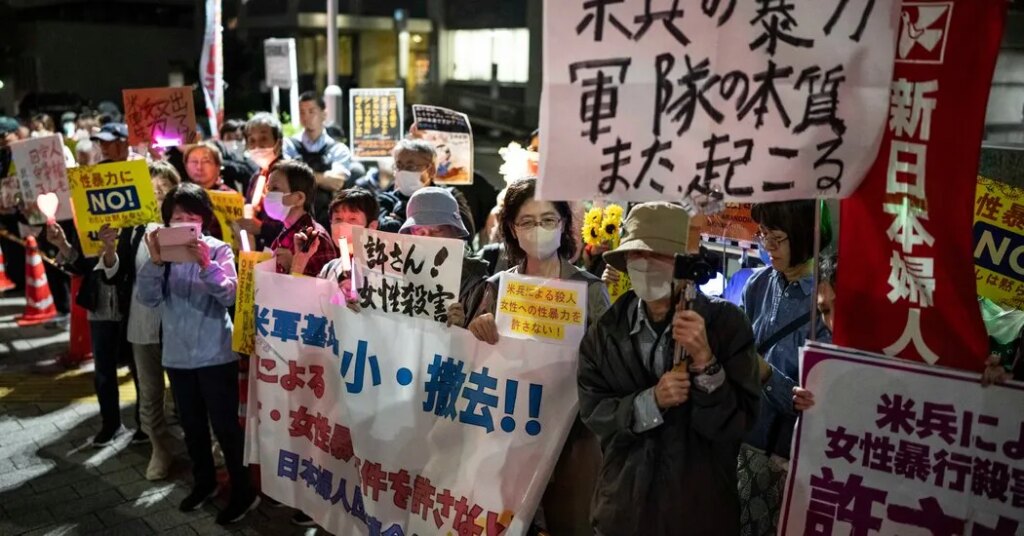
For days, the people of Okinawa, a Japanese prefecture that hosts a large American military presence, have expressed outrage over the death a local woman, who the authorities say was killed by an American Marine.
On Wednesday, the anger reached the doorstep of Japan’s prime minister, Sanae Takaichi, a close American ally who has sought to accelerate a military buildup in Okinawa.
Genta Koja, the prefecture’s governor, had traveled to the capital to meet Ms. Takaichi and her advisers. He told Ms. Takaichi that the killing of the woman, Anna Yagi, “has caused great anxiety among the prefecture’s residents and is absolutely unforgivable,” according to a video of the meeting posted by the Prime Minister’s office. Mr. Koja also expressed concern about the American military, telling Ms. Takaichi that efforts by the United States to strengthen discipline among personnel in Okinawa “are not working.”
Ms. Takaichi reiterated at the meeting that Japan had lodged a protest with the American government.
“It is extremely regrettable that such a brutal and heinous incident has occurred,” she said. “I feel strong indignation.”
Mr. Koja is an ally of Ms. Takaichi and won office last month promising to uphold the central government’s defense policies. But he has faced pressure from Okinawans in recent days to deliver a forceful response to Tokyo and Washington. Japan has worked to turn Okinawa into a bulwark in its efforts to counter Chinese military aggression, in concert with the United States, which has about 30,000 active-duty personnel stationed there.
At the meeting, he handed Ms. Takaichi a request that called on the central government to help promote economic growth to “alleviate the excessive burden of military bases.” In the case of Ms. Yagi, he asked for “full cooperation with the investigation, the enforcement of discipline among U.S. military personnel, the implementation of measures to prevent recurrence, and effective, fundamental countermeasures.”
The Marine, Devin J. Ballard, a 20-year-old lance corporal assigned to the Third Marine Expeditionary Force in Okinawa, was arrested on Sunday. He is accused of robbing and killing Ms. Yagi, 39, who was found in a hotel room in Naha, Okinawa’s capital, on Saturday. Okinawan news outlets have reported that he told the police he denied the charges.
American military officials in Japan announced on Tuesday that they would pause operations for two days and impose a ban on alcohol during that period. They also plan to implement a monthlong curfew on Okinawan bases.
“Every interaction with our neighbors either builds or undermines the trust that is essential to our team,” Lt. Gen. Benjamin Watson wrote in a letter to U.S. military personnel in Okinawa announcing the measures. “When that trust is damaged, it affects the strength of our alliance and the security of this region.”
Mr. Koja told reporters after his meeting with Ms. Takaichi that the steps taken by the American military show that the United States “takes this incident seriously.” But he added that the “crucial question is whether these measures will actually prevent a recurrence.”
Crimes committed by American service members in Okinawa have been a source of tension between the United States and Japan for decades. Okinawa, with a population of about 1.5 million, hosts 70 percent of the U.S. bases in Japan, despite accounting for only 0.6 percent of the country’s landmass. The United States seized Okinawa from Japan after World War II; it returned the island in 1972 but has continued to operate bases there.
Okinawans have taken to the streets in recent days to protest the killing, shouting slogans like “violence will not be tolerated” and “the American bases are a human rights issue.” There have also been scattered demonstrations in Tokyo.
The incident poses a test for Ms. Takaichi, who only a few weeks ago was celebrating Mr. Koja’s win. Her supporters thought his victory might make it easier for Tokyo to advance plans to deepen cooperation with the Americans and to add more Japanese troops, missiles and radar towers to Okinawan islands.
Mr. Koja ousted an incumbent last month who had criticized Ms. Takaichi’s defense policies and had opposed the construction of new U.S. armed forces facilities in Okinawa.
Some analysts were skeptical that the outrage over the killing of Ms. Yagi would have much impact.
Manabu Sato, a professor emeritus at Okinawa International University, said Ms. Takaichi seemed to recognize the importance of managing the swelling anger in Okinawa. But he said much of the reaction from top leaders was “theater.”
“They make strong demands or put on a show of anger,” he said, “but they never take substantive action beyond that.”
Hisako Uenocontributed reporting.
The post Tokyo Faces Outcry After U.S. Marine is Accused of Murder in Okinawa appeared first on New York Times.