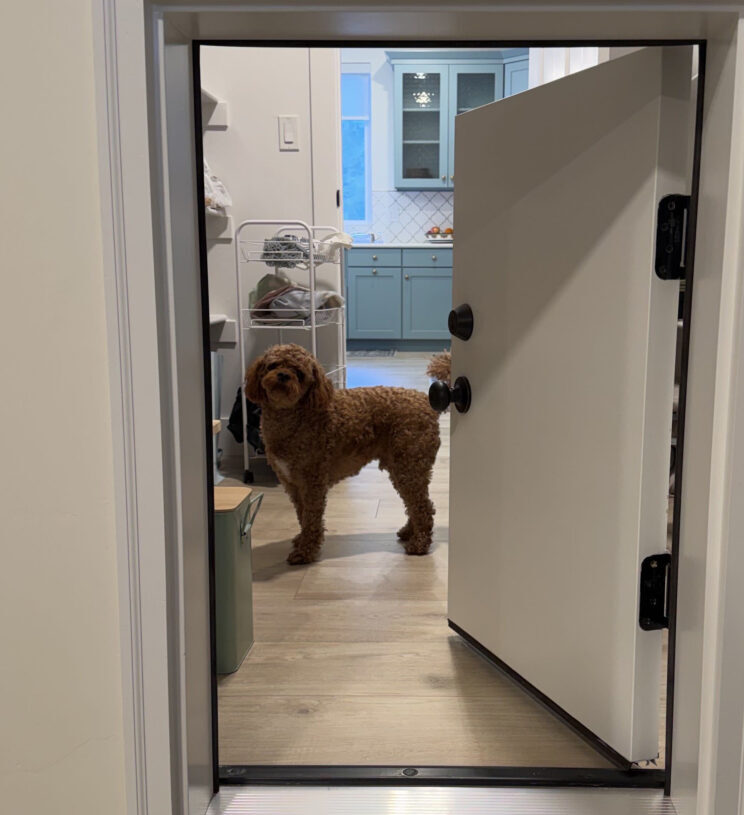
Residential floor plans in 2026 are sadly lacking in laundry chutes, milk doors and dumbwaiters, but innovations in home efficiency continue to evolve. Case in point: the Costco door.
Named for their popularity among fans of the bulk warehouse, these miniature doors connect a garage to a pantry or kitchen so that shoppers can deadlift 25-pound bags of Jasmine rice and liters of Kirkland Signature olive oil directly from the trunks of their vehicles into their homes rather than transport them in multiple trips like pack mules.
“It’s such a simple feature, but it makes everyday life so much easier,” said Sasha Kudinova, a 39-year-old in Alpine, Utah, who asked builders to add a Costco door to her house last year.
Kudinova’s husband is a travel doctor, so she usually unloads groceries alone. Pushing items through the small door from her garage into her pantry saves time and is less likely to exacerbate her back problems.
“I haven’t really found a downside,” she said.
Kudinova’s builder, Jay Roberts, said that about half the customers of his custom home-building company, Canyon Point, ask for a 2-by-2-foot Costco door once they see an example. He and his co-owner brother have the feature in their homes.
“When you tell someone it’s roughly a thousand bucks to put one in, they’re like, ‘Yeah that’s a no-brainer — why would we not do that?’” Roberts said.
The first Costco doors the brothers built were inspired by need, not preference. About 10 to 15 years ago, they were building a house for a client who was paralyzed, and they designed the door as a way to make life a little easier. “It was for his wife — she had a lot on her plate,” Roberts said.
Meanwhile, in Ontario, Canada, Asmaa Hussain lives with her husband, mother, mother-in-law and two children, whose preferred name for their tiny kitchen entrance is “the doggy door.” She loves to cook and host groups of friends and family members as big as 50, so after seeing examples on social media, she asked her contractor to install a Costco door during a home renovation.
“The Costco toilet paper, paper towels, laundry detergent,” she said, “it’s just easy to push it directly there.”
For those who dream of seven-pound wheels of gouda, the Costco door is a winning novelty. But on social media, viral videos featuring grocery bags seamlessly transported into pantries also provoke harrumphing from some homeowners, who argue that an additional door might add construction woes, let in pests or create a security risk.
Andrew Rus, a builder at P&D, a company near Columbus, Ohio, that builds custom homes, said people who are interested in adding Costco doors need to consider building codes: The door might need to be specially designed to prevent the spread of fire and be placed with attention to the structural integrity of the wall.
Other than that, he said, “it’s no different than a standard door.”
The Costco door is relatively easy to install, and it’s Instagram-friendly, but could it actually benefit bulk buyers who suffer from back pain? “From an ergonomics perspective, they have the potential to reduce the physical work associated with unloading groceries from a vehicle by reducing the number of steps and the duration of the carrying tasks,” said Steve Lavender, a professor of orthopedics at the College of Medicine at Ohio State University.
If you put a 30-pack of seltzer through a Costco door, you’ll still get a workout. Depending on the height of your door, Lavender said, you might have to lift a pile of groceries off your kitchen floor. “With that said, I can see that these have the potential to reduce the possibility of falls, as most houses require one or two steps to be ascended when entering from the garage.”
Some rewards of the Costco door are more immediate: “You never have to carry groceries through the house again,” Kudinova said.
The post Costco fans are renovating their houses to make unloading groceries easier appeared first on Washington Post.