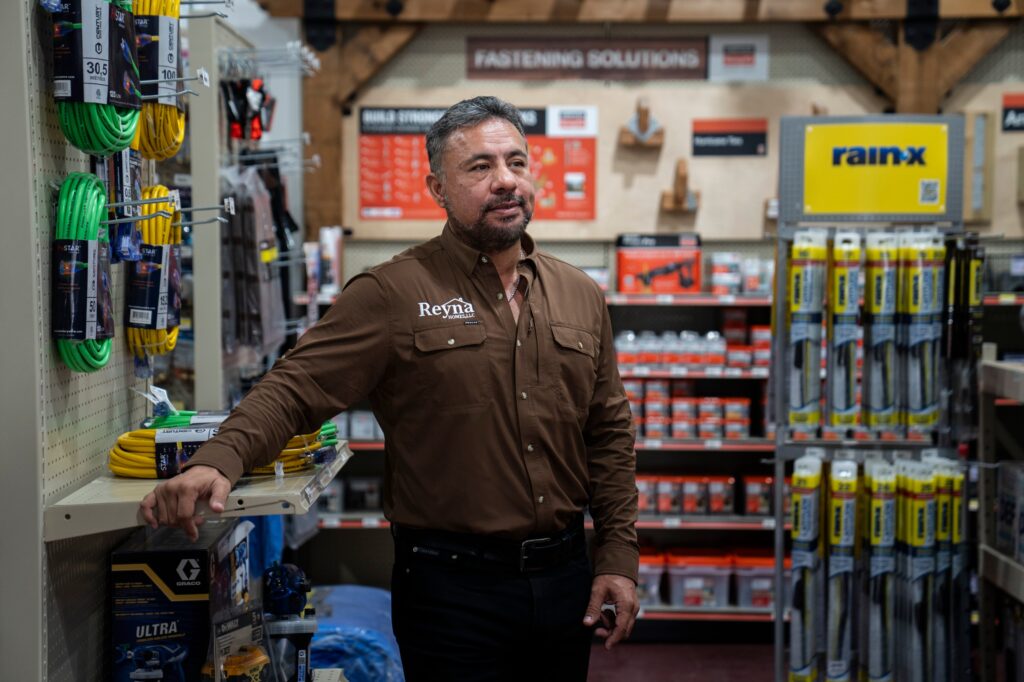
RIO GRANDE CITY, Texas — Across his two businesses in this once-booming border town, David Reyna sees signs of ramped-up immigration enforcement everywhere.
Fewer customers are coming to his lumber yard. Even fewer people are calling his upstairs real estate business. And the house he is building? It is stalled, a set of concrete slabs and wooden planks untouched for months.
“We didn’t think this administration was going to crack down on undocumented workers that hard,” Reyna said, but “it is completely devastating the local construction industry. It’s grinding it down to a halt.”
That slowdown has been weighing heavily on the 50-year-old as this slice of South Texas could determine control of Congress this fall. The Rio Grande Valley is carved up into three highly competitive House contests, all of which could be key in next month’s midterm elections. The region is also pivotal in unusually competitive races for Senate and governor.
Voters like Reyna, a second-generation Mexican American, helped Trump flip this overwhelmingly Latino area for the first time in generations, in part due to the president’s promise to lower the cost of living and secure the border. He is set to rally for GOP candidates in San Antonio on Wednesday.
But here, in a part of the country that depends on illegal immigrant labor to fuel the economy, a different part of Trump’s immigration agenda — his effort to deport people already in the U.S. — has come into conflict with his economic agenda. And interviews with more than two dozen business leaders, local officials and economists suggest what polls show: Republicans may suffer as a result.
A sharp uptick in arrests by federal agents has taken undocumented immigrants out of local labor forces that depend on them, from construction sites in new subdivisions — building permits are down sharply across the state — to shrimping boats on the Gulf Coast. A ban on commercial driver’s licenses for some immigrants has left the trucking industry hurting, too.
The effects have been severe enough that some business owners traveled to Washington earlier this year to warn Trump administration officials that raids on construction sites could lose them the midterm elections.
As the government continues arresting laborers who are in the U.S. illegally, many South Texas voters who backed the president appear to be shifting back to Democrats.
More than one-fifth of Hispanic Trump voters in Texas said they would not support a generic GOP House candidate, according to a Cook Political Report-TelevisaUnivision poll last month. The same pollster found that nearly two-thirds of all Hispanic voters in Texas would be less likely to vote for a candidate who supports Trump’s deportation policies.
Reyna still keeps “Make America Great Again” caps in his office, but he counts himself among the skeptics.
“The whole valley was red,” Reyna said, “and now it’s going to be blue.”
More ICE arrests, fewer workers
Trump broke through the Rio Grande Valley’s long-standing allegiance to Democrats by vowing a hardened border and a strengthened economy.
Like others here, Reyna said he was drawn in by the president’s promises to tame inflation and bring down taxes. He was also frightened by people running through his small ranch in a gated community after crossing the Rio Grande from Mexico.
“The borders were wide open” under Joe Biden’s presidency, he said, “and we saw what that meant firsthand.”
Starr County, the hilly scrubland in the Rio Grande Valley where Reyna lives and runs his businesses, had been steadily trending toward the GOP for years.
Trump flipped it in 2024, breaking a Democratic presidential winning streak that began in 1896.
Reyna acknowledged that Trump had vowed to deport immigrants who are in the country illegally — a cheap source of labor on which his industry has become reliant.
But he didn’t expect the ramped-up enforcement that swept up people without criminal records. “I don’t think anybody saw that coming,” he said.
Arrests made by U.S. Immigration and Customs Enforcement in South Texas “at large” — in homes, at worksites, during immigration check-ins, or in other public spaces — rose more than twentyfold, from about 400 in 2024 to more than 9,000 in 2026, according to a Washington Post analysis of government data.
Since Trump returned to office, nearly 80 percent of those arrested at-large by the agency’s Harlingen field office had no criminal records.
The fallout has been devastating to the subcontractors that build new houses and strip malls in this sprawling region, said Mario Guerrero, president of the South Texas Builders’ Association.
Most U.S. citizen construction workers who live in the area often travel north to San Antonio or Houston for jobs with higher wages, he said. Undocumented workers, who were willing to work for less, rushed to the industry — and federal officials didn’t seem to do much about it.
Trump has long pointed to the impact of illegal immigration on lowering wages as a basis for the crackdown. But many of his supporters here say American workers have not filled the gap, resulting in delays of several months on construction projects.
“It’s easy to see a lot of jobsites aren’t moving the way they normally do,” Reyna said.
Construction payrolls in the Brownsville-Harlingen area are down 5 percent from a year ago, even as Texas builders keep hiring, and in Cameron County, the labor force has shrunk by nearly 2 percent as people have left or stopped looking for work, according to a Washington Post analysis of U.S. Bureau of Labor Statistics data.
The sharpest impact has been in agriculture. Agricultural jobs in the four counties fell 13 percent in the year to March, one of the steepest drops of any Texas county with a sizable farm workforce, while farm employment across the state held steady. The decline began years before the current crackdown, but it accelerated sharply in 2025.
Economic crunch leads to political friction
Earlier this year, Guerrero, the local construction official, traveled to Washington with a message to top DHS officials: If ICE continued arresting laborers at worksites, the GOP would lose the South Texas voters that Trump had won over.
The agency did appear to pause arrests at work sites. But it soon increased other kinds of enforcement, and ICE agents now simply stop crews on their way to and from work, said Jacob Monty, an attorney in Houston who advises companies in construction and other industries that have large Hispanic workforces.
“They found out that stopping a number of Latinos in a truck, it’s a good bet that some of them are undocumented,” he said.
At a Hispanic Heritage Month event at the White House last week, Trump suggested he was not sweating the consequences.
“They’ll say you’re too tough or you’re too soft,” he said. “Get tougher, get softer. No matter what you do, it’s always tough.”
Reyna and others, however, say they are looking to make their own statement in the midterm elections.
In the 34th Congressional District where he lives, the GOP candidate, Tano Tijerina, and has sought to in some cases distance himself from the Trump administration on immigration.
Tijerina is a former Democrat who serves as the top elected official in Webb County, which includes Laredo.
He said he supported efforts to create a temporary guest-worker program for construction workers, an idea floated by Rep. Monica De La Cruz (R), who is running in a neighboring district, as well as measures that would give amnesty to “Dreamers” who were brought to the U.S. as children and create special exceptions for Canadians and Mexicans to promote trade.
“I’m going to go out there and do everything I can. It might not be fully a Republican thing to do, but I have to work for my district,” he said.
But the frustration may instead boost Rep. Henry Cuellar, a moderate Democrat from Laredo who has represented parts of South Texas in Congress since 2005.
A longtime member of the powerful Appropriations Committee and the top Democrat on its DHS subcommittee, Cuellar is pitching himself as having both the independence to stand up to his party and the ability to navigate Washington for solutions.
He set up the meeting between Guerrero and top DHS officials and also pointed to his efforts to fund body cameras for ICE and order the agency to focus on criminals through funding bills.
And Cuellar also brought up recent cases of Texas clergy who were taken into ICE custody. “I can still pick up the phone and call somebody up there and they release the nun within a few hours,” he said.
A scandal-plagued Democrat
The election battle between Tijerina and Cuellar, like the two other seats covering the Rio Grande Valley, will also answer much broader questions about whether voters who went for Trump will stick with the GOP.
In 2024, Cuellar outperformed the president by 13 percentage points. This year, the congressman is betting that similar crossover from voters will keep him safe, even in a district that Texas Republicans redrew to try to boost the party’s chances of holding onto the House.
Cuellar’s record of personal scandal adds an additional complication: He and his wife were indicted by a federal grand jury in May 2024 on corruption charges, then pardoned in late 2025 by Trump, who proceeded to lash out at Cuellar for his failure to join the Republican Party.
Pablo Barba, Reyna’s father-in-law and a salesman at his building firm, had voted straight-ticket Democrat two years ago but now labeled Cuellar a “crook,” and was not sold on his efforts to rein in ICE.
But he was skeptical that Tijerina would ever stand up to the president. “Have you ever heard a Republican say that Trump’s done wrong?” Barba asked.
Cocco reported from Washington. Jack Herrera, Lauren Kaori Gurley and Emmanuel Martinez contributed to this report.
The post The border counties that swung to Trump are now short of workers. They may swing back. appeared first on Washington Post.