Brian Deese, an Innovation Fellow at MIT, was director of the National Economic Council from 2021 to 2023. Anna Pasnau, a Stanford law student, worked at the Council of Economic Advisers from 2021 to 2024.
Across the country, a political backlash is building against one of the most effective tools available for bringing down electricity prices. The opposition has nothing to do with cost or performance. It is the result of guilt by association.
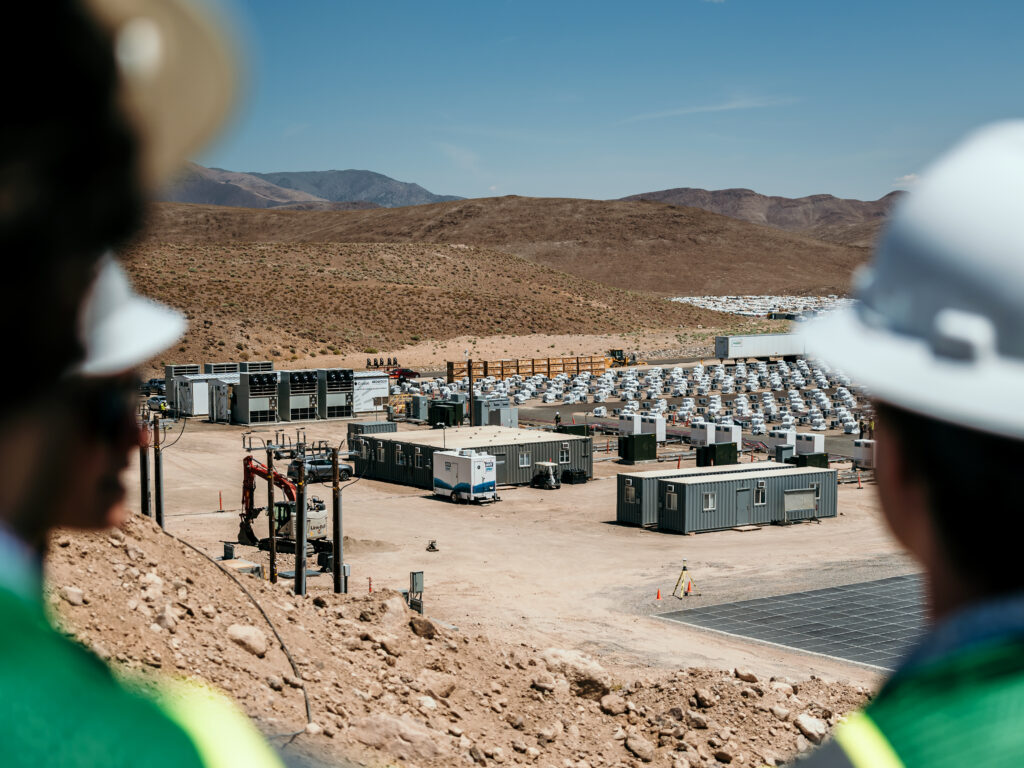
The backlash is against battery energy storage systems, which take in cheap electrons when they are abundant and release them back to the grid when they’re needed most, and it is spreading because opposition to batteries has become tangled up with the separate fight over data centers.
The conflation is a mistake, and if it hardens into law across enough states, it will be an expensive one.
Grid-scale batteries turn intermittent electricity generation — from wind that blows at night or sun that shines during the day — into capacity that can be called on during periods of peak demand. Deployed in the right places, batteries could cover roughly half of the country’s projected growth in peak electricity demand, according to researchers at Duke University’s Nicholas Institute.
On some California evenings this summer, batteries met as much as 36 percent of peak electricity demand. In Texas, new battery capacity helped cut the chances of a summer grid emergency from 16 percent to under 1 percent — and batteries added in 2023 and 2024 have already saved Texans at least $750 million. States that have leaned in to batteries are seeing the payoff in higher reliability and lower electricity prices.
But batteries matter even more for communities facing data center development. The electricity costs of data centers are largely tied to the grid on which they are located: Within the PJM electricity grid in the Midwest and Mid-Atlantic, the largest grid in the United States, data center demand has added close to $30 billion in costs that will show up in customers’ bills. Much of that could be alleviated by batteries, which can reduce the need to run the expensive natural gas “peaker” plants that are used only when demand is high. And batteries can be deployed quickly — often in months, compared with the years it can take to build new stand-alone electricity generation — meaning they can meet surges in demand.
The irony is that the same data center boom that makes batteries more urgent has also made them more politically fraught. At the state level, the number of anti-battery bills introduced more than tripled between 2024 and 2025, and the number enacted doubled. The numbers will be even higher this year. Legislation has been proposed in 18 states and enacted in eight, from Minnesota to Texas to Virginia. Upstate New York is littered with small white road signs that say “No to BESS” — battery energy storage systems.
One argument against batteries is that in some cases they can create a fire risk. In 2025, a battery fire in Monterey County, California, forced the evacuation of some 1,200 residents. But that battery was permitted in 2019, before there were national safety standards for battery installations, and it packed an outdated battery chemistry into a single enclosed building. Later that year, an nonprofit standards body issued a fire code called NFPA 855 to govern how grid batteries are installed; once adopted, it requires outdoor or fire-resistant enclosures, spacing between units and rigorous testing. And increasingly, smaller batteries can be deployed at commercial sites, reducing the fire risk of any one large battery while delivering the same, and in some cases greater, grid resiliency.
Though fire concerns persist, the anti-battery movement is becoming increasingly intermingled with data centers. Until this year, only one of the 34 anti-battery petitions tracked by Change.org mentioned data centers. In the first half of 2026, it was 1 in 3. In the past two months, it’s been nearly all.
Fortunately, it’s not too late to reverse this trend; the number of municipalities that have enacted outright bans remains small. But the risk is significant. According to polling by Heatmap, batteries are the least popular of all climate-friendly -free energy sources — less popular with the American public than nuclear power or natural gas.
To counter this trend, policymakers should do three things: First, extend and enshrine strong safety measures both for their own right and as a way to take cynical arguments about fire risk off the table. States should require compliance with the latest edition of NFPA 855. That mandate should come paired with preemption of local bans, as Texas and Oklahoma have done. States should also require that the older, pre-2020 battery fleet be audited against modern standards.
Second, fully credit batteries financially for the capacity benefits they provide, particularly to communities and distribution grids facing large new loads. Where utilities and public utility commissions have actually compensated batteries appropriately, we have seen significant deployment — Texas leads the nation. Others are lagging. PJM, for example, still credits a four-hour battery with only about 59 percent of its true capacity value — even as it faces some of the most acute data center pressures in the country.
Third, encourage the deployment of distributed batteries that are smaller, faster and easier to install but can be connected to provide the kind of benefits needed to lower electricity prices and manage load growth.
All of this needs to happen quickly. Laws are harder to unwind than to pass, and the fight now playing out in state capitols will shape the grid for a generation. A fight about data centers shouldn’t get in the way of the cheapest, fastest tool there is for keeping the lights on and prices down.
The post The battery-storage backlash is a costly case of mistaken identity appeared first on Washington Post.