OTHER WORLDS THAN THESE: A Talisman Novel, by Stephen King and Peter Straub
For decades, Stephen King has been building a vast multiverse, a fictional sandbox in which he can create and destroy lives, cities and civilizations. It’s unsurprising, given the breadth of his imagination, that novels and even series that start as stand-alones eventually tend to cross-pollinate with other books in his oeuvre. “The Talisman” (1984), for example, concerns a parallel universe called the Territories; in the sequel, “Black House” (2001), the Territories start to seem a lot like Mid-World, a setting from King’s Dark Tower series.
King confirms this link in the publicity materials for his latest novel, “Other Worlds Than These,” the final volume in the Talisman trilogy. (He wrote it based on an idea from the co-author of the first two novels, Peter Straub, who died in 2022.) Mid-World, King says, “was always the Territories by another name.”
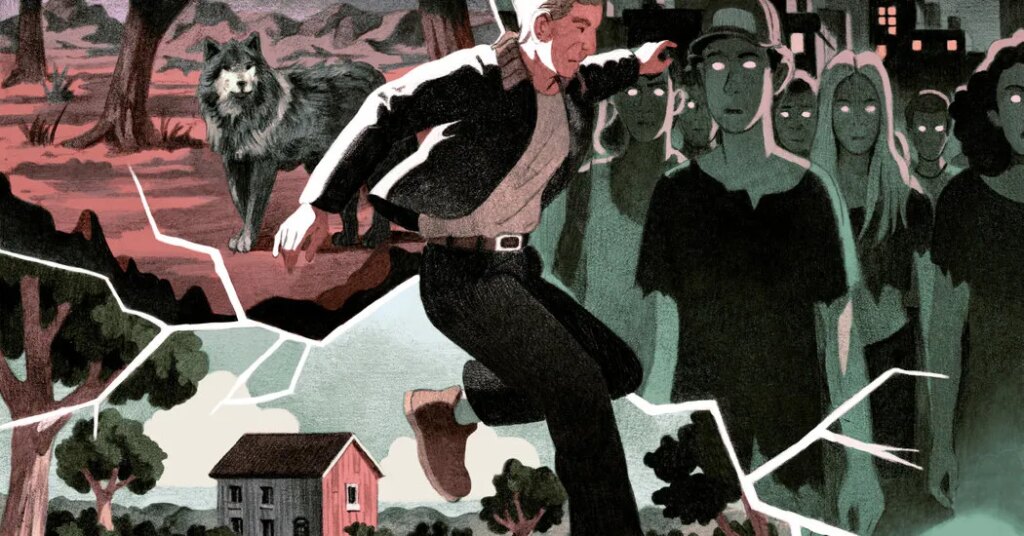
Our guide to Mid-World is Travelin’ Jack Sawyer, whom we met in Book 1 as a 12-year-old in New Hampshire who could “flip” into this other universe. Now in his late 50s, he lives in Mid-World full time and occasionally runs errands for the local governor, a tiny tyrant with a taste for pulp novels and Coca-Cola. These errands usually require Jack to flip back into our world for a few days at a time — as long as he can safely manage before the bullet wound he sustained at the end of “Black House” begins to threaten his life again.
It’s on one of these trips that he gets troubling news: A pair of teenagers are on a killing spree reminiscent of the real-life murders committed by Charles Starkweather and Caril Ann Fugate in the late 1950s. (Readers of “Black House” will find this familiar: Charles Burnside, the noxious octogenarian in that novel, models his crimes after the serial killer Albert Fish.) It’s not long before the violence spills over into Mid-World, where the strange homicidal contagion spreads to other teenagers. It falls to Jack and an ersatz ka-tet of fellow expatriate Americans to uncover the cause of this epidemic of violence and bring it to a halt.
Stephen King, like the universe he’s constructed, contains multitudes. Every bit of praise bestowed upon his fiction is true; every criticism levied against it is also true. He has an innate gift for the machinery and momentum of storytelling that hasn’t faded over his long career. His characters are beautifully, sentimentally — and sometimes grotesquely — human. (As Dwight Garner wrote in his review of “The Institute” (2019), they are “the kind of people who hear the trains in the night.”) King has an eye for arresting images: A door between worlds stands “by itself in a noose of blood-red roses.”
But he’s also repetitive. Every time Jack transports a physical object between worlds, the author makes sure to tell us how it changed in the transition, a bit of world-building that quickly loses its appeal. King is overly concerned with brand names and the makes and models of vehicles and weaponry. (I could have lived the rest of my life quite happily without reading a reference to a Tesla Cybertruck in a fantasy novel, but alas.)
His nonwhite characters are benignly stereotypical at best and downright offensive at worst. The custodian and blues musician Speedy Parker, Jack’s guide and mentor in the first two books, is mostly absent here, and missed, but I found myself relieved not to have to read King’s approximation of Black vernacular speech.
And King has never created a fat character he didn’t insist on treating as a disgusting spectacle. In “Other Worlds Than These,” there’s a particularly insulting episode concerning a family of fat people; King seems to take perverse pleasure in commenting on their “elephantine thighs” and “huge rolls of flesh.” Jack speculates that the family’s front porch “must have been specially reinforced to take the combined weight of such behemoths,” and when the daughter attempts to rape and kill him in his bed that night, she “lands on him like a truck falling off a jack,” breaking the bed frame. I wonder if it has ever occurred to King that fat people read his books, too.
As the capstone to the Talisman trilogy, “Other Worlds Than These” is a middling success. It moves and entertains, but it’s perhaps too reliant on the audience’s assumed familiarity with the Dark Tower saga; the shadow of the gunslinger Roland Deschain hangs heavily over these pages. Readers hoping to visit with old friends from “The Talisman” and “Black House” will be disappointed: The few characters from those novels to appear here do so only briefly.
It’s fun to spend so much time in Mid-World again, populated as it is with mutants, sentient Wolfs (never wolves, thank you), raccoon-like billy-bumblers, and vampires (called, regrettably, wompies in the local vernacular), though I wish we saw more of it through other eyes than Jack’s. The resolution of the novel’s plot comes out of nowhere, but I suspect that, when completing a trilogy begun more than 40 years ago, the emotional outcome takes priority.
Which brings me back to Travelin’ Jack. He’s the beating heart of the series, and his boyhood odyssey, adult trials and grief for lost loved ones have made him the man he is in this novel: stalwart, loyal and lucky as ever. The resolution of his decades-long journey moved me almost to tears, which took me by surprise. I may have my complaints about execution, but right here and now, I’m just glad I got to travel with Jack one more time.
OTHER WORLDS THAN THESE: A Talisman Novel | By Stephen King and Peter Straub | Scribner | 691 pp. | $35
The post An Epidemic of Violence Crosses Dimensions in Stephen King’s Latest appeared first on New York Times.