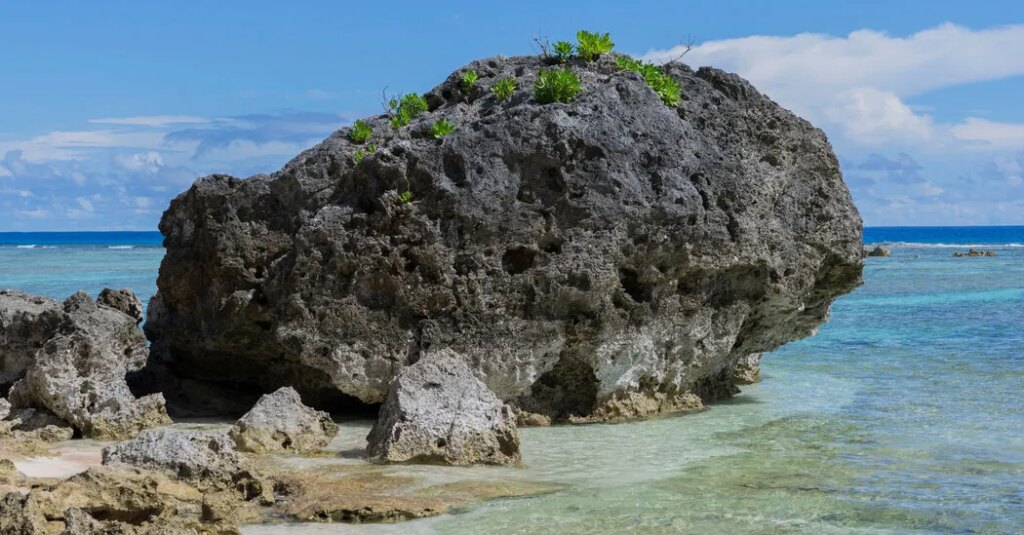
Tarague Beach is a tropical expanse of white sand on the island of Guam, where sea turtles lay their eggs, migratory seabirds forage and reef fish glide in the clear blue-green water.
But the future of this beach, nearly 8,000 miles from Washington, D.C., now rests with the Supreme Court. The court will hear arguments on Wednesday to decide whether the U.S. Air Force can continue to use it to dispose of expired rockets, bombs and hazardous waste munitions.
The dispute pits Prutehi Guahan, a local nonprofit dedicated to protecting Guam’s natural and cultural resources, against the U.S. military, which has long maintained a major presence on the island.
Guam’s proximity to Asia — it’s closer to Beijing than to Hawaii — has made it an increasingly important military outpost. That presence has only grown in recent years with rising tensions in the Pacific. Military experts often refer to the small island — about 170,000 people live on its 210 square miles, roughly five times smaller than Rhode Island — as the tip of the spear for American military might in the region.
Tarague Beach is near the northern tip of the island, within the bounds of Andersen Air Force Base, and for decades the military has used it a place to destroy expired munitions. The leaders of Prutehi Guahan have challenged the practice, arguing that the explosions threaten the fragile marine ecosystem, nearby archaeological remains, traditional fishing sites, and the island’s water supply, sending dangerous toxins and debris hurtling into the air and the water.
The legal question for the Supreme Court is a technical one about whether the Air Force followed environmental regulations as it sought a permit in recent years to continue detonations on the beach. In court filings, the Air Force has said that the detonation site is crucial for disposing of hazardous waste and that although it must reapply for a permit every three years, that process is meant to ensure ordinary compliance with the rules and not impose new restrictions.
The challengers say that the dispute is deeply personal. They argue that enforcing federal environmental laws is among the few ways for Guam residents — who are U.S. citizens by birth but who cannot vote for the president — to make their voices heard against the powerful U.S. military.
“It’s truly one of the only mechanisms that we have to have an impact on federal projects that will permanently alter our physical landscape, our environment, our cultural resources and our daily lives,” said Monaeka Flores, executive director of Prutehi Guahan, who is Chamorro, the Indigenous people of Guam.
Ms. Flores, whose family has deep roots in Guam, said that her relatives took shelter on the beach when Japan attacked the island hours after Pearl Harbor, hiding from the bombing and fishing for food.
Her great-grandfather, Luis, ranched and farmed the land, cultivating coconuts and raising pigs. Ms. Flores’s parents used to go on camping trips near the beach. After she was born, they brought her to the clear waters to learn to swim.
Near the beach is the site of what is thought to be a more than 3,000-year-old Chamorro village, with stone megaliths and prehistoric rock paintings. The Guam National Wildlife Refuge, a protected area for fruit bats, birds and turtles, is only a few hundred yards away.
“This is part of the collective memory, and therefore collective stewardship, of the Chamorro people,” she said. “We need to preserve it for all future generations, and everybody should have a chance to come and appreciate how special the area is.”
Since 1982, the U.S. Air Force has used the beach as a site for disposing of unexploded ordnance — tear gas, ammunition and other explosives — some dating back to World War II. The military set up what it calls an open detonation site on the sand.
Prutehi Guahan argues that when the Air Force reapplied for a permit from the Guam Environmental Protection Agency to continue the explosions in May 2021, it did so without properly examining the environmental consequences or allowing for public comment.
The requirement for the Air Force to renew the permit comes from a 1976 law called the Resource Conservation and Recovery Act. That law gives the Environmental Protection Agency the power to authorize state and territorial regulators to handle the treatment, storage or disposal of hazardous waste. In court filings, lawyers for the Air Force asserted that the military viewed the permitting process as part of ensuring its ongoing compliance with environmental rules.
But the challengers say that the military should also be required to undergo a vigorous environmental review under a Nixon-era law called the National Environmental Policy Act. That law has been interpreted by federal courts to require the government to take a “hard look” at any environmental consequences of plans before taking actions that could significantly affect “the quality of the human environment.”
After the Air Force sought the new permit, the Guam Environmental Protection Agency, the local territorial agency tasked with ensuring compliance with environmental laws, held a public hearing on the plan. After hearing concerns about the explosions, the agency announced it would consider whether to give the military its permit. In the meantime, though, the Air Force was allowed to keep detonating munitions on the beach.
Joni Quenga Kerr, a member of Prutehi Guahan who teaches science courses at Guam Community College, said she only learned about the open detonation program when the Air Force applied for its permit renewal.
“It’s so close to the ocean — it’s right on the beach,” Ms. Kerr said. “Just a few yards away is open ocean, the reef, and so, what kind of things could possibly happen to the air, the land, the water, the ocean, the organisms that live there?”
In January 2022, Ms. Flores and other members of Prutehi Guahan sued to stop the explosions. The plaintiffs raised concerns that land owned by neighbors could face contamination, and they asserted that the group’s members regularly used the beach for recreation, cultural and spiritual practices that would be harmed by the smoke, noise and pollution. They also worried that shock waves from the explosions would harm scientists’ efforts to study sea turtles.
They argued in court filings that the Air Force had failed to take a “hard look” at the consequences of the explosions, as required by law, or to consider “a reasonable range of alternatives.”
In court filings, the Air Force argued that it had followed the rules to reapply for its permit for the site. To require yet another layer of environmental review, the lawyers for the Air Force argued, “threatens to make the permitting process unduly burdensome and time consuming.”
In February 2025, a divided three-judge panel of the U.S. Court of Appeals for the Ninth Circuit sided with Prutehi Guahan.
The judges in the majority, Marsha S. Berzon, a Clinton appointee, and Eric D. Miller, a Trump appointee, ruled that if the Air Force had undertaken the required examination of the environmental impacts of its plan and had “appropriately engaged the public,” the military might have “chosen a different place or method for handling the waste munitions.”
The dissenting judge, Lawrence VanDyke, a Trump appointee, argued that the Air Force should be allowed to continue its detonations on the beach, as it had for decades.
In court filings, Trump administration lawyers, representing the Air Force, called the Ninth Circuit decision “inconsistent with basic principles of administrative and environmental law.”
Wednesday’s Supreme Court argument is likely to lean heavily into the technical reading of federal statutes and administrative procedure, but it will be closely watched in Guam, where the practical implications of the court’s decision will play out.
As the oral argument date approached, Ms. Flores prepared to fly to Washington. She walked along the shoreline of Tarague, gathering shells. She planned to slip them into her pockets the morning of the argument, to bring a bit of the beach past the red velvet curtains and into the courtroom.
The post The Military Explodes Bombs on This Beach. Is It Following the Law? appeared first on New York Times.