LONDON — In a speech to U.S. forces last week, Defense Secretary Pete Hegseth echoed President Donald Trump’s triumphant descriptions of Iran as a vanquished foe.
The United States has “destroyed” Iran’s navy, air force, leadership and “entire defense base,” Hegseth said, crippling Tehran’s conventional capabilities and leaving its shattered “nuclear ambitions laid bare for the world.”
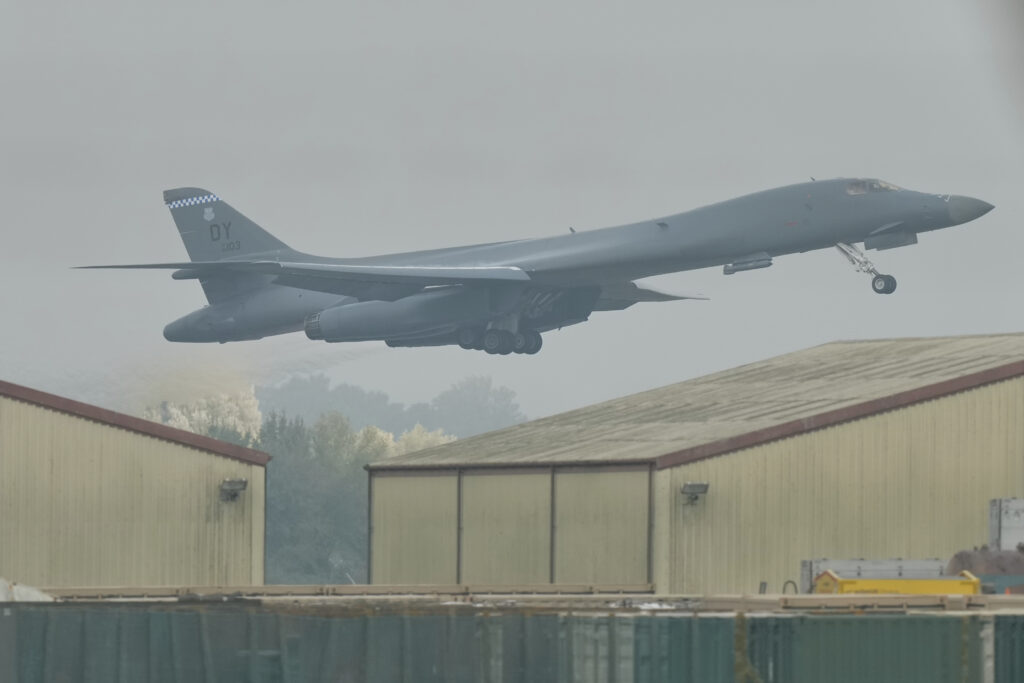
Days later, American B-1 bombers secretly began leaving a high-security military base in the British countryside, fleeing what U.S. officials described as the threat of a potentially catastrophic “swarm drone” attack planned by Iran.
The evacuation from Royal Air Force Fairford — a British air base in use since the 1944 D-Day invasion — underscored Iran’s continuing ability to wield the threat of asymmetric warfare despite being militarily outmatched by the U.S. and Israel.
Tehran has used the threat of unconventional attacks not just to instigate the hasty relocation of a dozen long-range U.S. bombers but to inflict chaos on global energy markets, and threaten the safety of Air Force One — all against a drumbeat of declarations by Trump administration officials that the war has been won.
Iran’s use of unconventional tactics — or in some cases merely the threat of doing so — has enabled it to claim a series of remarkable symbolic and tactical victories, security experts said.
“I don’t think anyone including the Iranians thought on Day One that they could stand up to the United States and Israel — two of the best militaries and air forces in the world — and fight an even fight,” said Daniel Byman, a counterterrorism expert and security studies professor at Georgetown University. “That said, we are seven-and-a-half months into this war and Iran is still inflicting damage — and that’s quite remarkable.”
Iran’s campaign of drone strikes on oil cargo ships in the Strait of Hormuz has given it leverage over a critical shipping lane and global energy supplies that it could never achieve though conventional naval force, according to security officials and analysts.
Tehran has escalated attacks in the strait in recent days, apparently in response to expanded U.S. operations that had brought oil flows back up to near prewar levels. Over the past week, Iranian attacks have hit more than 10 ships, according to maritime monitoring data.
The threat of an Iranian assassination plot set in motion an extraordinary sequence in July in which Trump was secretly slipped out of Air Force One via an airport catering truck — a ruse to protect him from the threat of attack by an adversary he described as “finished” in March and more recently has called “decimated.”
At the British air base, RAF Fairford, Iran appears to have forced the U.S. to withdraw a symbol of its military firepower, a fleet of planes that has carried out punishing strikes in the war, with no indication that Iran had managed to put in place either the personnel or equipment needed to launch a “drone swarm” attack.
Beyond its harassment of oil tankers and B-1 bombers, Iran has used drones to cause extensive damage to U.S. bases in the Middle East and to kill some troops. Iran also has enlisted its Houthi allies in Yemen to strike parts of Saudi Arabia that Iran likely could not reach otherwise.
Iran has done this despite the toll inflicted by U.S.-Israel airstrikes this year that killed Supreme Leader Ayatollah Ali Khamenei and much of his inner circle, including top officials in the Islamic Revolutionary Guard Corps who likely would have been tapped to oversee its asymmetric campaign.
Trump sought to play down the significance of bombers’ departure from Britain this week. “Rather than tempting the enemy, we’ll capture the enemy and beat the enemy,” he said. “So we moved them around a little bit. Not very far.”
If U.S. airstrikes against Iran were to resume, however, the bombers would have to travel thousands of additional miles after being relocated to bases in South Dakota and elsewhere in the U.S. from their former home 80 miles west of London.
Former security officials said the evacuation was a symbolic victory for Tehran, but ultimately of limited consequence. “It does not limit our military options against Iran or change the strategic course of the conflict,” said Norman Roule, a former senior CIA official and Iran expert.
Even so, Roule said the sequence shows that Iran has proven adept at taking advantage of drone technology that is forcing military officials to reevaluate the vulnerabilities of Fairford and other bases long seen as secure.
Iran “is showing how the new technology of cyber and drones compel us to reshape our protective architecture,” Roule said.
In a measure of the alarm over the threat, U.S. officials said that the bomber evacuation began before refueling aircraft were fully in position to support their journey across the Atlantic.
The harried redeployment came amid conflicting signals about the urgency of the threat to Fairford and about Iran’s ability to carry out such an elaborate plot.
U.S. officials said the bombers were moved in response to multiple streams of intelligence indicating that the aircraft could be hit in an attack similar to the one Ukraine launched against Russia in June 2025. In that strike, called Operation Spider’s Web, Ukraine destroyed more than a dozen Russian military planes using small armed drones that had been smuggled into the country in cargo trucks.
Fears that such an attack might be unfolding on British soil likely gripped U.K. officials after police received calls shortly after midnight on Oct. 4 about three white cargo vans approaching the Fairford base.
News photos taken after police arrived showed five men stripped of their shirts and seated on the ground in the dark under police guard. News footage the next morning showed bomb inspection robots moving among the vans.
And yet, police found no drones, explosives or weapons in the vehicles — only canisters containing gasoline. All five suspects were released the next day on bail, reflecting a determination by British police that they posed no ongoing threat.
Trump at the time said that the suspects were planning to cause “big damage.” But the bombers were not evacuated until a week later. And though U.S. officials cited new streams of alarming intelligence, British officials said no new threat to the base had materialized. The officials spoke on the condition of anonymity, to discuss an ongoing investigation.
The seemingly disparate responses raise questions about “how serious was this threat,” Byman said, and whether the U.S. has seen intelligence its allies have not or has taken a step of extreme caution “over aspirational terrorism.”
Britain has faced dozens of plots traced to Iran in recent years, but no details have surfaced from these cases to suggest Iran has the capacity to mount a complicated attack on a heavily guarded military base.
Instead, Iran is accused of being behind a steady stream of low-level sabotage operations and plots involving proxies recruited from criminal networks on social media platforms. Recent plots include the stabbing of a Jewish pedestrian and an arson attack on ambulances that serve the Jewish community in north London.
Iran’s increasing reliance on criminal proxies is seen by experts as an indication of how difficult it has become for Iran’s own agents to elude MI5 and other security agencies on British soil, let alone sneak in truckloads of armed drones.
The plot against RAF Fairford may have been an attempt by Iran to probe British defenses — and alarm Washington — without risking the fallout or failure of a full-scale attack, experts said.
It “may be less that Iran intended to carry out such an attack than that it wanted Western intelligence services to discover that it could,” said Ali Vaez, deputy Middle East program director at the International Crisis Group.
The outcome, Vaez said, was “a carefully calibrated warning shot: a way of demonstrating that Iran can extend the battlefield onto European soil.”
Steve Hendrix in London and Tara Copp and Susannah George in Washington contributed to this report.
The post Pullout of B-1 bombers shows how an outgunned Iran is keeping the U.S. on edge appeared first on Washington Post.