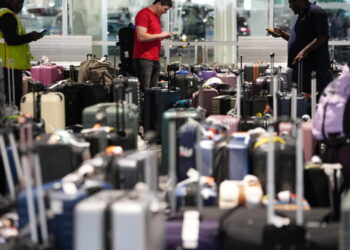
To understand Europe’s growing alarm over its trade deficit with China, consider a striking statistic: China now sends six containers of goods to Europe for every one it gets back.
That ratio has more than doubled in China’s favor over the last five years as Beijing’s drive for greater economic self-reliance has expanded the range of goods China produces at home instead of buying from abroad.
Jens Eskelund, president of the European Chamber of Commerce in China, cited those figures last month and provided a simple explanation for why.
“China makes everything,” he said.
That is the dilemma confronting Europe as its trade deficit with China exceeds $1 billion a day. European consumers and companies still want, and in many cases need, what Chinese factories produce. Increasingly, the reverse is not true.
“The Chinese are basically succeeding in self-reliance,’ said Joerg Wuttke, a partner at DGA-Albright Stonebridge Group, a Washington-based consultancy and a former president of the European Union Chamber of Commerce in China. “What else do they want from us? They are producing everything in excess. And they are competitive left, right and center because of scale.”
For years, Beijing has pursued self-reliance partly as insurance against the possibility that tensions with the West could expose economic weak points. Over the past decade, China has poured resources into industries and technologies intended to reduce its dependence on foreign suppliers.
The result is a trade relationship that has become more lopsided than the headline figures suggest. Falling prices in China mean that trade measured by value understates the sheer volume of Chinese goods entering Europe and the industrial overcapacity at the center of the trade dispute.
Mr. Eskelund has identified some of what those containers coming from China are carrying — household appliances, electronics, machinery, furniture, chemicals and textiles.
It was not always this way.
In the years after China joined the World Trade Organization in 2001, its economic relationship with Europe was more complementary.
While China supplied Europe with the affordable consumer goods that kept many Europeans happy, Europe also sold China industrial machinery, luxury goods and high-end automobiles for a rising middle class.
The relationship began to change as Chinese manufacturing became more sophisticated and moved up the industrial ladder.
Chinese production of solar panels, aluminum and steel surged, pushing down global prices and battering European producers. At first, many Europeans regarded the fallout as confined to a few industries. China, meanwhile, remained an enticing growth market for European companies.
Then, China stepped on the gas.
In 2015, Beijing issued an industrial strategy called “Made in China 2025.” It set out China’s ambitions to dominate advanced manufacturing, targeting sectors including robotics, electric vehicles and green technology. One result was enormous amounts of state-backed funding directed toward favored industries.
“Everyone still kind of reassured themselves that China could do the lower value-add part of everything and that they would retain the higher value part,” said Agatha Kratz, a partner who specializes in E.U.-China relations at Rhodium Group, a research firm.
Even as Europe remained broadly open to Chinese exports, European companies faced barriers inside China.
“As an ambassador there, I was tired of asking the Chinese to let our companies do the same things in China that their companies did in Spain,” said Rafael Dezcallar Mazarredo, who served as the Spanish ambassador to China for six years until 2024. “They nodded politely and they did nothing.”
Under Xi Jinping, China’s top leader, the country expanded its industrial aspirations. Beijing promoted a strategy called “Little Giants,” unleashing small and medium-sized enterprises to build technology and address vulnerabilities in domestic supply chains. Another strategy paired greater economic self-reliance at home with continued access to foreign markets for Chinese exports.
To many European analysts, the direction was clear.
“It’s out-Germanying Germany,” said Andrew Small, director of the Asia program at the European Council on Foreign Relations.
Few industries illustrate the transformation more clearly than automobiles.
The Chinese government funneled at least $231 billion to the car sector from 2009 to 2023, according to the Center for Strategic and International Studies, which described the figure as “a conservative estimate.”
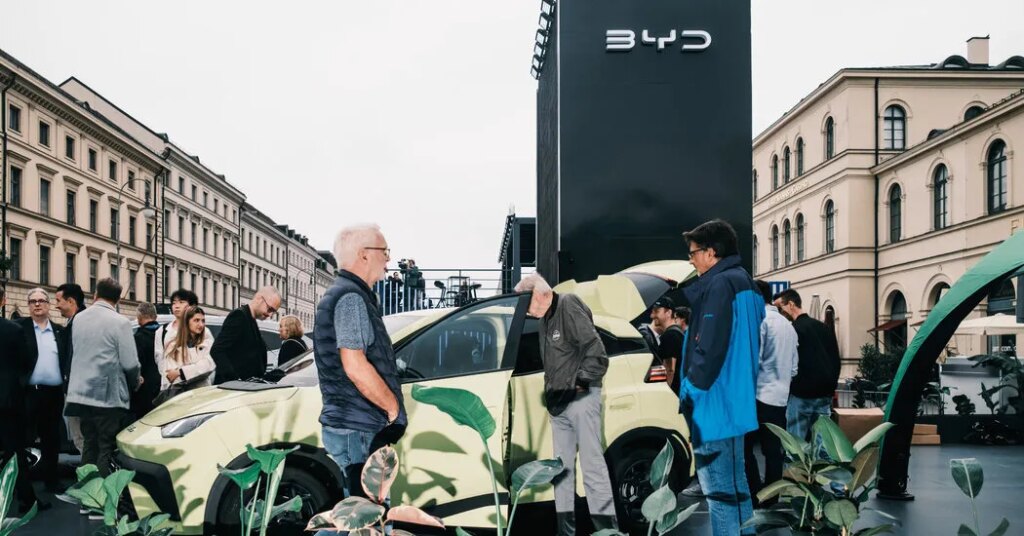
More than 200 domestic electric vehicle manufacturers appeared in the Chinese market. The resulting production boom eventually exceeded China’s own demand, causing a brutal price war and pushing brands to look abroad for growth.
By 2023, some of Germany’s biggest automakers — nearly all of them with significant operations in China — were issuing profit warnings. Around the same time, China’s E.V. makers started expanding into Europe.
When the European Union imposed additional tariffs on electric vehicles, Chinese carmakers increased exports of hybrid cars, which now make up a large share of China’s exports to Europe.
When German media reported last month that Volkswagen would close four major plants in Germany, the announcement marked a turning point. German automakers had long been among the strongest opponents of measures that might provoke Beijing, urging restraint against tougher European trade policies.
Now, the German automotive industry association said it supported tariffs, opening the door for Germany to adopt a harder stance against China.
A decade ago, Mr. Eskelund said, “China made the pie bigger for everyone.” Now it’s taking market share in Europe at a time when European companies in China face a slower economy and fierce domestic competition.
Mr. Dezcallar, the former Spanish ambassador, said Europe still has some leverage over China because of its market of 500 million high-spending consumers. Beijing also has reason to avoid letting its economic relationship with Europe deteriorate to the level of its feud with the United States.
“It is not in their interest,” he said, “to have two open fronts at the same time.”
The post China’s ‘Self-Reliance’ Drive Is Upending Trade With Europe appeared first on New York Times.