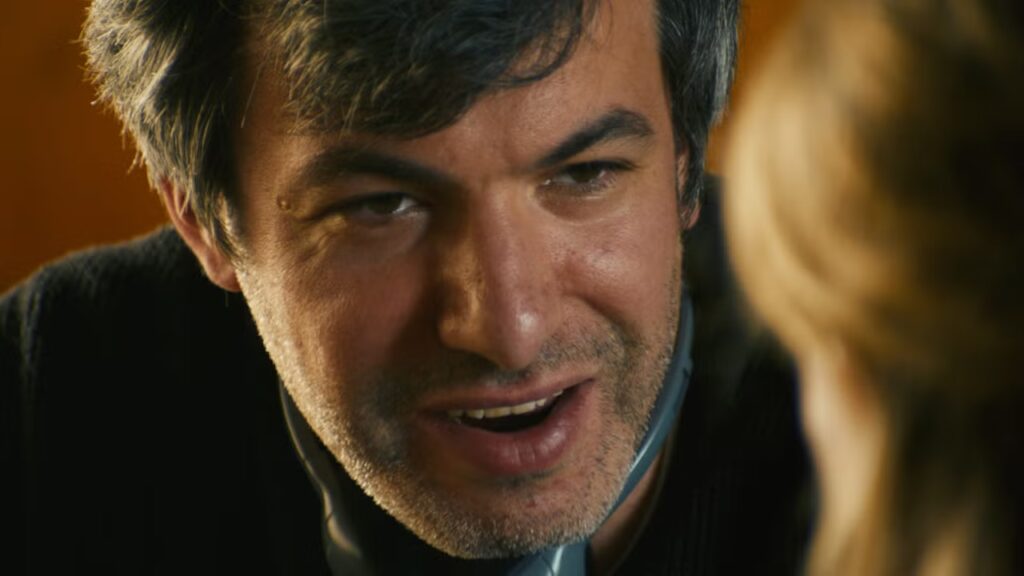
A24 hosted an early screening of Lance Oppenheim and Nathan Fielder’s buzzy Elizabeth Holmes documentary “You Can See Everything” at the David Geffen Theater at the Academy Museum Tuesday night. The event comes exactly one month after the film — which hadn’t even been announced to the public yet — debuted as a secret screening at Telluride Film Festival, instantly rocketing into the awards race.
Years after filming, Fielder still can’t make heads or tails of it.
“I still am not sure to this day what I experienced,” Fielder told the crowd at a Q&A. “Maybe it being out there, everyone can help me understand what I went through a little bit. What we all went through.”
Fielder and Oppenheim sat in conversation with Bill Hader after the film, revealing their magic tricks to a nearly full crowd (a rare feat for a late-night Q&A). Numerous stars turned out for the screening, held just over a week before the film hits theaters, with Zach Cregger, Adam McKay, Patrick Ball, Hannah Einbinder and Aidy Bryant among those seen in attendance. Everyone wanted to see what Fielder and Oppenheim had in store so soon after the latter released “Primetime,” his equally buzzy film starring Robert Pattinson as Chris Hansen. The room was not left disappointed.
We won’t disclose spoilery details for that film, but we did learn a bit more about how it even came to be. Oppenheim said that he reached out to Fielder after the “Nathan for You” creator watched his debut feature, “Some Kind of Heaven,” on an online platform.
“I was like, man, we should make something together,” Oppenheim said of reaching out to Fielder. “I threw some ideas at him, and he didn’t like any.”
But, as fate would have it, an idea soon came to them. Fielder invited Oppenheim to attend the Hollywood magicians’ venue The Magic Castle, where one of the performers in a close-up magic room asked the audience for a suggestion of a name.
“Elizabeth Holmes!” one patron shouted out.
Oppenheim immediately recalled hearing, a day before, that the Theranos founder and her partner, Billy Evans, had just asked A24 if the studio wanted to make a documentary about Holmes’ last days before going to prison.
“First off, why A24?” Oppenheim wondered. “Secondly, she hadn’t been on camera in many, many years. I thought there could be something interesting about that.”
“She hadn’t talked to anyone,” Fielder said. “She hadn’t done any press or anything in I think seven or eight years at the time.”
So Fielder and Oppenheim, in turn, went to A24, asking for a meeting with Holmes. Fielder still recalls the experience of meeting the one-time health mogul, who was sentenced to 11 years in prison for fraud, for the first time before cameras rolled.
“It was a really disorienting experience, talking to someone like that, when they seem so sincere,” Fielder told the crowd.
There’s a bit of irony in that. Fielder’s claim to fame was initially “Nathan for You,” a documentary series in which he approached struggling businesses with comedic “solutions” to help bring in more customers. He later followed this up with he HBO series “The Rehearsal,” in which he constructed fabricated environments with the goal of helping people practice for life’s stressful moments. Both of those shows involve an incredible amount of thought and manipulation from Fielder and his team, often yielding the question of where the show ends and the host begins. Oppenheim likewise played with the concept of the camera’s clash with reality in “Primetime,” a film interested in the ethics of Chris Hansen’s televised predator-catching.
Oppenheim revealed that “You Can See Everything,” much of which was filmed in 2023 before Holmes’ imprisonment, didn’t initially involve Fielder as much of an on-camera protagonist. Early on, however, cameras started wandering in Fielder’s direction to help moor the audience amid the confounding characters of Holmes and Evans.
“The only way to make this work is to have someone confront their delusions,” Oppenheim told the crowd.
When Fielder and Oppenheim went back to A24 about the project, they were shown an open door, told that they would be given resources to film Holmes and Evans, regardless of whether or not a film actually came out of it. This came together less than two months before Holmes’ prison sentence began. Several times, Fielder said he offered to leave when things got heated or emotional, especially knowing that they had two young children at home. The duo repeatedly rejected Fielder’s offer.
In fact, they invited Fielder to stay with them in their guest house for the duration of the filming (around 35 days in total). Oppenheim said that, at one point, they bought a $10 debugger to see if Fielder’s room was wired to clue Evans into their crew’s conversations. The cheap tool did not work, so they rolled the dice.
Fielder and Oppenheim expressed confusion at why Holmes wanted them there in the first place. They were also confused by just about everything they saw while there.
“The first place that we started from was like, ‘Can we document this in a way that brings the audience into this experience?’” Oppenheim said. “That puts you in the house. That puts you into that feeling.”
The duo brought with them a crew of seven individuals to film the day-to-day of Holmes’ life before incarceration, including David Bolen, who shot Oppenheim’s “Primetime.” As Fielder, Oppenheim and their crew witnessed the same strange reality of Holmes and Evans’ life, they hoped to collectively make some sense of what they were experiencing. But that sense never came.
“At the end of the day, Lance and I would talk about what had happened, and we would be on totally different sides of what we thought was actually happening and completely disagree on moments that we both witnessed,” Fielder said. “That’s when we were like, ‘Oh, there’s maybe something here in this if we just follow our natural curiosity with it all. That’s interesting.”
“It wasn’t just us, that we couldn’t agree on certain things,” Oppenheim. “Even just really simple, mundane moments, everybody in our crew had different opinions about it.”
Maybe the audience can suss it out.
“You Can See Everything” releases in theaters on Oct. 16.
The post Nathan Fielder Needs the Audience to ‘Help Me Understand What I Went Through’ in Making Elizabeth Holmes Doc appeared first on TheWrap.