Bill Harris, a Marine Corps veteran who was one of the main kidnappers of the heiress Patricia Hearst in his role as a top lieutenant of the Symbionese Liberation Army, the underground band of firebrands that epitomized — and, to many, helped discredit — the revolutionary far left of the 1970s, died on Sept. 10 in San Francisco. He was 81.
His wife, Rebecca Young, confirmed the death, at a hospital, and said the cause was a heart attack.
Mr. Harris’s byzantine journey into the American consciousness began around 9 p.m. on Feb. 4, 1974, when he and two other “soldiers” from the Symbionese Liberation Army, or S.L.A., burst into the Berkeley, Calif., apartment that Ms. Hearst, a 19-year-old sophomore at the University of California known as Patty, shared with her fiancé, Steven Weed.
Ms. Hearst was a scion of California’s equivalent of a royal family. She was a daughter of Randolph A. Hearst, the chairman of the Hearst Corporation, which was founded by her grandfather William Randolph Hearst, the lordly media baron and model for the title character in “Citizen Kane.”
“Patricia Hearst was a symbolic target,” Mr. Harris said later, adding: “Her family was in control of a media empire that we viewed as an arm of propaganda for the United States government.”
On that February evening, after a brief, violent struggle, Mr. Harris stuffed her — writhing and screaming, wearing a bathrobe and fuzzy blue slippers — into the trunk of a Chevrolet Impala. It was the start of one of the defining news epics of the era, as Ms. Hearst morphed from Patty to Tania — a gun-toting urban guerrilla and bank robber — and back to Patty again.
For the ever-voluble, ever-dogmatic Mr. Harris, it was also the start of a headline-grabbing odyssey of crime and punishment that unfolded over decades, involving one of the largest manhunts in F.B.I. history, two prison sentences and enough revolutionary sloganeering to make Mao’s head spin.
The S.L.A. represented a distillation — or, perhaps, a fun-house mirror distortion — of the tide of anger that had been building since the 1960s, particularly among the young, over issues like the Vietnam War and the halting successes of the civil rights movement and the feminist struggle, against a backdrop of rampant drug use and an ever-increasing extremism.
The group was founded in 1973, with Donald DeFreeze, an escaped convict who assumed the grandiose nom de guerre General Field Marshal Cinque, as its figurehead. According to one probation report, Mr. DeFreeze had “a schizoid personality with strong schizophrenic potential.”
Cinque, as he was known, and his cadre of radicalized middle-class young people banded together under an incendiary slogan: “Death to the fascist insect that preys upon the life of the people.”
Historians of the American left have been less than charitable toward the S.L.A. over the years.
“Marx wrote that ‘history repeats itself, first as tragedy, then as farce,’” Todd Gitlin, the author and former president of the Students for a Democratic Society, told CBS News in 2002.
“The tragedy” of the S.L.A., Mr. Gitlin added, “was the demise of the ‘new left’ into a collection of political sects who made no sense. The farce was that here was this small cult mouthing the words, like lip-syncing revolutionary rhetoric.”
In a 2018 interview on CNN, Mr. Harris, known in the S.L.A. as General Teko, offered a different perspective.
“Reality isn’t always on the surface,” he said. “Sometimes you have to look a little deeper to see what’s real.”
William Taylor Harris was born on Jan. 22, 1945, to Betty and Fred Harris in Fort Sill, Okla., where his father, a lieutenant in the Army Air Corps during World War II, was stationed at the Army base. The elder Mr. Harris later worked as a salesman in Carmel, Ind., an Indianapolis suburb, where Bill grew up.
In high school, Bill won a local journalism award and golfed for the school team; he was also an acolyte at St. Christopher’s Episcopal Church. His mother later told Time magazine that he grew up respecting authority and “would never have thought of arguing with his dad.”
When he graduated from high school in 1963, he told CNN, “the civil rights movement was ramping up, but I had no political consciousness of any kind.”
As a student at Indiana University, he joined a fraternity and, according to “The Voices of Guns” (1977), a history of the S.L.A. by Vin McLellan and Paul Avery, was more interested in sports and beer than academics. He drifted away from school and joined the Marines in 1965 to “find himself”; when he enlisted, he was a registered Republican.
When his father died of a heart attack the next year, “he took it hard,” a friend later recalled, noting that the death “robbed him of the one person he was trying to prove himself to.”
He shipped out to Vietnam and was stationed in Da Nang. “My first day in Vietnam,” Mr. Harris told CNN, “I had to witness the torture of a Vietnamese prisoner. When you get into that kind of level of conflict, it’s really hard to adjust coming back home.”
After his discharge, he returned to Indiana University, where he joined Vietnam Veterans Against the War and his politics drifted left. In 1968, he met Emily Schwartz, a fellow student who came from an affluent Chicago suburb and was also developing far-left leanings. They married in 1971.
According to a 1975 New York Times article, Mr. Harris studied theater and earned a master’s degree in urban education. Soon after, the Harrises followed another couple from their college circle, Angela Atwood, a future S.L.A. member, and Gary Atwood, to California. Mr. Harris took a job at an Oakland post office, and the Harrises drifted toward the radical fringe.
In November 1973, the fledgling S.L.A. earned its first headlines by using cyanide-laced bullets to kill Marcus Foster, the Oakland schools superintendent. Mr. Foster, who was Black and a respected progressive, had been considering security measures, including issuing student identification cards, that the group deemed “fascist.”
Many on the left were horrified by the shooting. The Harrises were intrigued.
Soon after, Mr. Harris recalled on CNN, “we were approached and asked if we wanted to meet the people who carried out the Foster assassination. Emily and I and Angela were taken to a location where hoods were put over our heads, and we were led into a van and we were transported up to a place we didn’t know.”
Before long, the Harrises had become S.L.A. soldiers and were helping to plan the Hearst kidnapping.
The group’s initial communiqué claiming credit for the kidnapping, which described Ms. Hearst as a “prisoner of war” who had been “arrested,” made no ransom demands. The S.L.A. eventually insisted on a food giveaway to the needy that could have amounted to about $400 million (nearly $3 billion today); the Hearsts pledged $2 million, which the kidnappers judged insufficient.
Ms. Hearst spent the weeks after her abduction largely confined to a closet in an S.L.A. safe house in Daly City, just south of San Francisco, often reading the group’s propaganda by flashlight. On April 3, 1974, the S.L.A. released a Polaroid photo of her posing with a sawed-off M1 carbine in front of a banner bearing the S.L.A.’s seven-headed-cobra logo.
It was accompanied by a tape-recorded statement in which she identified herself as Tania — a name inspired by a onetime comrade of the Cuban revolutionary Che Guevara — and assailed the establishment. “I have learned how vicious the pig really is,” she said, “and our comrades are teaching me to attack with even greater viciousness.”
About two weeks later, wearing a Guevara-style beret and carrying a semiautomatic carbine, she played a key role in an S.L.A. robbery at a Hibernia Bank branch in San Francisco that yielded about $11,000. Fearing arrest, the group fled to Los Angeles. On May 16, the Harrises and Ms. Hearst set off on a run for supplies in a red-and-white Volkswagen bus, as Jeffrey Toobin recounted in his 2016 book, “American Heiress: The Wild Saga of the Kidnapping, Crimes and Trial of Patty Hearst.”
Their last stop was Mel’s Sporting Goods in Inglewood. While shopping for heavy-duty clothing there, Mr. Harris slipped a revolution-ready shotgun-shell bandoleer into his pocket. When he was confronted by one of the store’s employees — whom he later described in an S.L.A. communiqué as a “pig-agent clerk” attempting to “show his allegiance to his reactionary white bosses” — Mr. Harris and the employee ended up in a tussle on the sidewalk.
Ms. Hearst, waiting in the van across the street, helped Mr. Harris escape by peppering the store with automatic-weapon fire, shattering the plate-glass windows but somehow injuring no one. “She saved my bacon,” he later said.
The three escaped, stealing multiple cars. In the chaos, they left behind the Volkswagen van, which held a parking ticket that indirectly led authorities to an S.L.A. hide-out in South Central Los Angeles.
By then, the Harrises and Ms. Hearst had fled south, to a motel room in Anaheim with a view of Disneyland. They watched on live television as police and F.B.I. teams descended on the modest yellow house where their comrades were hiding.
An officer outside the house overheard Mr. DeFreeze imploring his five followers to choose death over surrender, Mr. Toobin wrote. Ultimately, they did.
Ignoring repeated calls to give themselves up, the group responded to tear gas with gunfire. A furious battle ensued, and the house caught fire, the roof and walls collapsing. All six S.L.A. members died.
The remnants of the group returned to the Bay Area and began to recruit new members.
On April 21, 1975, the refashioned S.L.A. organized an armed robbery of a Crocker National Bank branch in a Sacramento suburb. While group members barked orders to those inside, telling them to get down on the floor, Ms. Harris accidentally discharged her shotgun, killing Myrna Opsahl, a mother of four who was there to deposit church collections.
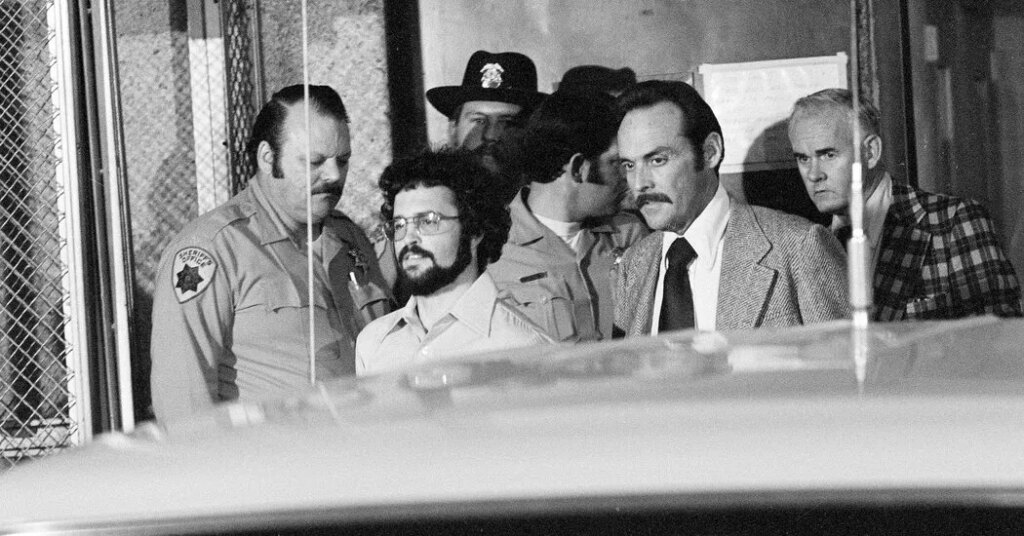
The Harrises and Ms. Hearst were arrested that September in San Francisco. The Harrises faced possible life sentences after being convicted in August 1976 on charges related to their Los Angeles crime spree, including armed robbery and auto theft. They were in jail awaiting trial when they were indicted in the Hearst kidnapping, which resulted in a plea deal. They each spent about eight years behind bars before being released on parole in 1983.
The Harrises divorced after they were paroled; Ms. Harris had come out as a lesbian in prison. Mr. Harris went on to become a private investigator. He married Ms. Young, a Bay Area defense lawyer, in 1988. They had two sons, lived in Oakland and eventually moved to San Francisco.
In 2002, he, Emily Harris and three other S.L.A. members were arrested on charges related to the fatal Crocker Bank robbery. All five pleaded guilty to second-degree murder. Mr. Harris served four years.
In addition to his wife and their sons, Cody and Shane, he is survived by two sisters, Joanne Johnson and Amy Duke.
Ms. Hearst endured her own legal perils. In 1976, she received a seven-year sentence for her role in the Hibernia Bank robbery; she served about 22 months before President Jimmy Carter commuted her sentence in 1979.
Like the Manson Family courtroom circus several years earlier, hers was frequently described as the trial of the century. And as with the Manson case, which involved young hippie cult members committing brutal murders to fulfill Charles Manson’s vision of apocalyptic revolution, the Hearst saga raised questions about brainwashing — a concept that “Tania” had vehemently denied in her S.L.A. communiqués.
Had Ms. Hearst been coerced to join the group, as her showman lawyer F. Lee Bailey argued, fearing that she faced death if she didn’t?
Or, like so many college students of her era, was she a child of comfort who experienced a political rebirth, concluding that America was an irretrievably racist, sexist oligarchy? Was she Tania through and through?
After being released from prison, Ms. Hearst eventually wrote a memoir, “Every Secret Thing,” published in 1982. (She also raised French bulldogs that won top awards at the Westminster Kennel Club Dog Show and acted in multiple films by the master of camp, John Waters.) In the book, she recalled how the S.L.A. had presented her options during captivity: “I knew that the real choice was to join them or be executed.”
Mr. Harris disputed that claim in a 2024 interview with the journalist and S.L.A. chronicler Roger Rapoport.
“There were many factors that influenced Patty’s decision to stay and fight,” he said. “What we didn’t know when we kidnapped her was that she had rejected her mother, a gold digger and right-wing ideologue.”
He reflected on his own legacy in a 2002 interview with The Los Angeles Times.
“If you do something and you succeed, then you’re a revolutionary of high quality and you get to be George Washington, the father of the country,” he said. “But if you challenge power and you’re rubbed out, you’re in the trash bin of history.”
The post One of Patty Hearst’s Kidnappers Has Died appeared first on New York Times.