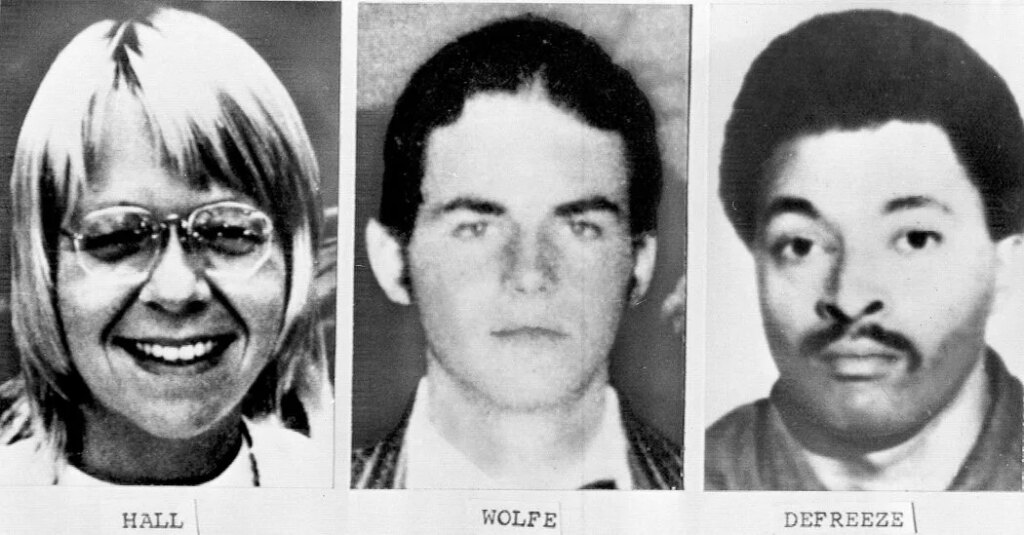
In a six-page “declaration of revolutionary war” — issued in 1973 and rendered, like a church bulletin, in the standard Courier lettering of a typewriter — the newly formed Symbionese Liberation Army made its intentions clear. This band of professed urban guerrillas, however small in number, was immensely ambitious.
“We of the People and not the ruling capitalist class will build a new world and system,” the missive read. “Where there is really freedom and a true meaning to justice and equality.”
But within three years, six of the group’s dozen or so members — including its architect, Donald DeFreeze, an escaped convict known as Cinque — were dead, killed in a shootout with Los Angeles police. Others, including Bill Harris and Emily Harris, were behind bars after a string of crimes that had made headlines worldwide, among them the murder of an Oakland schools superintendent and the kidnapping of the heiress Patricia Hearst.
The recent death of Mr. Harris, a half-century later, recalls a flashpoint in American history touched off by this ragtag group that was reviled as a terrorist organization by the mainstream as well as many in the counterculture.
The Cultural Setting
By the time the S.L.A. emerged, the sunshine optimism that had seemed to bathe even foggy San Francisco, the Day-Glo hippie capital of the 1960s, had darkened. The Weather Underground and countless other, more obscure groups had been preaching — and practicing — armed violence toward revolutionary ends.
After years of mass protest, the Vietnam War had lurched into a new decade, and the Watergate scandal was confirming the most pessimistic suspicions of the young agitator class — that the establishment was crooked to the core.
By the 1970s, drugs were harder and horizons dimmer. To battle-ready extremists, it seemed clear that America would not be reborn through protest songs and sit-ins. It was time, they believed, for violence.
The Soldiers
Berkeley — home to the campus of the University of California that Time magazine called the “cradle of student radicalism” in 1975 — was the crucible of the S.L.A.
Of the group’s core members, Willie Wolfe, Nancy Ling Perry and Patricia Soltysik had been students at the university; Camilla Hall and Russell Little lived in the city. And then there was Ms. Hearst, who was a Berkeley sophomore at the time of her kidnapping.
Multiple future S.L.A. members volunteered with the Black Cultural Association, an inmate tutoring and education group at the California state prison in Vacaville. Through the program, they got to know Mr. DeFreeze, who was serving time for robbing a tourist in Los Angeles. In March 1973, Mr. DeFreeze — who had been transferred to a prison in Soledad, further south — escaped. With the help of his tutor friends, he took refuge in Ms. Soltysik’s Oakland home.
Their circle would soon include three former Indiana University students: the Harrises and Angela Atwood.
The Dogma
The core philosophies of the S.L.A. were a swirl of -isms: Marxism, Maoism, Black nationalism, feminism.
The group drew inspiration from the writings of George Jackson, who became a face of the prison-reform movement in 1970, when he published “Soledad Brother,” a collection of his letters arguing that Black inmates were political prisoners of a fascist state and that revolution was the only path to justice.
Another influence was “Revolution in the Revolution?” (1967), by Régis Debray, a guerrilla comrade of Che Guevara in Bolivia. It advanced the theory of foco, or foquismo, which posited that a small cadre of firebrands could spark mass revolution through brazen attacks on the establishment.
As Jeffrey Toobin recounted in his 2016 book, “American Heiress: The Wild Saga of the Kidnapping, Crimes and Trial of Patty Hearst,” S.L.A. members were well acquainted with Costa-Gavras’s 1972 film “State of Siege,” which chronicled the exploits of the Tupamaros, an insurrectionist group in Uruguay known for robbing banks and kidnapping or killing authority figures.
The word Symbionese in the group’s name was derived from the biological concept of symbiosis, referring to organisms working together for mutual benefit. The group’s seven-headed-serpent logo — which became “about as familiar as the Jolly Roger,” Rolling Stone observed in 1974 — was meant to reflect the Seven Principles of Kwanzaa: unity, self-determination, collective work and responsibility, cooperative economics, purpose, creativity and faith.
Mr. Harris made plain the group’s vision in a 1976 interview: “The long-run aim of the S.L.A. was to work toward the annihilation of U.S. imperialism and the culture and institutions that support it.”
The Crimes
From 1973 to 1975, members of the S.L.A. were involved in a series of violent crimes, including the murder of Marcus Foster, the first Black superintendent of the Oakland school district; the kidnapping of Ms. Hearst; the armed robbery of two banks; a fiery shootout with Los Angeles police at an S.L.A. hide-out that left six of the group’s members dead; and the attempted bombings of two police squad cars in Los Angeles.
The Legacy
Joseph Remiro was sentenced to life in prison for the Foster murder; Mr. Little was found guilty of the same crime, but was acquitted by an appeals court.
The Harrises were found guilty of multiple crimes, including the Hearst kidnapping, and each served about eight years.
Ms. Hearst was initially sentenced to 35 years for her part in a robbery; she served 22 months before President Jimmy Carter commuted her sentence in 1979.
Kathleen Soliah spent more than two decades as a fugitive, changing her name to Sara Jane Olson and marrying a doctor in Minnesota. After being featured on the television show “America’s Most Wanted,” she was apprehended and served nearly seven years for a car bombing attempt and her role in a murder.
“The S.L.A. were the gravediggers of something that had been alive,” Todd Gitlin, a historian of the New Left, said in a 2002 interview with The San Francisco Chronicle. “That’s the historical meaning. There was absolutely nothing positive about it. It was just pure wreckage.”
In a 2000 interview with The Los Angeles Times, Mr. Harris, too, seemed skeptical of the S.L.A.’s legacy. “Did I accomplish anything?” he asked. “Yeah, I accomplished ignominy.”
The post What Was the Symbionese Liberation Army? appeared first on New York Times.