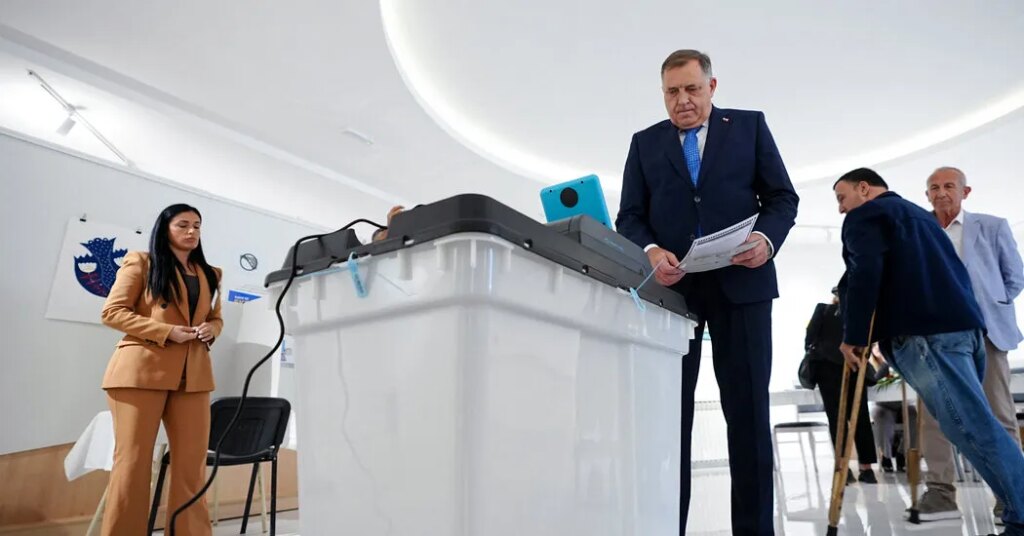
As President Trump crisscrossed the country last week trying to help his party avoid a blowout in next month’s midterm elections, two of his top political advisers were in the Balkans helping a pro-Russian government looking to tighten its grip on power.
James Blair and Chris LaCivita, who are leading a big-money midterm advertising campaign for the Trump political operation, spent some of the past few days in a small self-governing territory in Bosnia and Herzegovina called Republika Srpska ahead of elections there on Sunday, according to four people familiar with their travels who requested anonymity because they were not authorized to discuss the Balkan work.
The engagement is the latest example of Trump advisers profiting from far-right politicians abroad who have sought favor from the U.S. president while bucking the international community.
Mr. Blair and Mr. LaCivita were paid hundreds of thousands of dollars each through a Washington-based law firm that was retained by Republika Srpska’s government to provide counsel on voting issues, according to two of the people familiar with the engagement. They said the work was for the government and not the nationalist party that controls it, though they are essentially one and the same.
Under the control of that party, Republika Srpska has aligned itself with President Vladimir V. Putin of Russia, while spending heavily to court Mr. Trump and his supporters.
Mr. Trump’s allies have promoted the party’s embrace of Christian conservatism and its resistance to joining the European Union. In the run-up to Sunday’s elections, the party had warned that its hold on power could have been threatened by the debut of voting machines like those that Mr. Trump and his allies continue to falsely blame for his loss in the 2020 U.S. presidential election.
Some delays and technical issues were reported during voting on Sunday. But the nationalist party won convincingly.
In a victory speech late Sunday, Milorad Dodik, the party’s leader and until recently the autocratic president of Republika Srpska, thanked Mr. Putin for his support and credited Mr. Trump’s 2024 victory with creating a favorable political environment, according to media reports.
The Republika Srpska government did not respond to requests for comment about the work or payments for it.
It is not uncommon for political consultants, lawyers and lobbyists with ties to U.S. presidents to offer their services to foreign governments and campaigns.
But it is notable that the trip to Republika Srpska, from which Mr. Blair and Mr. LaCivita returned on Monday, came as they were playing key roles in the Trump team’s efforts to limit Democratic gains and preserve Republican control of Congress.
Mr. Blair, who was the political director of Mr. Trump’s 2024 campaign, left his role as a deputy chief of staff at the White House in the spring to run MAGA Inc., the Trump-backed super PAC expected to spend heavily to help Republican candidates from the $415 million it had in the bank at the end of August. Mr. LaCivita, the co-manager of Mr. Trump’s 2024 campaign, is a senior adviser to MAGA Inc.
Alex Pfeiffer, a spokesman for MAGA Inc., declined to comment on the trip to the Balkans. But he said that during the travel, Mr. Blair and Mr. LaCivita remained fully engaged in the midterm effort of the PAC.
“James and Chris hosted a team call with race captains on Saturday morning to go over recent survey data,” Mr. Pfeiffer said in a text message.
The two men are not the only Trump allies who have accepted payment to help the Srpska government.
Lobbyists and operatives with connections to Mr. Trump and his Republican allies have been paid more than $4 million by the government of Republika Srpska since the beginning of last year, according to records filed with the Justice Department. The influence campaign scored a major victory late last year when the Trump administration lifted sanctions on Mr. Dodik, his family and his aides.
The sanctions were first imposed on Mr. Dodik in the final days of the Obama administration. They remained in effect during the first Trump administration and were supplemented during the Biden administration.
They were punishment for Mr. Dodik having undermined the U.S.-backed Dayton Accords peace agreement. Signed in 1995, it ended bloody sectarian fighting in the 1990s between Bosnian Muslims, Serbs and Croats in the former Yugoslavia. It enshrined Republika Srpska, which is overwhelmingly Serbian and Christian, as one of two political divisions in Bosnia and Herzegovina. And it created a tripartite presidency that governs Bosnia. It consists of a Serb seat, which Mr. Dodik’s party retained during Sunday’s elections, as well as a seat for Muslims, who are known as Bosniaks, and Croats.
Mr. Dodik has been the dominant political figure in Srpska for decades. Once considered a moderate who would de-escalate sectarian tensions, he largely fell out of favor in the international community as he increasingly embraced Serbian nationalism and Moscow.
Mr. Dodik’s allies have sought to cast him as a sort of Trump of the Balkans. They present him as the victim of the same sort of political prosecutions that Mr. Trump claims he and his allies have faced, and as someone willing to cut lucrative deals with Washington.
Mr. Dodik also was convicted by the Bosnian court system for disobeying the international entity overseeing the Dayton agreement, resulting in his removal as president last year and a ban from holding office.
But the support of Trump allies and the lifting of the sanctions has helped Mr. Dodik and his party weather domestic and international pressures that could have weakened him, said Adnan Cerimagic, an analyst at the European Stability Initiative, a Berlin-based think tank.
“Not only did it provide him legitimacy with the voters of his party — it has also strengthened him politically against both inside and outside critics,” said Mr. Cerimagic.
He noted that Mr. Trump’s eldest son, Donald Trump Jr., visited Srpska in April as the guest of Mr. Dodik’s son, a trip that was viewed as a sign of support. And Zeljka Cvijanovic, a member of Mr. Dodik’s party whose hold on the Serb seat in the Bosnian presidency was affirmed by Sunday’s election, met last month at the White House with Susie Wiles, Mr. Trump’s chief of staff.
The meeting was arranged by Alex Garcia, a lobbyist who worked on Mr. Trump’s 2024 presidential campaign under Mr. Blair, according to two people with knowledge of the circumstances behind the meeting.
Mr. Garcia, whose firm registered to represent Srpska in February for $35,000 a month, according to a contract filed with the Justice Department, was in the region for the election, according to two people familiar with the trip. He declined to comment through a spokeswoman.
Any affiliation with Mr. Trump is politically potent in Srpska, said Rod Blagojevich, the former governor of Illinois, whose family is of Serbian descent and whose firm has been paid $1.325 million by Republika Srpska since last March, according to lobbying filings.
“They love Trump in Serbia and Srpska,” Mr. Blagojevich said in an interview. “Being pro-Trump in the Republic of Srpska is a huge political plus.”
The post Amid Midterm Crunch, Trump Advisers Took Time to Help Russia-Aligned Government appeared first on New York Times.