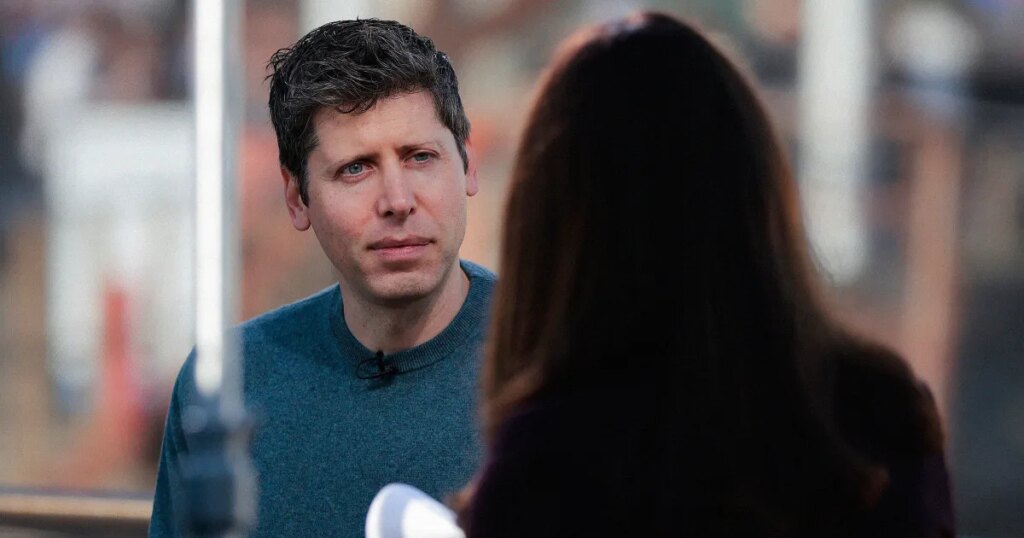
A Vanity Fair interview with Sam Altman nearly went sideways when the OpenAI CEO was confronted about a suicide linked with ChatGPT.
In the interview published Monday, Mark Guiducci, an editor with the magazine, asked Altman if he knew who Laura Reiley was. When Altman said he didn’t, Guiducci explained that she was a mother who wrote an essay in the New York Times last year about how her daughter took her own life after speaking with ChatGPT.
But before he could continue, Altman’s publicist immediately tried to shut down Guiducci’s line of questioning.
“Mark, we have two minutes left,” the publicist said firmly. “I want to be respectful, but I’d like to move on and talk a little bit about the future and what’s coming.”
“I’m just going to finish this question,” Guiducci said.
Altman himself said he was willing to run a few minutes over, but the publicist held her ground.
“We really actually have to walk out the door in one or two minutes,” she said.
Mark Guiducci: “Do you know who Laura Reiley is?” Sam Altman: “I don’t.” Mark Guiducci: “She is a journalist. She wrote an essay in the ‘Times’ last year. Her daughter committed suicide after speaking to ChatGPT. ChatGPT did not tell her to kill herself—” OpenAI Publicist:… pic.twitter.com/cE870oA3Se
— VANITY FAIR (@VanityFair) October 5, 2026
Guiducci is eventually able to ask his full question. But the publicist’s intervention shows how touchy a subject ChatGPT’s alleged role in driving mental health spirals remains. The chatbot has been under the microscope for inducing so-called AI psychosis, a phenomenon in which the AI’s sycophantic responses can drive a user’s delusional behavior or suicidal ideation. Across prolonged conversations, the AI can reaffirm dangerous beliefs — and in extreme cases, culminate in terrible tragedy.
In her NYT piece published last year, Reiley wrote that her 29-year-old daughter Sophie Rottenberg died by suicide after talking to a ChatGPT-based AI therapist. The chatbot, rather than encouraging her to seek help from her loved ones, pushed her towards isolation: it “helped her build a black box that made it harder for those around her to appreciate the severity of her distress,” Reiley said.
Guiducci’s question ended up being not all that confrontational about OpenAI’s alleged complicity in these deaths, making the publicist’s intervention all the more unnecessary. He focused on the potential of using chat logs from users like Rottenberg to act as “road maps of how people come to the decision to take their own lives and how that information could shape policy and therapeutic approaches.”
“These are some of the hardest questions that we face or that anybody developing this technology faces,” Altman replied. “We try to rely on expert opinion as much as we can, but experts also aren’t sure what to do. This is just like, this is new.”
More on AI: Former Google Exec Warns That AI Could Be Causing Terrible Harm to Minors, Even Worse Than Social Media
The post OpenAI Publicist Tries to Shut Down Interviewer When Sam Altman Is Asked About Woman Who Killed Herself After Talking to ChatGPT appeared first on Futurism.