I grew up in Cairo under Hosni Mubarak, who had ruled for longer than I had been alive. I was 15 when the revolution erupted in January 2011, a high school student just coming into political consciousness as the streets around me cracked open with possibilities for otherwise futures.
Two years later, politics had permeated our homes, our friendships, our classrooms, our morgues. In July 2013, the military, led by Gen. Abdel-Fattah el-Sisi,overthrewMohamed Morsi of the Muslim Brotherhood, who was Egypt’s first democraticallyelected president. Over the following weeks, Morsi’s supporters camped and protested in eastern Cairo near the Rabaa al-Adawiya mosque. In August 2013, the military and police opened fire on the protesters in what came to be known asthe Rabaa massacre. The father of a dear friend was among those killed.
Enraged, I joined the street movement against the coup. On Oct. 6, 2013, I was arrested at a mass protest near Tahrir Square and spent the next six years and three months as a political prisoner. Released by a chance miracle in 2020, I fled Egypt for the United States.
Gen. el-Sisi crowned himself field marshal and president and continues to rule Egypt. The revolution has beencrushed, tens of thousands remain imprisoned, and economichardship has broken the backs of Egyptians. When I look back at my country, I see an Egypt structured by ghosts: four relentlesshauntings that explain what has become of the country in the wake of those fleeting blue mornings in January 2011, when we were last touched by a dream.
That bridge in Cairo
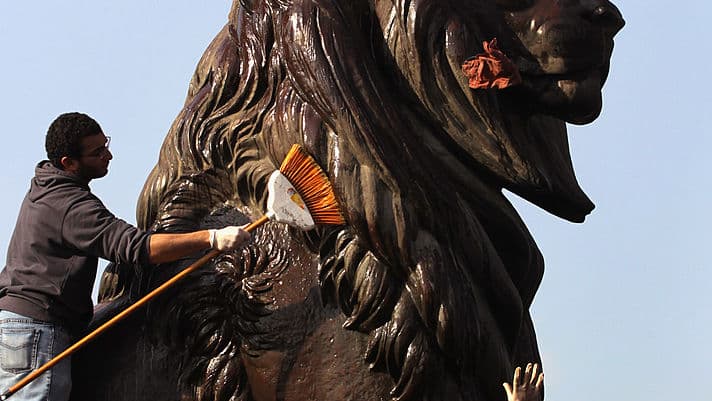
Something always draws me back to Qasr El-Nil bridge. Even in my prison cell, I often closed my eyes and returned to the faded bronze of the two lions at its threshold. To Jan. 28, 2011, the “Friday of Rage,” three days after the spark of the Egyptian revolution. Specifically: the famous video ofclashes atop the bridge between protesters and police.
Throughout the clip, security forces push the protesters back; armored vehicles accelerate to drive bodies back. Tear gas canisters sizzle through the air, leaving cloudy trails as they sail toward the advancing sea of bodies. Water cannons slam into protesters, catapulting them backward. Rubber bullets crack bones.
Yet something wondrous keeps happening: each time the police push the protesters off the bridge, the protesters surge forward again. And each time they return, they push and trespass farther. Push. Return. Trespass. Push. Return. Trespass. Until something ruptures: the masses start running not away from but toward the forces.
And you can tell that everyone on that bridge feels the rupture rip through the air, because for a split second, even the police freeze, confounded. And once the rupture takes hold, the soldiers—those who have never been run toward—turn and flee. The crowd erupts—cheering, screaming, cursing—as if shocked by the very movement of their bodies, the bodies they have always moved but have never moved this way before. This is the second haunting. I begin with the second because I write from and toward the rupture.
The eagle family
To grasp Egypt’s ghosts today, we must understand its first haunting: the Eagle Family. Since the Free Officers overthrew the monarchy in 1952, Egypt’s political order has remained, in practice, under military rule. Officers emerged from that coup as the architects of the new state and cast themselves as the custodians of its national interest.
The military’s authority has beensanctified over seven decades, and that exalted status extends to the broader security apparatus: police, prosecutors, judges, and intelligence officers. Together they form the Eagle Family, named after the emblem on the Egyptian flag that also adorns officials’ uniforms. The eagle became shorthand for an implicit social contract: those who bear it personify the nation; those outside its ranks are expendable.
Then, the expendable subjects rose up in revolt on Jan. 25, 2011. After decades of repression, Egyptians were shaken by the brutal 2010 torture and killingof Khaled Saeed, a 28-year-old from Alexandria, who the police claimed had died after swallowing a packet of drugs. The photographs of his bashed-in face surfaced online, and the images became one of Egypt’s earliest cases of social media virality, igniting public outrage that helped coalesce into the uprising that ousted President Hosni Mubarak. The revolution was anunthinkable event: one that fundamentally contradicted the ruling order’s conception of the relationship between civilians and eagles.
As protests intensified, state media unleashed a frenzied smear campaign, casting Egyptian protesters as foreign agents and outside agitators. State mediaclaimed that revolutionaries had been trained by Israel and tied them, simultaneously, to the United States, Iran, Hamas, al-Qaeda, the Muslim Brotherhood, and international NGOs. State media outlets even circulated the absurdaccusation, laterimmortalized as a running joke, that protesters were being fed and financed by Kentucky Fried Chicken.
Protesters went on to torch police stations across the country,overrun national security headquarters in multiple governorates,storm torture chambers, andunearth archives of horror and abuse. The headquarters of theNational Democratic Party was setablaze. Founded by Anwar Sadat in 1978 and led by Hosni Mubarak from 1981 until 2011, the party had long dominated Egypt’s political system as its de facto ruling party. Its headquarters were left smoldering on the banks of the Nile.
To the Eagle Family, these scenes were sacrilege. Their untouchable status was profaned before millions. And by whom? Lowly civilians. The “Friday of Rage”, and especially the clash on the bridge, remains an open wound in the Eagle Family’s psyche, feeding its fury, fears, and insatiable hunger for revenge. Since then, the one-way street has become a two-way street: the Eagle haunts the civilian; the civilian haunts the Eagle.
The founding massacre
Between Mubarak’s fall and the 2013 coup, military violence resurged. The Supreme Council of the Armed Forces, while posturing as the guardian of a democratic transition,governed through massacres and military tribunals. When the Muslim Brotherhood’s Mohamed Morsi won the 2012 elections, the Brotherhood provedincompetent to govern a fractured nation under the shadow of a military establishment that had never surrendered real authority.
By mid-2013, massdisillusionment with the Brotherhood provided fertile ground for a military comeback. Demonstrators filled the public squares, demanding early elections. The military and police, who saw the Brotherhood as their archenemy, openly backed the anti-Morsi demonstrations and even recruited participants. Theirbacking attracted hordes of counterrevolutionaries and Mubarak loyalists. On television, I watched officers carried and celebrated by the crowds as saviors. And in July 2013, Gen. el-Sisi, the minister of defense, staged a coup and took over the country.
From the first moment, the 2013 coup regime hurled itself toward a singular goal: the eradication of every possible reminder of the January 2011 rupture. One of its earliest preemptive spectacles of violence became our third haunting: the Rabaa massacre.
On Aug. 14, 2013, security forces stormed the Rabaa al-Adawiya Square in eastern Cairo where supporters of Morsi had entrenched themselves in a sprawling sit-in demanding his reinstatement. Police bullets seared flesh, shattered skulls; the air filled with thuds, shrieks, and the hiss of flames. The Egyptian police and military, killingat least 1000 protesters, committed what would be recorded as one of the deadliest massacres in modern Egyptian history.
Rabaa ended the Arab uprisings. The regime transmuted its coercive force into political legitimacy through the spectacular destruction of dissident bodies, restoring reverence for the Eagle. For the Brotherhood, Rabaa became the definingcatastrophe of its post-2013 political memory, upending its organization, self-conception, and belief in its own permanence.
Some secular activists say they are stillhaunted by how the militaryexploited them, even as they now find themselvessharing prison cells with the very Brotherhood members they once opposed. The deep state had appropriated their opposition to the Muslim Brotherhood,redeploying it as justification for the massacre.
Most disturbing were those whocelebrated the killings:artists,media figures, and segments of thepublic who blessed the dispersal in the name of stability or anti-Brotherhood conviction. Once one blesses mass killing, there is no going back: they must continue to sanction the violence they had endorsed again and again.
Today, Egypt’s prisons hold no fewer than60,000 political prisoners. Thousands have spent more than a decade behind bars for a passing protest, a stray chant, or a post on a screen. Hundreds have died undertorture, inovercrowded cells, or from medicalneglect. Thousands have been swallowed byenforced disappearance. Most of those with release orders are denied their freedom and held in prison on new, fabricated charges.
Egyptian media operates under a single,unchallenged state voice; independent outlets aresuppressed or banned; journalists faceunending detention. Television and cinema have been converted into instruments of state-managedproduction geared toward “patriotism,” the eradication of any mention of the revolution except as a catastrophe, and there-sanctification of the Eagle Family through propaganda shows.
When even an unregulated utterance can end a life, and when such utterances are made to go unwitnessed, what remains? What meaning can sacrifice ever hold again? The force that keeps this machinery running with such ruthless efficiency is, in my view, the fourth and most defining haunting of contemporary Egypt: political prisoners as state-manufactured ghosts.ghosts.
Manufacturing ghosthood
These ghosts haunt me. Recently, I wanted to write again about my incarcerated best friend,Ayman Moussa. Ayman was 19 when we were arrested at the same protest in 2013, tried in the same case, and handed the same 15-year sentence. He is 32 now; the bars have swallowed his entire twenties.
I had run out of new pictures of him to post. I have posted every iteration: laughing at a joke he might no longer recall, staring to the right as if something has just escaped the frame, doing a backflip, doing a handstand, doing a silly dance at his prom with his feet in the air, moving in that way he moves, as if gravity never learned his name. But his face, his frozen face, has reached a point where it has saturated the minds of onlookers, no longer catching anyone by surprise.
I am lucky. I carry contraband memories of him that the world has no access to. I remember the soft migrations of his features, the new edges and lines, the ones etched into our faces when prison time pressed too hard against our skin. I caught myself thinking of the nearest anniversary and realized I was writing eulogies. I was mourning Ayman, and I was tired of mourning him when he is here. He is here, right across the wall. He is not a ghost; he has been ghostified.
Ayman is but one of over 60,000 lives behind bars. There’s a famous Egyptian prison prayer that goes: “Lift this suffering off us, us, us, us, us, us, O God!” A prisoner would yell it from the opening in his cell door, and the whole cell block would shake in unison: O God! This call-and-response always fascinated me in prison. The lifting was assumed, God was the obvious entity being addressed, but what mattered most was the us, us, us. A prayer seeking—more than divine deliverance—to be witnessed. A prayer of ghosts.
Ispent over six years standing at the same cell doors myself, shuffled from jail cell to pretrial detention center to maximum-security prison. I know something about the seething despair that settles in when your years dissolve before your eyes and the outside world moves on without you. Locally, almost no one dares utter your name. You see friends sent for release only to berecycled into the same machinery on new, fabricated charges; you watch your prison mates die one after another.
Abroad, you open the state newspapers and watch the military regime imprisoning you receive extensive financial and political support from the United States government, primarily to serve the objective of maintaining Israel’s security and enforcing the siege on Gaza. You watch the European Union announce a $8.3 billionpackage for Egypt meant to incentivize its regime to curbmigration and guarantee E.U.security. You understand, inside your cell, that your body carries no value against the interests that make the regime holding you useful to others; that those others are, in fact,invested in your crushing.
In the official lexicon of the state, political prisoners do not exist. Egyptian officials have repeatedlyinsisted that they have no prisoners of conscience. Within Egypt, then, to speak of political prisoners is to enter a linguistic vacuum, mark oneself as suspect.
Over time, the knowledge of the thousands held in cells, disappeared into detention sites, or trapped in unending pretrial detention begins to discipline public conduct by way of anticipation: people train themselves not to know. Paradoxically, this kind of cognitive dissonance is possible precisely because of the saturation of public awareness with this knowledge and the hefty costs of acknowledging it. Because to acknowledge the ghosts is to risk becoming one.
To the bridge in Cairo, I return
I have had a ritual since 2013: on the eve of each anniversary of the revolution, I take out my copy of Egyptian poet Mostafa Ibrahim’s poetry collection, Manifesto, and recite it from cover to cover. Published in the wake of the 2011 revolution, Manifesto has become a kind of literary scripture for many of the politically engaged members of my generation. Ibrahim moves through the splintered dreams, among comrades who once shared a square, a sidewalk blanket, and a barricade. In the quiet of the night, I let its lyricism hold me, and I mourn. I always return to one iconic poem about Tahrir Square, “So-and-So.”
So-and-so: I never learned
his name, so I called him
cousin, and that was
enough.
The anonymous “so-and-so’s” continue until the end of the poem, and I cannot stop thinking about how, at the time of writing that poem, each was flesh and blood: a face we could summon from memory, a stranger turned friend whose number sat in our phones. Now, it has become a poem of ghosts that calls forth immense pain.
Yet, every year, I sit by my copy on the night of January 25 and choose the haunting. We are haunted not by romantic nostalgia, but by the ephemeral moment when the unthinkable became thinkable. When we were shocked, then giddy, at the chants tumbling from our lips, daring and transgressive as if each were testing the limits of the possible. In her 1996 memoir, The Stillborn, Arwa Salih, one leader of Egypt’s 1970 student movement, speaks wistfully about the naïveté her generation felt whenever they recalled the revolutionary rapture of their crushed movement. “But I find far harsher,” she writes, “the hand dealt to the generations who never got to know such abundance.”
We were intoxicated by revolution. We understood that we were, forever, of the rupture, so we embraced it, and when we embraced it, the rupture held us back. And for a fleeting moment, we could imagine otherwise. I am blessed to have known such abundance. I accept the haunting. I embrace the ghosts of defeat.
And so, I argue for a counter-haunting, one that pierces openings beyond the Eagle-controlled pores, letting the unsanctioned ghosts seep through. The state’s machinery is built to erase the memory that another world was—and therefore is—possible. Our task is to summon the tender ghosts of revolution, to do justice to the ghosts of state massacres, and to unghost, unpast the us, us, us banished behind bars.
I know how difficult it is to remain held open in taut receptivity. It is often draining, even for someone like me, who shared the handcuffs and the prison cell. But it begins here, haunting our way back to the bridge.
The post The Ghosts That Haunt Egypt appeared first on TIME.