The expanded political map for this year’s midterm elections has sharply increased the demand for polling, straining the call centers that conduct surveys, squeezing capacity and complicating the already difficult task of getting accurate reads on public opinion, according to pollsters.
“It’s like doomsday,” said Landon Wall, a Republican pollster and founder of GrayHouse, noting that his firm rotates through three different call centers depending on capacity constraints.
“It’s the most stressed I’ve ever been in my entire career. We are medium-sized. We do millions of dollars of polling. But even that does not mean we have the volume to book things out.”
“There are races coming online that should not have been,” said Brent Buchanan, founder and CEO of Cygnal, a prominent Republican firm. ”When you planned out how many polls you were going to need in a year, you’re polling in places you weren’t expecting to poll, or polling at the frequency you weren’t expecting to poll, and this is on both sides.“
”For Democrats, it’s more opportunity. For Republicans, it’s more defense,” he said.
As the fall campaign has moved into its final weeks, the pace has become so intense that pollsters describe staying up late to release surveys, waking up and doing it all again, barely stopping in between for coffee. “We are doing it over and over and over and over again,” said one research firm executive. “It’s relentless.”
One firm told The Washington Post it had been forced to turn down business. And because certain areas have become more time-consuming to poll accurately, the process is taking longer, and labor costs are rising.
The challenges come at a worsening political moment for President Donald Trump and his party. Just 27% of voters surveyed by the Economist/YouGov in late September said the country was headed in the right direction, even as the poll showed that Trump retained 91% approval among supporters of his Make America Great Again movement.
The demand for more polls to keep up with rapidly evolving races may be worsening the problem of obtaining a representative group of voters willing to participate.
“Even if you increase capacity, you’re getting a lower return per hour of calling now than you were two years ago,” Buchanan said. “I think a decent portion of it is, one, the emotional mood of the country, that you have a segment of folks who are just fired up and angry and willing to answer any call, but they don’t represent the electorate as a whole, and you have a lot of people that are discouraged, and that doesn’t make you want to answer a phone call and have a conversation about a political race.”
In many of the places now attracting increased attention, pollsters say voters are tired of being surveyed and increasingly reluctant to pick up the phone. Even text-message surveys, which place smaller demands on people’s time, are proving challenging.
The problem has become severe enough in some states to make polling substantially more difficult and expensive.
According to a document reviewed by The Post, one of the country’s largest survey-data-collection firms has told clients that, in at least one region, many of its agents are able to get just one completed interview per shift — sometimes fewer.
Alaska, the sprawling and sparsely populated battleground that could decide control of the Senate, has been particularly difficult, pollsters said.
In South Texas, a notoriously low-turnout area, several statewide races are dominating the airwaves, and numerous polls are in the field, compounding the problem of finding voters who will respond.
These difficulties have led some Republican consultants to question whether polling is accurately capturing the standing of candidates.
“Should you be concerned about accuracy of polling going into November? Absolutely, yes,” said Wall. “There are so many signs that the polling is really low quality right now.”
One much-discussed issue is what pollsters call non-response bias — the tendency of enthusiastic voters to more readily respond to polls than discouraged ones. How much that affects the accuracy of polls is almost impossible to know until after the fact: Among other complicating factors, voters who are too disheartened to answer a survey may also be unlikely to cast a ballot.
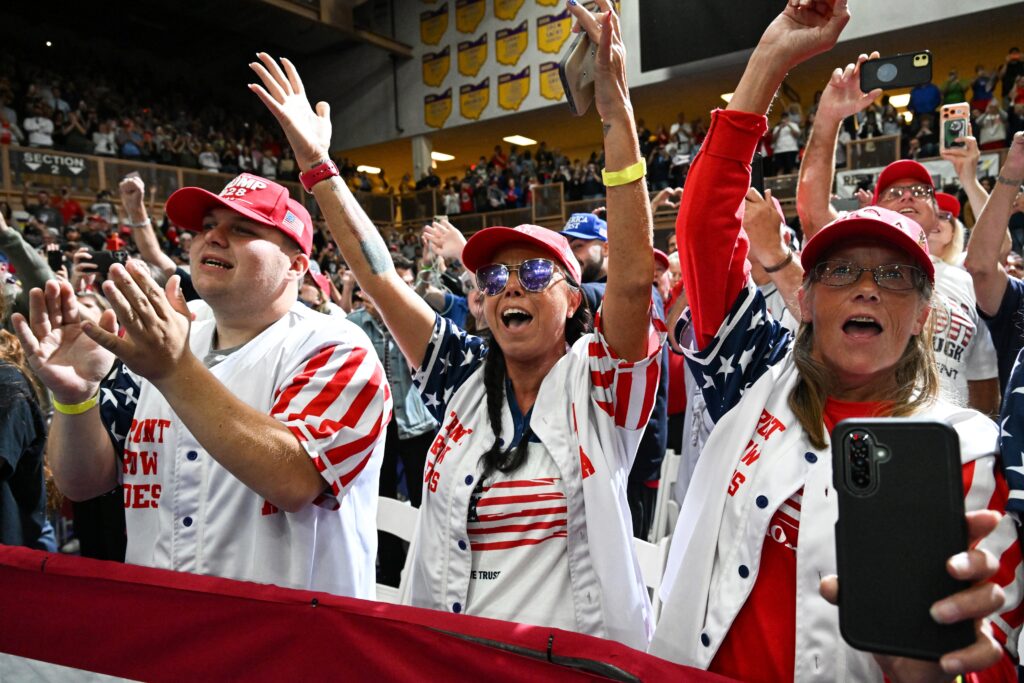
White House and GOP officials say that encouraging Republican turnout is the core of what Trump will be seeking to do over the campaign’s final weeks.
“President Trump is the unequivocal leader, best messenger, and unmatched motivator for the Republican Party, and he is committed to maintaining Republican majorities in Congress,” said White House spokesperson Davis Ingle.
“While Democrats squabble over the last two cents their party has to spare and throw in the towel on key races, the president is barnstorming the country, energizing our base, and supercharging Republican candidates in battleground districts and beyond,” said Republican National Committee spokesperson Natalie Baldassarre. “We have the resources to spend, and Republicans are full steam ahead to protect and expand our majorities.”
As Trump makes stops intended to bolster Republicans in key races, his outside political operation is also spending heavily on advertising, with about $96.6 million spent since Labor Day and another $89 million reserved through Election Day, according to data from media tracker AdImpact.
As the White House ramps up money and travel, the possibility that surveys are overrepresenting enthusiastic Democrats has emerged as a nagging worry for consultants on the left and a remaining hope for Republicans.
Some Republican strategists say they are seeing signs that the deterioration has begun to level off in certain states, even if the political environment remains difficult for the party.
“I don’t see it slipping anymore,” said David Kochel, an Iowa Republican political strategist who saw movement through July in the state when gas prices were weighing on consumers.
“It’s kind of stabilized, and stabilized in a fairly uncomfortable place for Republicans,” he said, “but I don’t think it continues to move.”
Isaac Arnsdorf contributed reporting.
The post Another sign of rapidly expanding political map: Pollsters can’t keep up appeared first on Washington Post.