The failed execution of Christa Pike has spurred the resignation of Tennessee’s prison chief, left Ms. Pike in critical condition and put renewed attention on the methods by which capital punishment can be carried out.
The unsuccessful attempt to end Ms. Pike’s life with a lethal injection infuriated the mother of her victim, a 19-year-old named Colleen Slemmer, who said the state had failed to deliver justice when two doses of pentobarbital left Ms. Pike alive.
Most modern executions in the United States — those that took place after 1976, when the Supreme Court ended a nearly 10-year moratorium — have been carried out by such injections, sometimes using a single drug and sometimes a combination. Lethal injection was introduced as a more humane alternative to hanging or the electric chair, although some who oppose the death penalty argue that it brings the veneer of a medical procedure to what can be a painful death.
As pressure on drug companies and legal challenges to capital punishment have made purchasing drugs for lethal injections more difficult, some states have authorized additional methods. Some, like nitrogen hypoxia, are new, while others, such as the firing squad and electric chair, hark back to earlier eras.
The United States was among 17 countries to carry out the death penalty last year, according to Amnesty International. Twenty-seven states still have the death penalty on the books, although only 16, plus the federal government, have carried out an execution in the past decade.
Recent polls have shown that a majority of Americans support capital punishment, though that support has declined in recent decades.
In Tennessee, Senator Marsha Blackburn, who is the Republican candidate for governor, has called for using the electric chair more often. Death penalty opponents — including the Democrat running against her — have used the botched execution of Ms. Pike to call for halting capital punishment altogether.
Jonathan Groner, a retired professor of clinical surgery at Ohio State University who has studied the death penalty, said he believes states want executions to look as much like medical procedures as possible, in part to avoid turning off the public.
“If a lethal injection goes smoothly, it looks just like outpatient surgery,” Dr. Groner said. “If there was not some kind of medical aura to capital punishment, we might not be doing it.”
As states seek to carry out death sentences, they have weighed the particulars of various methods, including the potential for problems in carrying out the execution and the impact on public opinion.
Lethal Injections
About 89 percent of the executions since 1976 were carried out by lethal injection, according to the Death Penalty Information Center, which tracks executions.
The first was carried out by Texas in 1982, when Charles Brooks Jr. was killed at a prison in Huntsville for his role in the murder of a mechanic, David Gregory.
In Ms. Pike’s case last week, experts said the lethal drug might have entered tissues around the places where the executioners inserted the needles, rather than her bloodstream. That could have harmed her, but left her alive because not enough of the drug was in her circulatory system to kill her.
Even in 1982, effectively inserting an intravenous line was a known challenge. The Texas prison system’s medical director said he had personally checked Mr. Brooks’s veins on the morning of the execution.
Since then, states and the federal government have experimented with mixtures of drugs as they have carried out nearly 1,500 more lethal injections.
The federal government used a three-drug protocol of a barbiturate, a muscle relaxant and a deadly amount of potassium chloride when carrying out three executions from 2001 to 2003. When President Trump revived federal executions in his first term, the Justice Department used a single drug, pentobarbital, the same barbiturate Tennessee used last week.
Other states have used other combinations. Several use midazolam, a sedative that is supposed to reduce prisoners’ pain as they are killed. The Supreme Court ruled in 2015 that the drug could be used in executions, though its use has been challenged by lawyers who say that it has caused prisoners to suffer unnecessarily.
Electric Chair
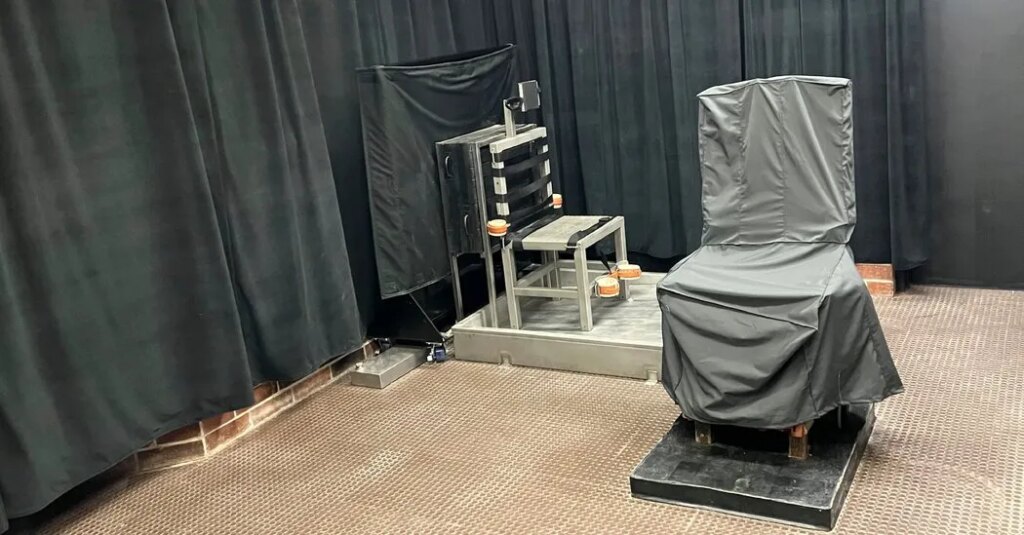
Before lethal injections, electrocution was the most common method of execution.
America’s use of the electric chair stretches back to 1890, when William Kemmler was put to death at a prison in Central New York for killing his partner, Matilda Ziegler.
That electrocution did not go smoothly, with the prisoner making noises after he was supposed to have been fatally shocked. He was eventually pronounced dead, but one doctor involved predicted — incorrectly — that the method would not be used again.
Instead, the chair continued to be used even after lethal injection was introduced. In the past 50 years, at least 163 people have been executed by electric chair, with the most recent taking place in Tennessee in 2020.
Several electrocutions have led to disturbing scenes, including prisoners who caught on fire.
Tennessee allows prisoners who were sentenced before 1999 to choose the chair.
Virginia has also used the electric chair as recently as 2013, though the state has since abolished the death penalty.
Deadly Gases
The latest method of execution in the United States is nitrogen gas, which replaces oxygen in a breathing mask and suffocates the prisoner. This method was pioneered by Alabama in 2024, when it executed Kenneth Smith, who was one of three men convicted in the stabbing murder of Elizabeth Dorlene Sennett in 1988.
Alabama said that other states could mimic its protocols. So far, only Louisiana has, executing one man that way last year.
Alabama and Louisiana prison officials said their executions had followed protocol, although several witnesses reported being disturbed by prisoners’ convulsions after the gas began flowing.
Alabama has used the method on six other men since Mr. Smith’s execution. But in June, the Supreme Court blocked the state from using it on another inmate after a lower court found that the state’s protocol was more likely than not to inflict cruel and unusual punishment. The state has since returned to using lethal injection.
Some states have employed other gases to kill prisoners, including North Carolina and Arizona, which used cyanide in 1998 and 1999.
California, which has not executed anyone since 2006, also used gas in two executions in the 1990s.
Firing Squad
Five states authorize firing squads, though only two states have deployed them in modern times. South Carolina executed three people last year by firing squad, while Utah last executed someone by firing squad in 2010.
A law went into effect this year in Idaho that makes the firing squad the state’s primary method of execution. It follows the state’s failed execution of Thomas Creech by lethal injection in 2024.
In April, the Trump administration authorized the use of the firing squad in federal executions. Mississippi and Oklahoma both allow firing squads, but only if other methods are unavailable.
Many people consider the firing squad to be the most effective method, though it is inherently bloody — and not without problems. Lawyers for one man killed by firing squad in South Carolina last year accused the shooters of missing the target on his heart, prolonging his death.
The Gallows
Common in some of the few countries that carry out capital punishment, hanging has not been used in the United States since 1996, when Delaware executed a man with the rope.
That was only the third hanging in the United States since 1965. The other two were carried out by Washington State in the early 1990s.
In earlier hangings, errors in the length of the rope or the mechanism of the hanging led to people dying a slow death or being decapitated.
The post Why These 5 Methods Used in Executions Have Stirred Debate appeared first on New York Times.