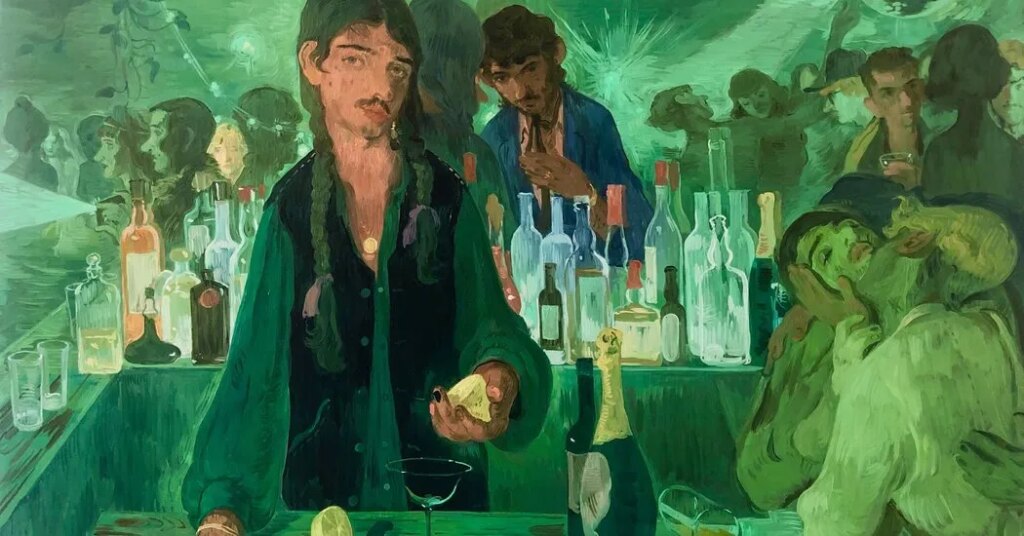
Perhaps your eye will be drawn by the infinite shades of green on green — seafoam, viridian, chartreuse, mint, pine, you name it — that make Salman Toor’s canvases radiate an otherworldly luminosity.
Or maybe you’re pulled in by how the figures, alone or in groups, seem to undulate softly. If you’re an art buff, you might delight at how gestures and compositions are borrowed from historical works, suggesting that to paint is always to participate in a kind of quotation.
Whichever way, “Salman Toor: Someone Like You,” an exhibition at the Courtauld Gallery in London, contains many seductive visual worlds: personal and painterly, past and present. It is the New York-based Pakistani artist’s first solo show in Europe and a rare dedication of the Courtauld’s modest temporary exhibition spaces to a living artist.
The presentation focuses on narratives, and the accompanying descriptions frequently describes the paintings as “stories.” Toor himself has emphasized the importance of knowing that his subjects are queer immigrants with tales behind how they appear. In his paintings, figures not usually given prominence in Western portraiture are in the forefront, attaining the dignity and solemnity that the genre affords.
Across 19 paintings of varying scale that Toor produced from 2019 to 2026 — a period during which the 42-year-old artist’s star has been on the rise — we see predominantly young men: together, alone, drinking, dining, carousing, opining.
In “Lunch,” a buoyant tondo (a round format popularized in the Italian Renaissance), three bons vivants in elegant, dandyish clothing sit together over a modest meal. I want to say it’s plates of spaghetti, but Toor’s line is so fluid that as soon as you think you see something, it slips away.
The men are painted in a similar palette of murky greens and yellows, shades that continue in two other works on show, “Man With Face Creams and Phone Plug” and “Citizens.” Those portraits, which are also of slender, brown-skinned men, at first seem similar — but their bodies are rigid and self-aware, and the atmosphere is more alienated.
The man with the face creams is looking down at his possessions that resemble a still-life tableau but have — the wall text tells us — been emptied from his bag for enhanced scrutiny at airport security. In “Citizens,” two men, one in a biker cap and the other wearing a clown nose, stand with hands on hearts — a romantic pledge to each other, I thought at first, though the title suggests an oath of citizenship. One clutches a small black flag — a minor protest?
As viewers of Toor’s images, we find our position constantly shifting. Sometimes we behold at a friendly distance; other times, we look on officiously from the perspective of agents of the state — border guards, civic registrars. Often, we are inexorably pulled, by composition, scale and perspective, into the space of the tableau.
It is in the larger and visually messier works that Toor is at the height of his powers. These are also more narratively enigmatic, prompting viewers to see that the how of the painting — the style, palette, texture, brushwork and idiosyncratic highlights — is as essential as the what.
“Three Friends in a Cab” puts the viewer in the back seat, heading out (or home?), with a full moon through the window and three passengers merging in one excited mass. In “The Joke,” a busy restaurant scene with gaping mouths and a drunk guest passed out on the table, shades of Impressionist Paris merge with Weimar-era social critique — or maybe it’s a present-day gallery dinner.
“Fag Puddle With Carriers” is a roiling but eye-pleasing scene, filled with curves and swags. On closer examination, it is dark and strange: It shows a cluster of people carrying a large platter heaped with what appears to be three heads and a tangle of limbs. To tell a story is not only to present something whole, but also to offer an image that is potentially fractured — “a camp comedy of parts and things that don’t make sense together,” in Toor’s words from a wall text.
The painting is inspired by “The Entombment” by Lorenzo Lotto, a 16th-century painting on display in the Courtauld’s permanent collection. There, you will also find Manet’s renowned “A Bar at the Folies-Bergère” (1882), on which Toor has based his “The Bar On East 13th.”
Yet the point of this exquisite proximity seems less about comparison than saying that we see ourselves through art, including through a canon that shapes whether we see ourselves as worthy subjects, or not. Toor’s paintings present this knowledge with love and levity, wearing the past just lightly enough that they seem familiar and yet entirely new.
Salman Toor: Someone Like You Through Jan. 10 at the Courtauld Gallery in London; courtauld.ac.uk.
The post In This Painter’s Seductive World, the Past and Present Meet appeared first on New York Times.