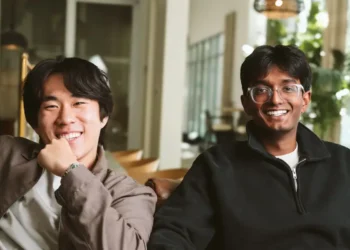
A few months ago, I finally read Helen DeWitt’s 2000 novel, “The Last Samurai,” in which the autodidact child protagonist, Ludo, teaches himself a vast spread of languages before turning 11: ancient Greek, Hebrew, Japanese, French, Arabic, Old Norse and Inuit, among others. Around the same time, my algorithm started pushing clips from Yuji Beleza, a 28-year-old Japanese Irish content creator with 7.6 million followers on Instagram and 11.1 million on TikTok. In his videos, Beleza wanders the streets of a city, susses out who might be a visitor or an expat and hits them with a variation of “Where are you from? I think I can speak your language.” Each subject, at first wary of this filmed intrusion, inevitably warms to Beleza as he eagerly starts a basic conversation in, say, Creole, Azerbaijani, Welsh or one of seemingly dozens of other languages or dialects.
While much of Ludo’s education in “The Last Samurai” is solitary, Beleza’s is seemingly always on display, wide out in the open, camera on. In the first video I watched, which has over 127.3 million views on TikTok, Beleza and three African basketball players slip between English, Japanese, Lingala, Yoruba and Bambara on a neon-lit Shibuya street. And though he might be one of the most viral online polyglots — Qatar Airways and Boss have collaborated with him — Beleza is hardly alone. Polyglot content creators are now churning out a flood of videos across social media. Some recite front-facing monologues through numerous languages, a niche community that most likely started with the #polyglotcheck hashtag during the pandemic. Some follow Beleza’s impromptu “man on the street” mode. Others offer composed interviews with regular-seeming people who just happen to speak, as in one clip, Danish, Spanish, English, Arabic, Portuguese, Swedish, French and Bahasa Indonesia, all with relative ease. A few test out polyglot comedy. This summer, when Mayor Zohran Mamdani posted promotional videos of himself speaking Mandarin, Bengali, Spanish and English, they made similarly viral waves. (The consensus among native Chinese speakers: The mayor’s tones are actually fairly solid.)
Polyglots — loosely defined as people who know at least several languages — are nothing new, nor is our fascination with them. Plutarch wrote that Cleopatra’s tongue was “like an instrument of many strings, she could readily turn to whatever language she pleased.” Both Marx and Engels were polyglots, with Engels claiming that he could understand 25 languages. Paul Robeson, who could perform songs in over 50 languages, spoke more than a dozen, though some claim that it was double that.
On the surface, these polyglot videos feel significantly more wholesome and worldly than a majority of flotsam floating around social media; some creators transmit a nearly enviable top-of-the-class energy. Yet this current trend shares some of the performative optimization of self-help tutorials and productivity hacks that circulate online. (One TikTok post even shows a woman doing her makeup while moving through six languages.) The more extreme end of the multilingualism spectrum — language-maxxing? — turns the endeavor of learning new languages into a completist collecting practice or a vain pseudo-intellectual flex. The spontaneous street interviews, the most viral of the online polyglot modes, aren’t cross-cultural dialogues in any real sense — just thin outlines of a stilted conversation edited down into digestible clips. If the precocious Ludo in “The Last Samurai” is teaching himself languages in order to watch Kurosawa films without subtitles, the online polyglot seems to be learning languages in order to make more clickable content.
Along these lines, there are plenty of detractors. One YouTuber has devoted part of his channel to investigating potentially fraudulent YouTube polyglots with videos like “Does This Carpet Cleaner REALLY Speak 24 Languages?” On r/languagelearning, one Redditor posted that “online ‘polyglots’ are a menace to the language learning society.” On Instagram, beneath a “These online ‘polyglots’ are lying” takedown reel — claiming that these creators are just committing a few key phrases to memory — one commenter naïvely asks, “Isn’t memorizing sounds and responses just speaking a language?” The resulting pile-on meanders through surprisingly philosophical terrain, with commenters chiming in with their own theses on the true nature of speaking, of listening, of understanding, of language itself.
Should these content creators claim to speak a language if they can only eke out a phrase or two, less than a chatty toddler? Probably not. (Beleza says he can speak around five languages fluently.) Are some of them riding their visibility to sell low-budget Duolingo knockoffs in true snake oil tradition? Definitely.
But what makes these polyglot videos so compelling isn’t the authenticity of a given creator’s language skills, but the glimpses of an almost utopian level of cosmopolitanism that are incidentally recorded in the process. Even the creators seem surprised by it. When a woman stops to talk to the creator who goes by Languy, who regularly sets up beneath the Eiffel Tower challenging passers-by to stump him, and casually says she speaks seven languages, effectively turning the tables, he is audibly shocked as they riff through them. How, he seems to wonder, could someone be so multilingual without making any self-promotional online content about it?
Many of the interlocutors in these videos reflect the purposes of learning multiple languages in the pre-internet era: growing up in a multilingual household, assimilating into a new culture or just following genuine curiosity. The polyglot creators, however, live in a different world. If they really wanted to optimize their interactions with foreigners, they could probably do so with the help of any translation app on the phones they’re using to film themselves. But that wouldn’t make for engaging content, with the suspense of whether these two people will really be able to connect.
In another Beleza video, he chats with a young, Ludo-aged girl from Dagestan who lives in Düsseldorf and speaks Arabic, Russian, German, English and Kvanadin, which is thought to have only a few thousand native speakers. He seems amazed not only at the girl’s abilities but also that he has the rare opportunity to learn a few words in an endangered language from her. It’s as if there are real polyglots all around us, whether the cameras are on or off.
The post Are Polyglot Creators Capturing Real Human Connection, or Gaming Social Media? appeared first on New York Times.