Julia R. Cartwright is a senior research fellow in economics and law at the American Institute for Economic Research.
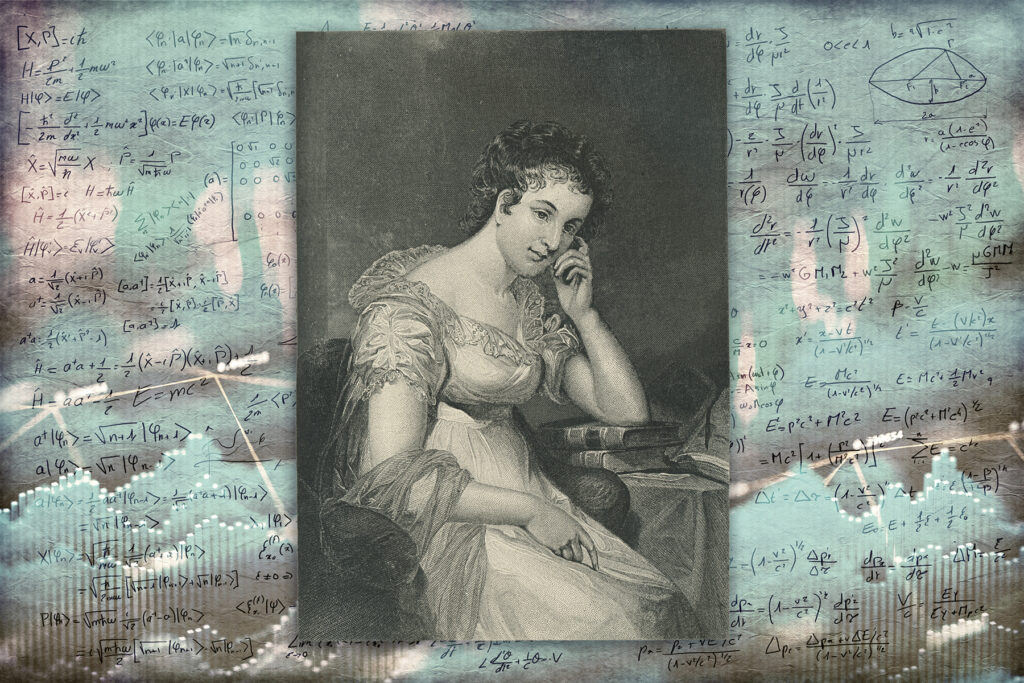
In opulent London salons at the turn of the 19th century, economists including David Ricardo and Thomas Malthus debated trade, famine and the fate of the poor. Among them was Maria Edgeworth, an erudite woman who helped shape how the emerging field of economics reached the wider world. In an intellectual world that offered women few conventional avenues into the discipline, she wrote it into novels, weaving lessons of political economy into the tales of captivating characters.
She arguably reached far more people with her economic ideas than her male counterparts because she translated the otherwise daunting language of thinkers such as Adam Smith into something much more accessible. Maria Edgeworth (1768-1849) is the economist most people have never heard of.
The book “The Invisible Hand of Maria Edgeworth” is about her: how she went from a celebrated literary figure to someone relegated to a footnote in the field of economics. Its author, Jeanna Smialek, a New York Times reporter who spent years translating the Federal Reserve for ordinary readers, is a fitting biographer for a woman who did the same for Adam Smith. Histories of economics usually feature its fathers, whom Smialek keeps as main characters, but the author focuses on the woman standing beside them who believed economics belonged to everyone.
Edgeworth’s story begins with a longing for affection. Her mother died when she was 5, and her father, the restless inventor Richard Lovell Edgeworth, remarried within months. The young girl turned rebellious and was sent away to boarding school, where she felt abandoned. Desperate to return to her father’s good graces, she discovered that writing could win back his affection, and the same gift soon made her the storyteller among her classmates.
The affection she had worked so hard to win returned when he finally pulled her out of school. Maria returned to the family estate in Ireland and rode alongside her father as he collected rent from his tenants. Richard Lovell shortened leases, rewarded tenants who improved their land and, following Smith, paid higher wages on the theory that better pay was good for everyone. He also required his daughter to study “The Wealth of Nations,” among other works, to prepare her to help manage the estate. Between the book and the rides, Maria gained an inside view of the lives of the poor, an experience few ladies of her upbringing ever had.
As a young woman, Edgeworth wrote children’s tales and books on education, and in 1800, she published the novel “Castle Rackrent,” a sensation. At her height, she outsold Jane Austen. Smialek writes that “readers were coming to Edgeworth books for dry quips, rollicking plots, and haphazard love stories, yet they were leaving them with an understanding of tenant-landlord relationships and the benefits of educating workers.” King George III reportedly said that after reading her work, he knew his Irish subjects better.
All of this unfolded in an age of tumult. The French Revolution in 1789-99 and the Reign of Terror in 1793-94 shook Europe, and the Irish rebellion of 1798 came so close to home that local loyalists, suspicious of Richard Lovell’s political sympathies, nearly lynched him. At 34, in 1802, Edgeworth traveled to Paris, where she discovered how famous she had become and turned down a proposal from a Swedish courtier, a decision that ended up leaving her heartbroken.
Her influence and knack for writing about economics for a general audience earned her respect in the field and a place in the rooms where economics was being invented. She befriended Ricardo and followed his sparring with Malthus over trade. She read and critiqued the work of Jane Marcet, whose 1816 “Conversations on Political Economy” became one of the earliest and most influential popular economics textbooks. Where Marcet spoke plainly about economics, Edgeworth hid it in narrative. Together, they helped pave the way for a generation of women to write about the subject.
In her 50s and 60s, as critics soured on her fiction, she remade herself as a political observer and unofficial economic adviser. The Great Famine, which began in 1845, underscored the limits of simple economic prescriptions: As blight destroyed the potato crop, grain and livestock kept leaving Ireland for export, sold to buyers who could pay. The poor had little money to buy food, and markets alone had trouble reaching them. Edgeworth spent her last years working to relieve the starving poor around her.
Her sex was surely a limitation, as “academic women were viewed as subversive, even dangerous,” Smialek writes — but it was also a strength. Largely shut out of the emerging professional world of economics, Edgeworth wrote stories, and they traveled where treatises never could. One could argue that confinement to the novel cost her a place in the canon, but Smialek makes the more interesting case that it is precisely why she mattered: “Maria’s lessons reached every corner of the empire” as “readers across the English-speaking world were exposed to whatever lessons she chose to tuck into her fictional pages: social commentary, ruminations on rent, ideas for improving the lot of the poor.”
Which leaves the question Smialek cannot stop asking: If she was so influential, “why do we hardly know her name?” The cruelest irony is that her name survives in every economics classroom through the Edgeworth box, named for her nephew Frances Ysidro Edgeworth. But Maria, who carried the ideas out of the salon and into the parlor, slipped away.
Return to those rooms where Ricardo, Malthus and other famous men argued over the pressing economic challenges of their time. The diminutive woman among them was part of the exchange, questioning, debating and advancing ideas alongside them. Maria Edgeworth’s name may have faded, but her legacy shaped the field of economics, bringing the dismal science into the lives of ordinary readers.
The post She wrote novels. She also taught the world economics. appeared first on Washington Post.