Last month, the annual day celebrating U.S. citizenship came amid deep challenges for our democracy. The Trump administration has launched an all-out assault on the right to vote, threatening to pass into law new challenges to voter registration that wouldn’t just make it harder for most Americans to make their voices heard, but outright strip tens of millions of people of their ability to vote. Meanwhile, in states like California with significant immigrant communities, Trump has deployed federal agents in an attempt to block naturalized citizens from the ballot box ahead of the midterm elections. He’s threatened to send those same agents to polling locations on election day.
Unfortunately, this all comes from a familiar authoritarian playbook. My family and I fled to Florida from Venezuela, a place where elections are rigged and voters are either openly bribed or threatened with violence by the government. It doesn’t take a political analyst to see that the Trump administration is rapidly taking us to a similar place.
This administration is openly hostile to democracy itself. Officials hope all the intimidation and bullying works, that we stay home and take our right to vote for granted. Well, that just isn’t going to happen.
There are 46 million naturalized citizens living in the U.S. right now — about 5.5 million of them adults in California, which is more people than live in most states. According to a 2025 analysis by the National Partnership for New Americans, more than 8 million Americans obtained citizenship in the last decade alone, myself included. These are families, faith leaders, innovators, caregivers, workers and business owners from nearly every part of the world, all working together to make the fabric of our nation — including our democracy — stronger, richer and more colorful. I know because I’m one of them.
In 2007, the year I graduated from high school, my family and I became undocumented after an immigration attorney mishandled our green card applications.
From that moment on, I could no longer afford to ignore politics and elections. While most kids at Florida State University were busy worrying about weekend plans, I was tuned into policy debates in the state Capitol and Washington that I knew could have a profound effect on my life and the lives of those in my community.
I thought to myself then: One day, I will have the opportunity to make my voice heard — and when I do, I’m going to make it count. Nearly two decades later, I did just that.
Last November, in a special election in California, I cast my first vote. The process was safe and easy, and I could track my vote from beginning to end.
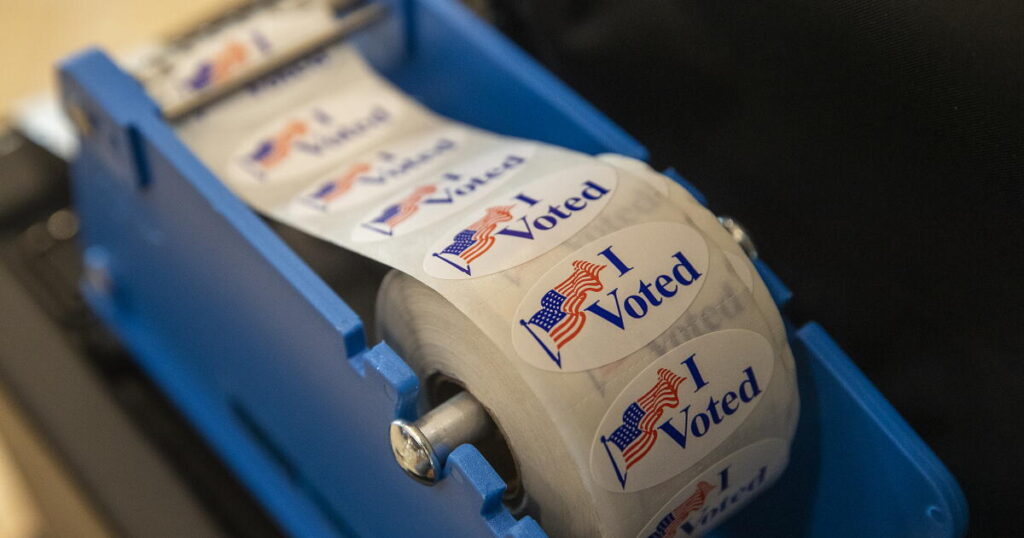
Even after all those years — after graduating from college and becoming an advocate for undocumented immigrants across the country; after moving to Washington, D.C., getting married, and then moving again in 2022 to my new home in Los Angeles — that moment still held more significance than I could’ve imagined, so much so that I made sure to always remember it by framing my first “I Voted” sticker and placing it right by my desk.
As part of the naturalization ceremony, all new citizens must raise their right hand and take an oath to uphold and defend U.S. laws and the Constitution — the same duty that all citizens are tasked with carrying out. Voting is a big part of that duty, whether you vote by mail, in person or at a dropbox. We vote not just in the face of a threat or in response to bullying, but in favor of something greater. Voting is how we defend our democracy, better our communities and express ourselves as a free society.
This November will be my first midterm election, and I, for one, look forward to adding a new “I Voted” sticker to my collection. I encourage all voters, especially naturalized citizen voters, to do the same. There are 16 million of us already registered, with 6.5 million more eligible but not yet registered. Let’s make sure that we make our voices heard and that, again, we do not take our votes for granted.
Juan Escalante is a digital strategist and immigrant rights advocate working with the National Partnership for New Americans.
The post Those who become U.S. citizens have a special relationship to voting appeared first on Los Angeles Times.