A decade ago, Santa Monica was one of California’s economic powerhouses.
Its office parks were home to top entertainment firms. Its beaches and pier were huge tourist draws. And its downtown area boasted a lively mix of high-end retailers and restaurants that made it a regional shopping and entertainment destination.
But the last six years have brought unprecedented struggles to Santa Monica.
A new Rand Corp. study found Santa Monica’s economic struggles began before the pandemic, though COVID-19 worsened them considerably. Although the pandemic brought economic challenges across the country, the study reveals that Santa Monica struggled more than its neighbors, such as Beverly Hills, Culver City and West Hollywood.
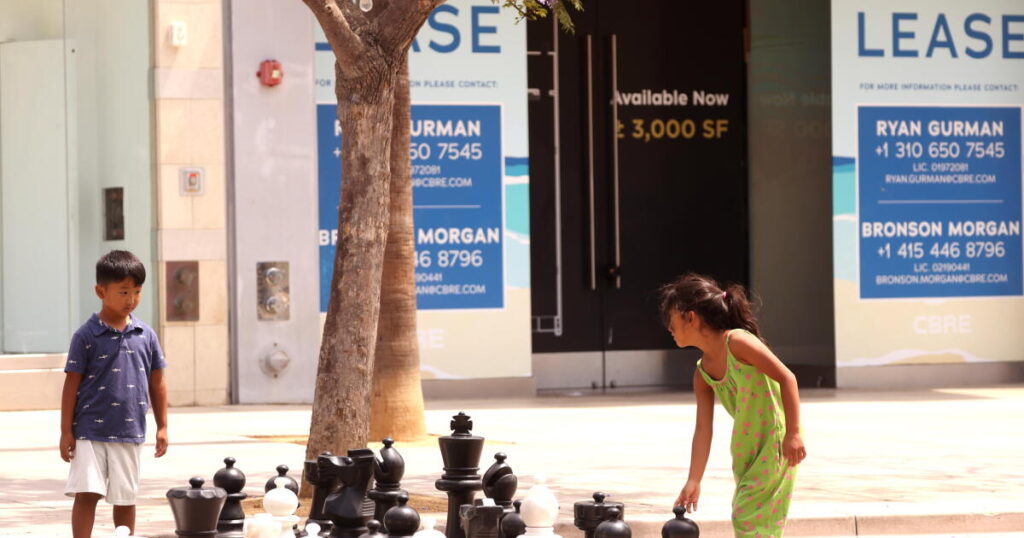
A dramatic exodus of retailers left noticeably empty storefronts at the city’s once-popular shopping centers, and worries about public safety and homelessness plagued the city.
The report found that more than 11% of Santa Monica’s retail space is currently empty, and that about 45% of those empty spaces are in Third Street Promenade and Santa Monica Place.
By comparison, West Hollywood’s retail vacancy rate is 9.2%, and Beverly Hills’ is 6%. In Culver City, 5.2% of retail space is empty.
“Santa Monica’s retail sales revenue never fully recovered to pre-pandemic levels,” the report reads. “This decline occurred in nearly every type of business, though the magnitude varied substantially by business type.”
Santa Monica City Manager Oliver Chi said the Rand report accurately portrays the city’s recent financial woes, and some of the steps it has taken to address them.
“It matches what we saw,” Chi said, adding that the issues highlighted in the report are what prompted the city to launch a realignment plan to turn around the city’s economic outlook. “For the city, we had to decide: Are we going to manage decline, or are we going to more progressively address the moment?”
AJ Sacher, director of operations at Barney’s Beanery, said businesses that have stayed in Santa Monica over the years have seen the struggles build up. For Sacher and other business operators, there’s been concern that services, upkeep and maintenance in the promenade and downtown area have been ignored.
“There’s a lack of investment in the area,” Sacher said. “People don’t want to be in an environment that is in disrepair and, then when you factor in the night, the disrepair starts to look scary.”
For restaurants and other businesses, Sacher said, what draws customers in is the experience, and images on social media and in local news about rising crime and a homeless crisis in the area have kept shoppers from Santa Monica, as businesses have already been struggling with macroeconomic forces.
But the report found that concerns about housing insecurity and crime worsening in Santa Monica are not backed by the data. Instead, researchers found homelessness decreased modestly in 2026, and although assaults and robberies have been elevated compared with the early 2010s, more than 70% of the incidents occur in 5% of the city’s area.
Homelessness and crime, the report found, have centered mostly in the downtown and beachfront areas, “where it is most visible to businesses and visitors.”
The Rand report comes as city officials have touted a plan for an economic turnaround and have recently focused their efforts on pulling the city out of “fiscal distress.” Adding to its financial woes, Santa Monica has also paid a settlement of more than $229 million after a former city employee was accused of preying on children in the city’s predominantly Latino neighborhoods.
The report analyzed data and included interviews with city officials, business owners, developers and other stakeholders. The data underscore concerns leaders expressed in September 2025 when declaring the city in fiscal distress.
Clothing and accessory revenue declined by 75% and food services dipped 24% in 2025 when compared with 2015, according to the report.
The economic decline persists, according to the report, with sales revenue this year still down about one-third from prepandemic levels.
While some cities recovered, Santa Monica’s tax revenue reached just 89% of its 2015 baseline by 2021. That continued to fall, with revenue at about 60% of the 2015 baseline in early 2026. Much of that tax revenue, according to the report, came from large downtown retailers, such as Nordstrom, that left the city.
Beverly Hills, Culver City and West Hollywood experienced steep losses in tax revenues during the pandemic, but the three cities returned to prepandemic sales levels by 2021, the report says. Those cities also saw declines in sales after, but Beverly Hills and West Hollywood saw a smaller impact than Santa Monica did, with a 10% to 15% decline compared with prepandemic levels by the end of 2025.
Culver City, according to the report, saw a 25% decline in sales.
Much of Santa Monica’s struggles came because, for decades, the city’s economy was built on drawing in international tourism, Chi said. But retail habits have shifted and the perception that the city was unsafe increased, prompting city officials to explore how to make visitors and businesses feel more comfortable downtown.
Now city leaders said they are focused on revamping the economy and bringing back foot traffic to the Third Street Promenade — and into the shops that remain — with large events such as concerts and watch parties for sports to lure people and dollars back to the city. The city plans to invest $3 million in the promenade and is beckoning visitors with a new “entertainment zone” that allows people to buy and stroll with open alcoholic drinks between Wilshire Boulevard and Broadway.
Chi said that the $3-million investment is a lot but not enough, and that the city will consider investing more in the area.
Sacher said the entertainment zone and the city’s efforts to use large events as fuel for its economy are a start, but he worries that it’s an effort that could backfire.
“We need the city to look at it as an opportunity to showcase how great the city is, not shocking people to wonder, ‘What happened to Santa Monica?’” Sacher said.
The city has launched a business concierge program to help local businesses navigate city services, such as permitting and other matters, streamlining services.
Mayor Caroline Torosis said the city has cut water and parking fees, limited conditional use permits and is working with businesses to expedite services. The city has increased police foot and bike patrols in the downtown area.
“We agree with Rand that downtown is where we need to focus, and we will keep going,” Torosis said. “Santa Monica is open for business, and our best days are ahead.”
Ryan Hawley, vice president of retail brokerage for JLL Los Angeles and a board member for Downtown Santa Monica Inc., said his and other businesses have already seen some of the changes take effect.
“People are recognizing that the promenade is on the right track,” he said.
He said that there are negotiations for new businesses to move into the promenade and other spaces, and that businesses are more eager to look at Santa Monica once again.
“It’s still a challenge, but I think the thought on the ground has changed quite a bit,” Hawley said.
Businesses have worried in the past that city officials made the process difficult for upstarts, but Hawley said the city has been trying to send out a message that “they’re doing everything they can to shed that reputation.” The city’s previous focus on international tourism had turned away local shoppers and local businesses, Hawley said, but that’s changed in recent years.
“The promenade used to turn its back on locals,” Hawley said. “The locals weren’t welcomed here, or didn’t feel welcomed. They preferred to go to the Lululemon in Pacific Palisades instead of the Lululemon in Santa Monica.”
Debbie Lee, chief executive of Downtown Santa Monica Inc., said there are already signs of hope. Although the Rand study noted a 31% vacancy rate on Third Street Promenade as of August, Downtown Santa Monica Inc. counted 79% of the stores there as leased. Lee said it was common for properties to remain on the market if a temporary tenant occupied them.
The group, a nonprofit that advocates for downtown businesses, also noted an increase of about 19% in average daily visitors to downtown this year compared with 2025.
“The Third Street Promenade of today should not be defined by a snapshot of the challenges of the past,” Lee said. “Businesses are opening, leases are being signed, storefronts are being activated, and people are here.”
The city is also looking at ideas, such as bringing a downtown valet service, to help visitors who struggle to find parking. Officials hope to have their plan in place for shoppers before Black Friday.
To address the perception that downtown is unsafe, Santa Monica police are being more proactive, making themselves more visible in the area, Chi said. Police made more than 100 arrests per week in February and March, and officers have increased drug investigations by more than 157% between December and February.
The city has already seen some results.
Chi said the city saw a 12% decrease in violent and property crimes in 2025 compared with the previous year, and an additional drop of about 10% this year. The Rand report noted that stakeholders interviewed by analysts also said the city has changed policies to provide incentives for new businesses.
The city has also noted that much of its homeless population may be concentrated in and around downtown because that’s where many of the services are offered. Chi said the city is considering spreading some services across a wider area, but not in its residential neighborhoods. The city will soon consider about two dozen facilities for those services.
But city officials are still in the midst of an enormous task to not just improve conditions but also convince businesses they can invest in Santa Monica again, Chi said.
“We didn’t get to this place overnight, and we’re not going to get out of it in a day,” Chi said. “Until we see the private sector invest in scale, we know our work isn’t done yet.”
The post ‘What happened to Santa Monica?’ Why city struggles as Beverly Hills, WeHo thrive appeared first on Los Angeles Times.