Vincent van Gogh spoke of his studio as “a haven” to which he could always retreat. But studios can be social places, too — more showcase than workplace — and artists have occasionally used them to mount exhibitions of work by friends and allies. Several such studio-based exhibitions are taking place in New York this fall in off-the-grid spaces guaranteed not to have a gift shop.
Tom Wesselmann (1931 to 2004), one of the founders of the American Pop Art movement, had his last studio on the ground floor of a 10-story office building at 30 Peter Cooper Square. The space (which is run by his estate) opened to the public last month, for the first time, with a two-person exhibition pairing Wesselmann with Tomokazu Matsuyama, a Brooklyn-based artist whom he had never met, but whose work is visibly inspired by Wesselman’s infatuation with supermarkets and other American themes.
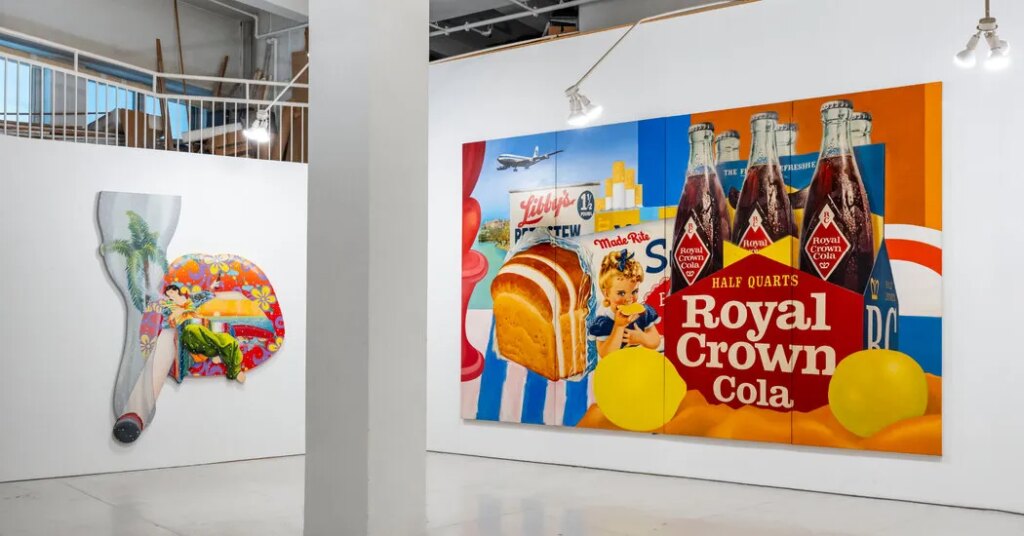
The show I saw was a casual affair that spilled from the studio into a hallway and onto the top of a wooden work table. It contained some historical biggies, like Wesselmann’s “Still Life #35” (1963), a ravishing billboard-size painting that mingles pristine passages of orange and sky-blue with scissored advertisements for Libby’s beef stew, Made-Rite white bread, and Royal Crown Cola. The painting harks back to Pop Art’s dewy beginnings, when Wesselmann’s satirical riffs on middle-class life, like Warhol’s Campbell’s Soup Cans, were mixed with an often-overlooked dollop of genuine affection.
Wesselmann, who was born in Cincinnati, is known best for bringing a boyish prurience to the opulent tradition of French figurative painting. His Great American Nudes, as he titled them, flattened the reclining odalisques of Henri Matisse into sleek beige silhouettes.
Among his younger fans is Matsuyama, who was born in Japan and raised in California. Matsu, as he is called, is a third-generation Pop artist for whom the appropriation of images is standard operating procedure. He culls his motifs from downloaded computer images that range from Baroque paintings and Japanese Ukiyo-e prints to ads for toothpaste, recombining them into compositions that can feel both sugary and ominous.
“We the People” (2025) is a 17-foot-long, three-panel, neon-radiant extravaganza set in an overlighted supermarket aisle, where merchandise is rendered in such fanatical detail you can spot the price of a package of DayQuil (“$11.99 clearance”). Shoppers — their poses swiped from Jacques-Louis David’s “The Death of Socrates” (1787)— convene in the aisle in assorted states of distress. Instead of downing a fatal dose of hemlock, the Socrates stand-in is an American youth in a navy tank top reaching for a bowl of Froot Loops.
The show was engaging enough, but looking at the thinness and coldness of the artist’s paint (much of it applied by his assistants) I longed to see an actual brushstroke. On the other hand, Matsu’s surfeit of minuscule detail deftly captures a culture in a state of permanent overdrive.
The studio of Tom Wesselmann, 30 Peter Cooper Square, may reopen in the future. In the meantime Matsu’s studio in Greenpoint, Brooklyn, is open by appointment: [email protected].
In the weeks ahead, you can visit other studio-based exhibitions downtown. On Oct. 8, six paintings by Yun Hyong-keun (1928-2007) will go on view on the ground floor of 101 Spring Street, the former SoHo home and studio of Donald Judd. The two artists met in 1974, and Judd was captivated by Yun’s paintings, which infuse the less-is-more forms of Minimalism with the meditative richness of Asian philosophy.
Yun Hyong-keun, at the Judd Foundation, through Jan. 16. Open Fridays and Saturdays, from 1 p.m. to 5 p.m.; 101 Spring Street, Manhattan.
The British artist Rachel Howard is currently showing new paintings in the studio of Sean Scully, 447 West 17th Street, in Chelsea. Hidden inside an unmarked blue-tiled building, Howard, a 57-year-old London-based artist, focuses her new paintings on the perils of surveillance, combining grainy images of drone warfare and tender views of mud-splotched infants. “As you get older,” she once said, “you realize you are experiencing plenty just by existing — life, death, children, madness. It’s all very, very near.”
Rachel Howard, through Nov. 5, at the studio of Sean Scully, by appointment: [email protected].
The post Artists’ Studios Where Creativity Is on Display appeared first on New York Times.