China has kept its export engine roaring with a combination of tax rebates and a weak currency, helping sustain economic growth at home while sending a surge of Chinese goods into markets abroad.
But that strategy is fueling tension with its trading partners. And this week, officials from Brussels arriving in Beijing are preparing to press Chinese officials about a European trade deficit with China that exceeds $1.1 billion a day.
Europe’s leaders say China tilts the scale with government subsidies and low-interest loans to its manufacturers, flooding European markets with inexpensive goods.
But subsidies are only part of the advantage Chinese exporters enjoy. The renminbi, China’s currency, remains unusually weak, making China’s goods cheaper overseas. At the same time, Beijing refunds exporters hundreds of billions of dollars a year in taxes, further lowering their costs.
Both policies have become difficult for China to unwind.
The renminbi is down more than 14 percent in inflation-adjusted terms from its early-2022 level against a broad set of currencies. Over roughly the same period, China’s trade surplus has nearly doubled. While the weak currency helps exporters, it also makes foreign goods more costly for Chinese consumers and businesses.
China’s export tax rebates have also surged. Rebates to export companies for value-added taxes reached $318.2 billion last year, equivalent to 1.5 percent of China’s economy, according to data from the country’s Ministry of Finance.
Together, the weak currency and extensive tax rebates capture the dilemma facing Chinese policymakers. Exports are one of the few bright spots in an economy weighed down by plunging apartment prices and weak consumer spending. Maintaining export momentum is important to Beijing’s goal of 4.5 percent to 5 percent economic growth. But supporting those exports carries high costs at home and abroad.
A weak renminbi raises the cost of oil and other imports, squeezing households already reluctant to spend. Export tax rebates drain government revenues when many local governments are struggling with the financial fallout from the housing downturn.
For China’s trading partners, Europe in particular, resentment has been building, prompting more protectionist policies.
“We need to rebalance our economic ties to ensure they are fair, sustainable and mutually beneficial — the current situation is unsustainable,” said Caspar Veldkamp, the European Union ambassador to China, in a speech on Sept. 22.
With China on track to match or exceed last year’s record global trade surplus of $1.19 trillion, allowing the renminbi to strengthen and reducing tax rebates could ease some pressure from overseas. But either step could also damage one of the economy’s few remaining engines of growth.
Some prominent Chinese economists have begun arguing that a stronger currency may benefit China by lowering the cost of oil and other imports priced in dollars. China’s central bank and state-owned banks intervene heavily in currency markets to set the renminbi’s value, although market forces also play a role.
“We need to reassess the issue of exchange rates: An appreciation of the renminbi is not necessarily entirely negative, while depreciation may not effectively boost exports,” said Shen Guobing, an economics professor at Fudan University in Shanghai, in a speech last December.
Beijing has been cautious about allowing meaningful appreciation. Policymakers are well aware of Europe’s unhappiness, but remain wary that a rapid rise in the renminbi would slow the country’s vast export machine.
The same caution applies to export tax rebates. Before the Covid-19 pandemic, they consumed about a tenth of tax revenue. Now, as exports surge while much of the domestic economy stagnates, they account for nearly one-eighth.
China has announced plans to halt tax rebates for battery exporters next year. Some influential economists are urging the government to go much further.
“Export tax rebates, which are essentially a form of export subsidy, should be reduced,” said Huang Qifan, a former mayor of Chongqing and an influential Chinese economist, in a speech in May.
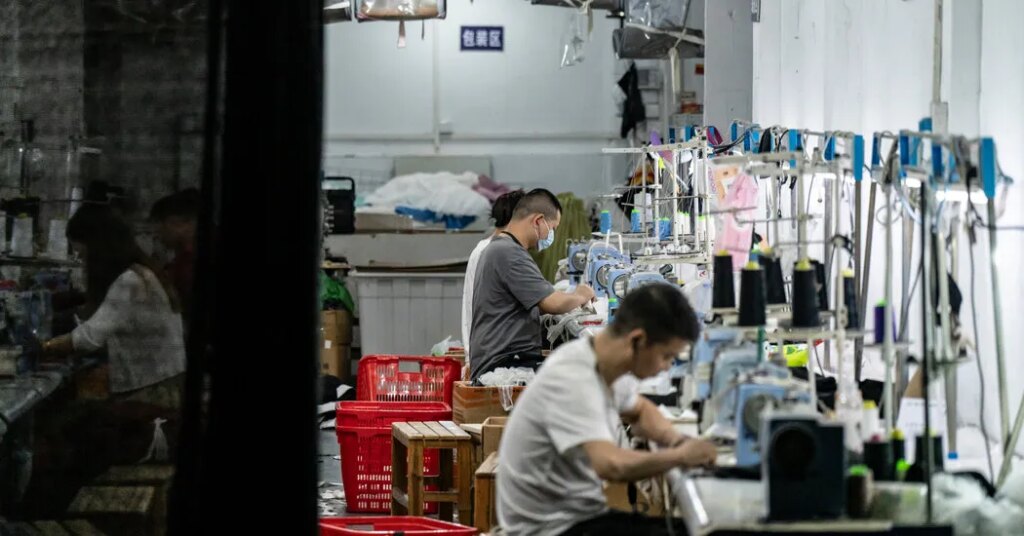
The reasons for Beijing’s reluctance to jeopardize exports can be seen in Guangzhou, a metropolis in southern China’s Pearl River Delta and the heart of China’s garment export industry.
On Haizhu Island, dozens of men and women loitered at an outdoor hiring area late one afternoon after waiting hours for anyone willing to pay them $45 to $60 for a day of sewing.
“Business has slowed down — the first half of the year was a little better, but things are really bad now,” said a worker at the hiring area who gave only his family name, Liu.
China’s housing crash has crippled domestic demand for new clothes, while tariffs and competition from lower-wage countries have hurt exports. Day labor rates occasionally reached as high as $150 a few years ago, when exports and domestic demand were much stronger, said the owner of a sewing machine distributorship whose family name is Yi.
“Compared with previous years, our business is down by at least a third this year — you could even say it’s close to half,” he said.
Such weakness helps explain why Beijing is reluctant to risk policies that could further undermine exports. Until 2022, the currency gradually strengthened in inflation-adjusted terms for many years, according to the Bank for International Settlements in Basel, Switzerland, which has tracked the renminbi’s weakness.
That changed after a stringent Covid lockdown began in Shanghai in March 2022. Consumer confidence plunged to the lowest level in 36 years of government record-keeping, while companies and households sought to move savings out of China. The renminbi started a long decline that eventually took it down about 20 percent.
The slide coincided with the collapse of China’s housing market. Prices for existing homes have fallen about 40 percent since the summer of 2021, eroding household savings and further weakening consumer spending.
The renminbi has strengthened somewhat over the past 15 months, but it remains far below pre-Covid levels after adjusting for inflation.
Currency movements can take time to alter decisions companies make about where they buy components and other supplies. American importers tend not to look for new suppliers unless a currency moves sharply against the dollar, said Joe Jurken, the managing director of ABC Group, a Milwaukee-based supply chain consultancy.
“A 15 percent appreciation would open up eyes and start some discussions,” he said.
A weak currency is not the only reason for China’s export strength. Chinese companies have become formidable competitors through innovation in sectors such as batteries, electric vehicles and solar panels. Fierce domestic competition has also pushed manufacturers to cut costs and prices.
But some economists argue that those low prices also reflect weaknesses in the domestic economy, including pressure on wages and corporate profits.
“The high quality and low price of Chinese goods is a global triumph, but it is built on the suppressed wages and squeezed margins of Chinese workers and enterprises,” wrote Zhao Jian, the founding dean of the Xijing Research Institute, a commercial research foundation, in a commentary on Sept. 22 in Caixin, a Chinese business publication.
Bert Hofman, a former China country director for the World Bank, said reducing tax rebates might have a bigger impact than allowing the renminbi to appreciate in terms of freeing up government revenue for domestic priorities.
“China benefits by increasing revenues, which they can use to increase government spending on health and education,” he said.
Ruoxin Zhang contributed research.
The post The Hidden Policies That Power China’s Export Boom appeared first on New York Times.