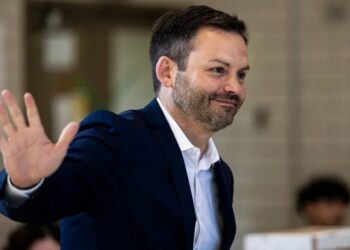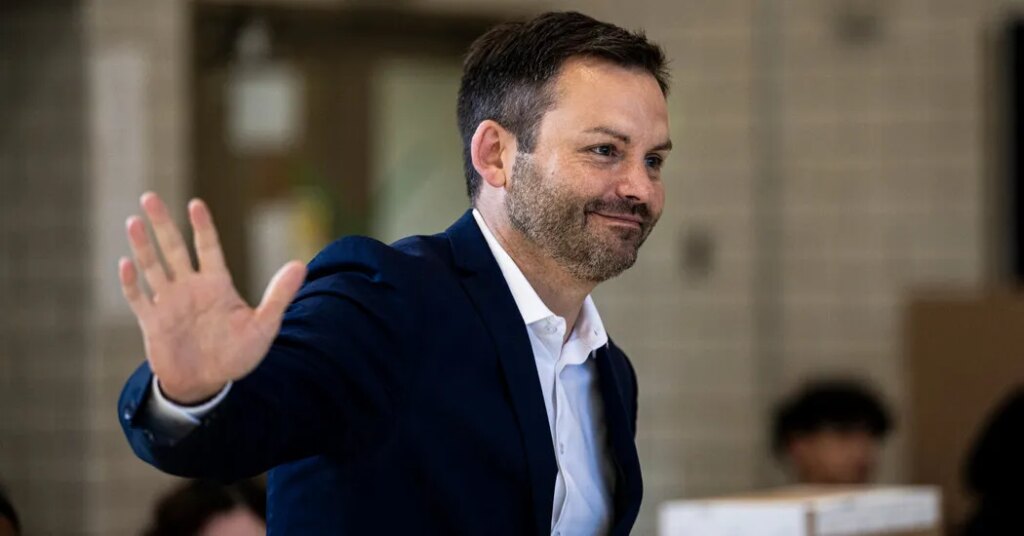
The separatist Parti Québécois won the provincial election in Quebec on Monday, possibly setting the stage for a referendum on the French-speaking province’s independence from Canada in the next few years.
Voters hungry for change returned the Parti Québécois to power for the first time in 12 years, even though they displayed little interest in the commitment of its leader, Paul St-Pierre Plamondon, to hold a referendum on secession from Canada.
The Parti Québécois fell short of clinching a majority, winning 59 seats out of 127 in the provincial legislature, according to incomplete results as of 10:15 p.m. Eastern. That could make it difficult for Mr. St-Pierre Plamondon to fulfill his campaign promise to hold a referendum after President Trump leaves office in 2029 and the economy stabilizes.
A Parti Québécois minority government could struggle to stay in power for a full four-year term. Mr. St-Pierre Plamondon will also govern after winning only about 28 percent of the popular vote, according to incomplete results, making it hard for him to claim a popular mandate.
The governing Coalition Avenir Québec, which held power for two terms and was re-elected in a landslide four years ago, suffered a total collapse in its support — winning no seats, according to incomplete results.
“It’s clearly a difficult result,” Christine Fréchette, Quebec’s premier and leader of the Coalition Avenir Québec, said in a concession speech.
For Prime Minister Mark Carney of Canada, the results come just two weeks before voters in Alberta decide whether to hold a referendum on separation from Canada. In the past, relations have often been tense between the federal government and a Quebec led by the Parti Québécois. But Mr. St-Pierre Plamondon said in a debate during the campaign that he was ready to “collaborate” with Mr. Carney, who remains extremely popular in Quebec.
Mr. St-Pierre Plamondon explicitly called for a referendum during the campaign, breaking with previous Parti Québécois leaders who opted for ambiguity to avoid alienating mainstream voters. Today, support for independence — around 30 percent — is at its lowest in decades.
Mr. St-Pierre Plamondon, 49, roused the party’s separatist base with his vow to hold a referendum but spoke little about independence during the campaign. He also tamped down anxieties over a referendum by pledging to hold one only after the end of President Trump’s term.
In Beloeil, a city about 30 miles southeast of Montreal, with a mostly French Québécois population, the candidate for the Parti Québécois unseated the long-serving incumbent of the governing Coalition Avenir Québec.
After voting at a school in Beloeil, Dominique Tessier, 68, a part-time school bus driver who used to work in real estate, said he had endorsed the Parti Québécois because of Mr. St-Pierre Plamondon’s promises, including to hold a referendum on independence.
“Will Quebec separate one day? Probably not,” said Mr. Tessier, a lifelong supporter of independence. “But it could strengthen our hand in Canada.”
The flag-bearer of the independence movement, the Parti Québécois led the province to two unsuccessful referendums, in 1980 and 1995. Historically the main supporters of the Quebec independence movement, French Québécois are wealthier and better educated than in the past — and less interested in seceding from Canada, experts say.
As the attitudes of French Québécois have changed — and as the population of immigrants, who tend to side against independence, has risen in Quebec — many separatists have come to believe that the next referendum could be their last chance.
Mr. St-Pierre Plamondon, who studied at McGill and Oxford and practiced litigation law in Montreal, has talked over the years about his changing attitudes toward independence. He voted “yes” in the 1995 referendum, then embraced federalism, and eventually joined the Parti Québécois as a strong champion of independence.
Voters displayed little interest in independence during the campaign, showing more concern over issues like the rising cost of living, the province’s dysfunctional public health care system, the lack of affordable housing and Canada’s trade war with the United States.
The Parti Québécois’s rivals seized on its promise of a referendum to portray Mr. St-Pierre Plamondon as a potential source of instability.
Ms. Fréchette said that a win by the Parti Québécois would create economic uncertainty in Quebec, deterring investments in the province by both private businesses and the federal government.
Ms. Fréchette said unpredictability will arise “the moment a referendum becomes part of Quebec’s political horizon.’’
But Mr. St-Pierre Plamondon was able to overcome such attacks, benefiting from what polls described as Quebec voters’ intense desire for change. Ms. Fréchette took over as her party’s leader in April after the resignation of the deeply unpopular François Legault. But Ms. Fréchette, a former minister of economy, has been unable to distance herself from her party’s track record, especially the failure of several high-profile economic and government projects.
“It was time for a change,” said Jonathan Crabey, 38, who works in construction and was voting at a school in Chambly, a city about 20 miles southeast of Montreal., where the Parti Québécois candidate defeated the incumbent of the governing Coalition Avenir Québec.
Mr. Crabey, who had voted for Ms. Fréchette’s party in the past, gave his support to Conservative Party of Quebec this time because of its pledge to lower taxes. He said he “hadn’t given much thought” to a referendum.
The federalist Quebec Liberal Party came in second on Monday, dominating in the diverse, multilingual electoral districts on the island of Montreal and making inroads elsewhere. The Conservative Party of Quebec also made gains and came in third place, followed by the left-leaning Québec Solidaire. The Coalition Avenir Québec came in last.
The post Parti Québécois Returns to Power, Reviving Quebec Sovereignty Push appeared first on New York Times.