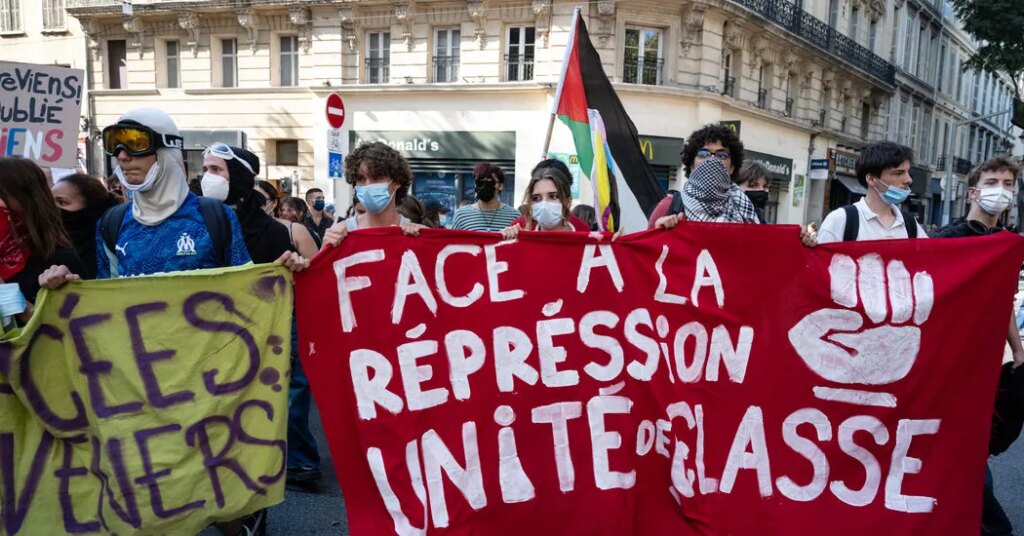
France was bracing for nationwide demonstrations on Tuesday after union leaders vowed to join high school students who have spent two weeks blockading their schools over understaffing, overcrowded classrooms and dilapidated buildings.
The planned demonstrations are a litmus test of the longevity of a protest movement that began last month in a single school in the suburbs of Paris and quickly spread to hundreds of schools across the country. Some demonstrators have barricaded school doors, set buildings on fire and shot fireworks at police officers, though many protests have been peaceful.
Roughly 6,000 people have been arrested since the protests began and about 270 high school students and school staff have been injured, as well as nearly 470 police officers.
The protests have set off a national debate over what constitutes justifiable protest. The French education minister, Édouard Geffray, has called the protesters’ demands “legitimate,” but said student-led violence had gone too far: “No demand can justify such acts,” Mr. Geffray said last week.
Others, including a major union of French judges and prosecutors and a prominent human rights group, have accused the police of using disproportionate force against students as young as 14.
The demonstrations have also heightened scrutiny of a far-left party, France Unbowed, whose leader, Jean-Luc Mélenchon, could make the runoff in next year’s presidential election, according to recent polling. Centrist government officials and far-right leaders have accused France Unbowed, which backs the protesters, of fomenting the violence — an accusation it denies.
The students’ complaints include frustration at a state-run website that students must use to apply for higher education programs. The site, called Parcoursup, has been called opaque and impersonal, in part because it has left tens of thousands of applicants waiting for months before learning if they have earned a place.
Mr. Geffray met with several student union leaders on Friday and visited a shuttered high school near Paris on Monday, aiming to reassure students that the government was listening to their demands while urging them to allow classes to restart on Wednesday.
On Sunday night, Prime Minister Sébastien Lecornu sent a letter to several cabinet ministers, pledging among other things to fill vacant teaching positions, identify urgent problems with buildings, and make improvements to Parcoursup.
That did not quell the protests. On Monday, students demonstrated again at hundreds of schools across the country.
“We’re not letting go,” a high school union, La Force Lycéenne, announced on social media. “No matter the repression, no matter the diversions of the government.”
Many university students have joined the movement, and several trade unions have also expressed support, calling on their members to join protests on Tuesday.
“Today’s high school and college students are tomorrow’s workers; they should not have to pay the price for austerity policies,” the C.G.T., one of the country’s main workers’ unions, said in a statement.
The protests come amid efforts by the French government to pass a new budget that would reduce spending on parts of France’s welfare system. The push to save money has been compounded by the rising interest payments that France must now make to its creditors, payments that are now almost as high as during the post-2008 financial crisis.
The post France Set for Nationwide Strikes, as School Protests Escalate appeared first on New York Times.