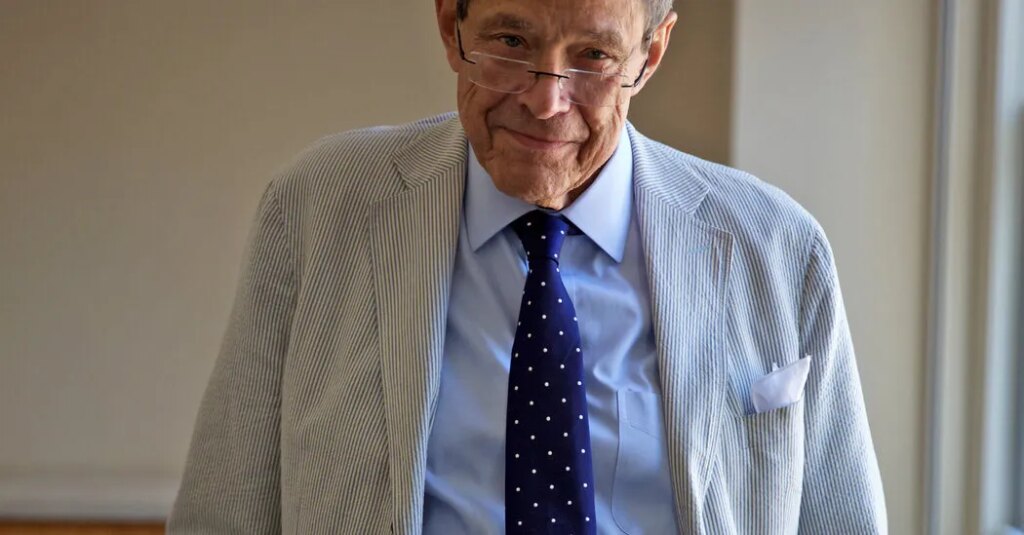
Gordon J. Davis, a New York lawyer and civic leader who helped revive Central Park during his tenure as the city’s first Black parks commissioner and elevated jazz to a permanent feature of Lincoln Center for the Performing Arts, died on Sunday in Manhattan. He was 85.
The death, at a hospital, was from complications of emphysema, said his daughter, Elizabeth Cooper Davis.
A scion of Chicago’s Black aristocracy, Mr. Davis delivered a legacy to his adopted city that included the establishment of the Central Park Conservancy, a successful public-private partnership, to restore and protect Manhattan’s 843-acre verdant oasis, and the founding of Jazz at Lincoln Center, which formally enshrined America’s original musical genre at one of the world’s leading performing arts organizations.
At 6-foot-5 and a graduate of Harvard Law School, Mr. Davis was among the more conspicuous members of a crop of young idealists to join the administration of Mayor John V. Lindsay in the late 1960s, and he became part of Mr. Lindsay’s inner circle of advisers, including as special assistant and speechwriter. Mr. Davis was later a rare person of color who ascended the ranks of the city’s most prestigious cultural institutions.
But it was his tenure from 1978 to 1983 as commissioner of the city’s Department of Parks and Recreation — a job once held by the formidable Robert Moses — that firmly established his civic reputation. “Parks appeal to me,” Mr. Davis told The New Yorker after being appointed. “They’re one of the few places that are genuinely democratic.”
To a sprawling city agency reeling in the wake of a citywide fiscal crisis, Mr. Davis was best remembered for the restoration of the Sheep Meadow, an expansive lawn in Central Park, and for bringing in the singer-songwriter James Taylor for a final concert before the field was closed to the public for a year of repairs. Mr. Davis helped obtain a substantial grant from the governor’s office for the renovation project.
Mr. Davis also made possible Elton John’s concert in the park in 1980 and a celebrated reunion concert between Paul Simon and Art Garfunkel on the Great Lawn in 1981.
In running a department that included more than 4,000 employees, nearly 600 parks and 900 playgrounds, more than 100 swimming pools and 500 tennis courts, more than 10 golf courses, three zoos, dozens of recreation centers, several beaches and ice-skating rinks, and many hundreds of baseball, softball, football and soccer fields, Mr. Davis spoke of the exhaustive effort it took to try to please every constituency.
“The day after my appointment was announced, I got 40 calls from people telling me what’s wrong at the tennis courts, at the rinks, with the trees,” he told The New Yorker at the time.
He launched a corps of urban park rangers, appointed borough administrators, privatized many of the city’s public golf courses, spurred the restoration of Bryant Park in Midtown, reintroduced a herd of sea lions to the Central Park Zoo, and was a founding trustee of the Central Park Conservancy, in 1980.
“It was Mr. Davis who perhaps best foresaw that the creation of the Conservancy as an institution was not simply an act of political and administrative will but a reaffirmation of the social democracy that is the hallmark of our park and our city,” Richard Gilder, another founding donor of the Conservatory, and Betsy Gotbaum, a subsequent parks commissioner, later wrote in a letter to the editor in The New York Times.
When Mr. Davis resigned from the parks department after five consequential years — citing “a gut uneasiness that comes in my case, perhaps, from being too familiar or too comfortable” — Mayor Edward I. Koch wrote a thank-you note saying he doubted Mr. Davis’s record of achievement “will ever be surpassed, and surely it will rarely be equaled.”
Diane M. Coffey, the former chief of staff to Mayor Koch, said Mr. Davis “woke up the parks department from what it was, which was terrible. He humanized it, and he brought a certain amount of class.”
In 1983, Mr. Davis joined Lord Day & Lord as one of a handful of Black lawyers to be named partner in a major New York corporate law firm, and he later worked at Venable. During his legal career, he specialized in complex public-private and nonprofit developments, such as Amtrak’s Moynihan station and the Rose Center for Earth and Space at the American Museum of Natural History.
By all accounts, he moved with social ease through black-tie galas, the well-connected lunch crowd at Michael’s in Midtown, and the exclusive Century Association, where he was a member. But Mr. Davis said he never lost sight of the fact that, as a Black man, he was an exception and worked to correct the inequity he experienced firsthand in worlds entrenched in white privilege.
By having exceptionally light skin, he said, he was often mistaken for white. He recalled countless times when peers in college and all-white law firms made racially insensitive or bigoted remarks in front of him. “You know that I am African American?” he made it a point to tell them.
“Maybe I’m self-contained, but it has nothing to do with race,” he said in a 1998 Times interview. “I grew up in a family that was very self-aware, and very confident in issues of race. My parents taught us that we were equal to, or sometimes better than, people who were white. We were never confused about what we were. Other people were confused, all the time.”
He served on the boards of not only Lincoln Center, where he was briefly president, and Jazz at Lincoln Center, where he was the founding chairman, but also the New York Public Library, the Studio Museum in Harlem, the American Museum of Natural History, the Public Theater and Dance Theater of Harlem. In 2010, President Barack Obama appointed Mr. Davis to a six-year term as a trustee of the John F. Kennedy Center for the Performing Arts.
He tried to recruit people of color to the boards on which he sat and often spoke out about the lack of diversity among the trustees of New York’s cultural institutions. “He was willing to speak up and stand up for racial justice in places where others were just happy to be in the room,” said Darren Walker, the president of the Ford Foundation. “He was one of the few voices to call out the lack of diversity in for-profit and nonprofit organizations.”
Thelma Golden, the director and chief curator of the Studio Museum in Harlem, said Mr. Davis “was consistent in his belief that cultural institutions and boards have to change to reflect the world around him.”
Gordon Jamison Davis, the younger of two sons, was born on the South Side of Chicago on Aug. 7, 1941. His father, Dr. W. Allison Davis, and his mother, Elizabeth (Stubbs) Davis, were social anthropologists who published studies on caste and class in the American South in the 1930s and 1940s.
Mr. Davis took great pride in the fact that his father, who was a professor at the University of Chicago, in 1947 became the first African American to be granted tenure at any white college or university in the United States (a postage stamp to commemorate him was issued in 1994).
At Williams, a private liberal arts college in Massachusetts that his father had also attended, Gordon Davis co-founded a campus civil rights committee that raised money for the Student Nonviolent Coordinating Committee and other activist groups. He also was a star basketball player and graduated in 1963 with a bachelor’s degree in political science.
Initially planning on a career in architecture, Mr. Davis did graduate work in city planning and public administration at Columbia University before deciding to switch to law on the advice of a friend.
“In those days, I thought buildings changed society,” he told The New Yorker in 1978. “The fact of the matter is, a good architect is a good planner. Still, it seemed to me that the best planners often tended to be lawyers.”
At Harvard Law School, he was a founding member of the Harvard Black Law Students Association and contributed to the newly established Harvard Civil Rights-Civil Liberties Law Review.
Soon after graduation in 1967, he became assistant to the budget director of Mayor Lindsay. After five years working as a labor and real-estate lawyer and serving part time on the city planning commission, Mr. Davis was named parks commissioner in 1978.
In 1968, he married Peggy Cooper, who became a professor at New York University Law School. In addition to his wife and daughter, he is survived by a brother, Allison S. Davis; and two grandchildren.
In 1987, Mr. Davis joined the jazz musician Wynton Marsalis; George Weissman, the chairman of Lincoln Center; and Albert Murray, a literary and music critic, in founding Jazz at Lincoln Center. Mr. Davis was named the founding chairman of the entity, which became a full-fledged constituent of Lincoln Center in 1996. Before he retired as chairman in 2001, he presided over the inception of Frederick P. Rose Hall, a venue that opened in 2004 as a center specifically designed for jazz performance, education and broadcast.
To The Times in 1998, he spoke of inheriting a love of jazz from his father, a learned academic who nonetheless considered Louis Armstrong’s 1928 recording of “West End Blues” “the greatest thing American civilization has ever produced.”
In 2000, after more than 20 years on Lincoln Center’s board, Mr. Davis took over for the longtime president of the performing arts complex, Nathan Leventhal, but his stint at the helm lasted only nine months amid clashes with Beverly Sills, the acclaimed soprano then serving as the center’s chairwoman.
Mr. Davis’s presidency was complicated by the center’s ambitious redevelopment project, which was initially rife with infighting among the constituent groups on the campus. And in serving on cultural boards, Mr. Davis could be a thorn in the side of some of his fellow trustees, frequently agitating for greater diversity and critiquing the slow pace of change.
At the same time, he inspired a fierce loyalty among colleagues and friends.
“If I were looking for honest, informed, wise counsel, I sought him out,” said Mary Schmidt Campbell, the president emerita of Spelman College in Atlanta and the former executive director of the Studio Museum. “Gordon was someone I could count on for the unvarnished truth.”
The post The City Leader Who Revived Central Park Dies at 85 appeared first on New York Times.