The fight over who should pay the soaring costs of climate change — the intensifying wildfires, storms and heat waves — has moved to the courts.
Nationwide, more than 60 state and local governments have filed dozens of lawsuits seeking damages from oil companies over global warming, which is caused by the burning of fossil fuels. With a president who has called climate change a hoax and a gridlocked Congress, courtrooms have become one of the few remaining options for communities seeking relief.
“Globally, neither national legislatures nor governments are taking adequate action, and so the advocates of climate action are turning to the courts,” said Michael Gerrard, director of the Sabin Center for Climate Change Law at Columbia University.
Now the highest court in the land has entered the fray. On Monday, it heard arguments over a lawsuit filed by the city and county of Boulder, Colo., against two energy companies. Many, if not most, of the dozens of other cases nationwide hinge on the Supreme Court’s decision.
The city and county had sued Exxon Mobil and Suncor Energy, claiming they misled the public about climate change and should pay for damages. The energy companies have asked the Supreme Court to throw out the case.
One of the industry’s main arguments has been that climate change is too complex a problem to be handled by individual courts. “This case and others like it reflect an all too regrettable trend of trying to resolve major political issues in court rather than leaving them to the political branches where they belong,” Kannon Shanmugam, a lawyer for the companies, told the justices on Monday.
If that argument prevails, then many similar lawsuits around the country are likely to be invalidated.
Kevin K. Russell, who argued on behalf of the city and county of Boulder, said the case was not about dictating policy, but rather about using state laws to seek damages for injuries suffered by residents, which he said was a core right. Since the nation’s founding, he said, “states have had the power to provide court remedies for injuries occurring within their borders.”
Mr. Russell argued that the lawsuit would require companies “to internalize a portion of the costs of their activities by paying for some of the damage that those activities inflict.”
Justice Brett M. Kavanaugh said that was “a little cavalier,” continuing, “It is going to bankrupt — you know, if there are enough of these — bankrupt these various defendants and certainly other defendants out there.”
The court showdowns are happening as greenhouse gas emission have reached all-time highs, and the goal of limiting global warming to 1.5 degrees Celsius above preindustrial times, a goal set in the 2015 Paris Agreement, is all but out of reach. Last year, weather disasters in the United States exceeded $100 billion in costs, according to researchers at Climate Central, a nonprofit group.
At the same time, an emerging field called attribution science has bolstered researchers’ ability to pinpoint the role of climate change in extreme-weather events. That has given new ammunition to environmentalists who argue fossil fuel companies should help pay for damage.
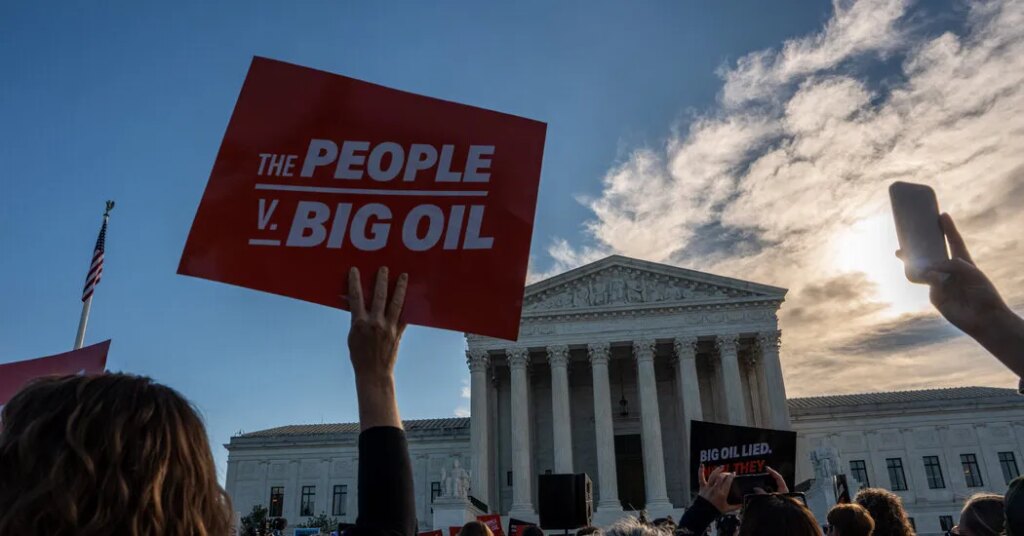
Outside the Supreme Court on Monday, dozens of protesters assembled, including two longtime cattle ranchers from Colorado who support the Boulder lawsuit. Deirdre Macnab, 70, who owns a ranch with about 600 Black Angus cattle in northwest Colorado, said that two wildfires last year killed cows in the region and that increasing heat and drought were making it harder to ranch, drying up fields and driving up the price of hay.
“This is food security, and it’s directly connected to climate change,” said Ms. Macnab, who was previously the president of a voting rights organization. “And these corporations, if they are not held accountable, they’ll never come to the table and be part of the solution. They’re making record profits while people’s cattle are dying.”
Coastal communities in California and New York had forged the legal path that Boulder County followed, filing suits starting in 2017 based on state laws that largely focused on sea-level rise. They argued that the oil companies had concealed their knowledge about the dangers of using their products.
Boulder’s case, filed by the city and county in 2018, focused on extreme heat, decreased snowpack, wildfires and floods.
None of the cases have gone to trial. Some have been dismissed, but about two dozen remain active. “The stakes are extremely high for the future of all these two dozen or so pending cases,” Mr. Gerrard said.
In recent months, some have been paused as judges await a decision from the Supreme Court.
But the number of lawsuits continues to grow. Last week, Middlesex County, N.J., filed a new case, which argued that it “has been reeling from the devastating impact of one climate disaster after another. And there is no end in sight.”
Erika Kranz, a senior staff attorney in the Environmental and Energy Law Program at Harvard Law School, said it was hard to tell from Monday’s arguments where the justices might land. Some justices adopted the oil companies’ view “that this case is really an attempt by Boulder to regulate out-of-state greenhouse gas emissions,” she said, “and other justices were more focused on Boulder’s framing, which is that this is a case about deceptive marketing.”
Boulder County and city argue, among other things, that the energy companies misrepresented the science of climate change in order to sell more oil and gas.
The energy companies are seeking to overturn a decision by the Colorado Supreme Court allowing the case to continue to trial. The justices could rule broadly in the companies’ favor, potentially blocking the whole batch of litigation. Or they could rule that it’s too early for the Supreme Court to weigh in, which would let the Boulder lawsuit proceed through the state courts in Colorado.
Proponents of the litigation point to the vast tobacco settlement of the 1990s and the more recent litigation over opioids as models for the climate cases. On Monday, some of the justices appeared to home in on that argument.
“This suit appears to be based on the old 1990s tobacco suits that were brought by states and local governments,” Justice Elena Kagan said at one point. She was trying to ascertain whether, under the same logic that Mr. Shanmugam was putting forth, federal law would have also blocked the tobacco and opioid cases.
Mr. Shanmugam responded that the cases were very different.
“This is the same kind of lawsuit against the same kind of actors for the same kind of harm,” Justice Kagan said.
The case is reaching the Supreme Court at a time when the Trump administration is laser-focused on increasing fossil fuel production and has scrapped many climate policies in the process.
Last year, the Republican-controlled Congress rolled back many tax breaks for clean energy that were part of the 2022 Inflation Reduction Act. The administration has taken aim at federal Environmental Protection Agency regulations and at state-level climate policies, and it overturned the “endangerment finding” that allowed the E.P.A. to regulate greenhouse gases at all. Those moves are themselves the subject of copious litigation. (And whether the endangerment finding changes the calculus in the Boulder case is an open question.)
And the court battles over climate are playing out other ways as well. New York and Vermont have passed climate “Superfund” laws seeking to force polluters to pay for adaptation measures, but legal battles have put them on ice. Meanwhile, industry supporters are pressing for laws that would shield fossil fuel companies from liability over climate change. Utah, Iowa, Oklahoma, Tennessee and Louisiana have recently passed such measures, and a similar shield law has been introduced in Congress, which could potentially block verdicts from being enforced.
Brad Plumer contributed reporting.
The post Why Cities and States Are Fighting Climate Change in Courtrooms appeared first on New York Times.