President Trump’s second term has revealed many weaknesses in America’s political system. This is one of them: It turns out that the government can function (or malfunction) based just on orders of the president and the Supreme Court’s rulings on those orders. Congress is largely irrelevant, if it wants to be.
As the court returns for a new term this week, we are due for another round of debate about the separation of powers — the fight between the executive and the courts, especially. Just as important, though far less frequently noted, is the balance between the Supreme Court and Congress. And that situation is deeply weird.
Here’s how it’s supposed to work but no longer does: Congress writes laws. The courts interprets them. When Congress disagrees with these statutory interpretations, it has the power to pass a new law to override them. Constitutional rulings are different: The Supreme Court claimed that it had say over interpreting the nation’s founding document in the case of Marbury v. Madison in 1803. Congress may still have room to respond with a new law, but it can’t just say the court got the Constitution wrong.
Today, Republicans in the House and the Senate have the power to give the president — the leader of their party — what he wants, even when the Supreme Court disagrees. Over the summer, for example, the justices handed Trump defeats on two cherished priorities, imposing global tariffs and resetting the rules for mail-in voting. A lower-court judge blocked Trump’s appointees on the board of the Kennedy Center from putting his name on it, which he appears to care about even more.
The judge in the Kennedy Center case, Christopher R. Cooper, underscored in his ruling what power Congress has. “Simply put,” he wrote, the board “cannot install memorials for President Trump or anyone or anything else at the Kennedy Center without Congress’s blessing.” Yet Republicans have not moved a bill to authorize adding Trump’s name.
In a sense, Congress’s inaction is easy to explain. It’s an increasingly do-nothing institution. The Senate rule requiring 60 votes to break a filibuster gives Republicans an excuse to distance themselves from some of the least popular decrees of an unpopular president. Trump also often disregards Congress. There was no reason for lawmakers to do anything, he said, when the Supreme Court struck down his tariffs last year.
But this is not really about Trump. He and the current MAGA Congress have revealed — and accelerated — a structural flaw that has been developing for a couple of decades. Several presidencies ago, Congress stopped asserting authority to override major Supreme Court decisions. Its passivity has continued no matter which party is in power.
By 2013, it was already “exceedingly rare” for Congress to reject a court decision, Richard Hasen, a law professor at the University of California, Los Angeles, wrote that year. Hasen charted the drop. From 1975 to 1990, Congress overrode an average of 12 Supreme Court decisions per term. The number fell to an average of 2.8 per term from 2001 to 2012. Since then, it has fallen nearly to zero, Hasen says — “certainly, nothing I’ve seen shows the numbers have turned around.”
Congress’s inaction is upsetting the balance of power between Congress — the branch that, according to the Constitution, is supposed to be most responsive to the electorate and the strongest — and the judiciary, which is supposed to be most removed and weakest. It’s a distortion of the separation of powers that has largely had the effect of moving American governance to the right.
One of the court’s most contentious decisions last term was Louisiana v. Callais, which gutted part of the Voting Rights Act. The history of the landmark civil rights law since its enactment in 1965 shows how things have changed in Congress’s push-and-pull with the court. The Supreme Court upheld it in the 1966 case Katzenbach v. Morgan. The 14th Amendment, the justices argued, gave Congress the power to enforce the promise of equal rights, a responsibility that the court respected.
But in 1980, a different court struck back with a ruling that required states to prove that laws intentionally discriminated on the basis of race. The ruling made part of the Voting Rights Act nearly toothless. Congress objected — and did something about it by amending the law so a plaintiff could win with proof that a state voting practice had a discriminatory effect. This back-and-forth was what the Constitution’s framers envisioned, and it continued for decades. The court enforced Congress’s amendment in 1986. In 2006, Congress reauthorized the Voting Rights Act by overwhelming majorities.
Seven years later, however, in Shelby County v. Holder, the Supreme Court gutted another key provision of it. This time, though, Congress did not pass an amendment or a new voting rights bill in response, even later when Democrats controlled the White House, the House and the Senate. The resulting power vacuum surely made it easier for the conservative justices to dismantle the remainder of the Voting Rights Act last spring — by reimposing the standard of proof of discriminatory intent in Louisiana v. Callais.
The main reason a new voting rights bill failed to pass is the same reason Congress has stopped responding to the court: partisan polarization, which ramped up in the 2000s. As conservative Democrats and liberal Republicans went extinct, bipartisan overrides ended. When one party is in control and can reject a court ruling on its own, the filibuster remains a barrier to such a bill passing.
In their new book, “Supremacy,” Nikolas Bowie and Daphna Renan, Harvard law professors, argue that Congress is passive because the Supreme Court made it so. “The court’s interpretation of Congress’s statutory authority has gotten stingier and stingier,” Renan said. Congress stopped responding to the court out of “learned helplessness.”
In the last few years, the Supreme Court’s conservatives have suggested that when they strike down statutes, they are inviting Congress to pass laws in response. Liberals in the minority, on the other hand, say the court is simply taking more power for itself. The dispute came to a head in a 2022 case in which the conservative majority said that the Clean Air Act did not authorize the Environmental Protection Agency to implement the Obama administration’s plan to limit carbon emissions at power plants. The majority imposed a relatively new standard, the “major questions doctrine,” saying that Congress was required to clearly state what it wanted the E.P.A. to do and that it had not done so. “A decision of such magnitude and consequences rests with Congress itself,” Chief Justice John G. Roberts Jr. wrote for the majority.
In a concurrence, Justice Neil M. Gorsuch said the major questions doctrine ensured that Congress, not agencies, makes laws. Dissenting, Justice Elena Kagan said that Congress chose to broadly delegate authority in the Clean Air Act and that the court was getting in the way. “The court substitutes its own ideas about policymaking for Congress’s,” she wrote.
Are the conservative justices frustrating Congress in service of a regressive agenda? Bowie and Renan think so. “Only legislation — creative new national laws — can begin to address the many profound challenges facing the United States,” they write. In a constitutional democracy, judges are supposed to preserve the rule of law by preventing the other branches from acting illegally. But Bowie and Renan think this Supreme Court is too supreme. “It is of course true that Congress may enact dangerous laws,” they write. “But there is little we can do about them when only the Supreme Court is allowed to determine which laws are dangerous.”
Republicans don’t have much incentive to reassert the power of Congress given the Supreme Court’s conservative leanings and Trump’s hold on their party. The president rails against the court when it stands in his way. But in far more cases, the justices have gone along with his directives.
The midterm elections may not alter this dynamic much. No matter who controls Congress, Trump will retain his veto power. But the game changes if Democrats win the 2028 election and take control of the presidency and the House and the Senate. “If the Democrats have a trifecta, the gap between the Supreme Court and Congress will be much larger,” Hasen said. “There will be huge pressure on Congress to address it.”
It’s easier to focus on more immediate problems now, but a crisis might emerge if and when there’s a Democratic trifecta with this current conservative court still in place. Imagine a Congress and a president who enact legislation to restore voting protections, or a national right to abortion, or limits on carbon emissions at power plants, or to prevent the president from dismantling a federal agency like the Department of Education. All of these laws would effectively reverse rulings by conservative Supreme Court majorities. What if the court strikes back at Congress by invalidating the new laws it passes?
Some advocates on the left want to play hardball. They hope to bring the court in line by adding new justices to dilute the conservatives’ hold on power. But this tactic has not been successfully executed since the 1860s. Congress resisted when President Franklin D. Roosevelt proposed “packing the court” in February 1937 after a conservative majority of justices blocked New Deal legislation. Then one justice famously switched sides during the debate over Roosevelt’s proposal, upholding the Democratic agenda in a ruling that April, and another one soon retired. In other words, Roosevelt got what he wanted, but by other means.
In contrast to expanding the court, passing laws that reject its decisions one by one would represent a return to what was, until recently, normal. To defend its work, Congress could shield legislation from future adverse rulings by requiring a supermajority of justices to strike a law down. The Constitution arguably gives Congress this power. If the Supreme Court disagrees, the country would learn how far the justices are willing to go to box Congress in. The resulting debate could lay the groundwork for the more drastic option of expanding the number of justices.
Playing proactive defense against the court would be Congress reasserting itself. It might well require getting rid of the Senate filibuster. Voters may see the necessity of these changes if they elect a Democratic president and Congress. “Imagine Congress does what you would like to see, as a post-Trump voter, but nothing changes because they didn’t address the supremacy of the court,” Bowie said. “Is the answer to keep allowing the court to do what it’s doing, or to change its level of authority?”
But if the conservative majority thwarts a future Democratic Congress, it could cause a showdown that the court loses. Maybe, to avoid that outcome, the court will give Congress unexpected leeway to override its past rulings. That would be a smart way to play the long game on checks and balances.
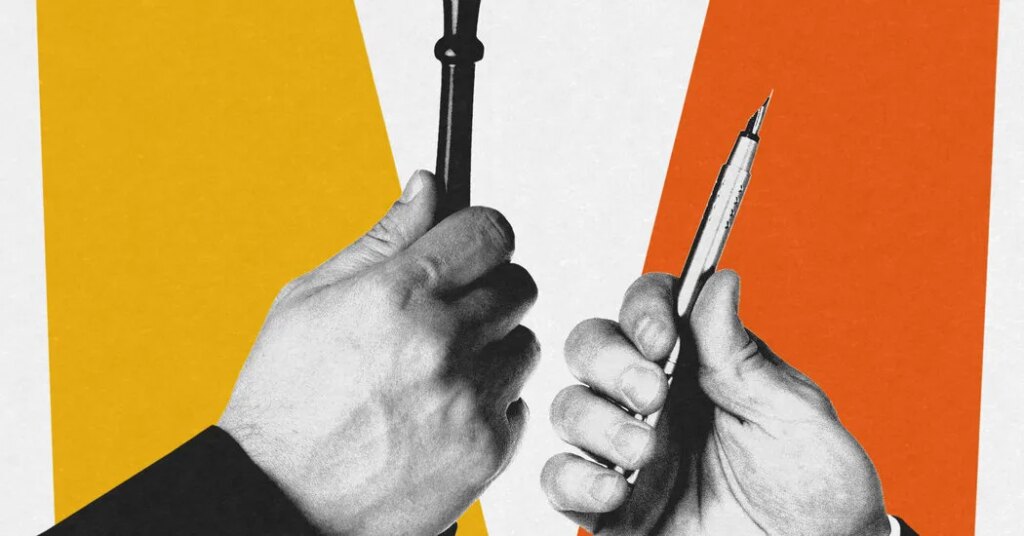
Source images for illustration above: iStock, via Getty Images; Glowimages, via Getty Images.
The post Congress Is Supposed to Be More Powerful Than the Supreme Court. Why Isn’t It? appeared first on New York Times.