It’s a turbulent time for Trumpism. President Trump’s approval ratings have sunk to new lows, and congressional Republicans have left Washington for their districts showing greater alarm over their chances in the upcoming midterm elections.
Have the strains of Trump 2.0 taken any wind out of the sails of the populist right — and will they prompt a reconsideration of what it means to be a conservative?
Stephanie Slade, the author of “Fusionism: Liberty, Virtue and the Future of the American Right,” explored those questions in a written conversation with John Guida, an editor in Times Opinion. It has been edited for length and clarity.
John Guida: With the political fortunes of Trump and the G.O.P. looking shaky, at least for the moment, are you hearing concerns or doubts about Trumpism itself or the direction of conservatism from conservatives?
Stephanie Slade: Oh, yes. I’ll give you two examples. As I speak with conservative voters, including some who cast votes for Trump in three elections in a row, I’m increasingly hearing them say they feel betrayed — over his war of choice in the Middle East, over his reluctance to release the Epstein files, over his administration’s apparent focus on anything and everything but people’s No. 1 priority of bringing down the cost of living. Trump once said he could shoot someone on Fifth Avenue and his base would stand by him, but I think that’s finally starting to change, at least on the margin.
The second thing I would point you to is the exodus last winter of scholars, donors and board members from the Heritage Foundation. When the Heritage president, Kevin Roberts, proudly defended Tucker Carlson after Carlson hosted Nick Fuentes for a chummy interview, a number of conservatives suddenly awoke to the ideological extremism and moral rot that had taken root on parts of the right, and many people showed fairly decisively that, however they may feel about Trump, they wanted nothing to do with groyperism.
Guida: Do you see these developments as a sign that conservatives are retreating from some of the commitments of Trumpism — like, say, tariffs — or are they just disappointed with Trump himself?
Slade: There’s a dawning recognition that Trump the man is an unreliable ally. He will say one thing on the campaign trail — no new wars! — but not feel the slightest bit constrained by his promises while in office. Another thing is the self-dealing: the genuine corruption of historic proportions in which the president’s powers are being abused to enrich his allies and family members, sometimes at taxpayer expense. People see that and wonder what happened to draining the swamp?
Guida: This week, some intellectuals of the populist right — the New Right, or as you call it, the Dissident Right — are meeting at the National Conservatism conference in Jerusalem. At the first edition of these gatherings, in Washington in 2019, the Israeli philosopher Yoram Hazony declared an “independence day” from many conservative predecessors and principles. Does the decline in Trump’s standing, even at the margins, have any impact on the broader national conservative project?
Slade: Many self-described national conservatives, including Hazony and the aforementioned Kevin Roberts, bet all their chips on Trump and Trumpism as the future of the conservative movement. That bet looks at the very least more questionable now. Polling suggests that the American people do not believe the MAGA agenda is delivering for them. This is going to be a definite challenge for the folks who have turned their whole intellectual and institutional purpose to the promotion of what I call “will-to-power politics” on the theory that this is what voters really want.
Guida: What is will-to-power politics?
Slade: It’s an approach that sees politics as purely a war to determine which side will get to wield power to reward its friends and punish its enemies. On the right, it explicitly repudiates the old-school Reagan-style commitment to limited government and free markets and instead calls on conservatives to be more “muscular” and less squeamish about using the coercive power of the state to enact their values and their conception of the common good.
At the end of the day, hatred toward the opposition is treated as a virtue. The goal, above all, is to defeat and destroy the other side rather than try to figure out how to coexist peacefully in a diverse society of 342 million people.
Guida: You have argued for a different path for conservatism — related presumably to the Reaganite approach — in which Republicans rediscover fusionism, a philosophy that emerged in the postwar years and prevailed on the right until the emergence of Trumpism. What is fusionism?
Slade: It’s the idea that both liberty and virtue are necessary for human flourishing. Mid-century fusionists argued that the American founding represented a synthesis of the Judeo-Christian moral tradition, with its lessons about the habits and choices that lead to a fulfilling life, and what we would eventually come to call the classical liberal political tradition, with its commitments to individual rights, the rule of law and so forth. Until about a decade ago, this was more or less a consensus position on the American right. But that consensus has now broken down.
Guida: So it’s a synthesis of what you call virtue (the moral tradition) and liberty, or freedom. A citizen needs to know how to live virtuously with that personal freedom. You need both.
Slade: Exactly. Unlike at other times and places, where conservatives were defenders of, say, the monarchy and the aristocracy, the throne and alter, in this country conservatives were long concerned with protecting individual liberty from government tyranny while also cultivating a healthy moral culture rooted in religious truths.
Guida: You mentioned that the consensus broke down with the emergence of Trump. How do you assess Trump’s second administration in particular on the axis of virtue and liberty?
Slade: Trump represents a profound departure on both axes. From name calling to mockery of political opponents, the virtue piece is self-evident. And while there are moments when he has claimed to be concerned with protecting individual liberty (by trying to reduce the size and scope of government through the Department of Government Efficiency, for example), on the whole he seems to believe he should face almost no constraints — legal, electoral or otherwise — on his ability to use the powers of the presidency to fulfill his every whim. Think of his demands that the Department of Justice investigate his enemies, or his threats to demolish the Kennedy Center if the courts won’t allow him to put his name on it, or his declaration that “He who saves his Country does not violate any Law.” This is the antithesis of classical liberalism’s commitment to separation of powers, checks and balances, decentralization and so on.
Guida: And so what about virtue and liberty was no longer fulfilling the wishes and aspirations of conservatives? Or the vision for the country that someone like Mitt Romney offered?
Slade: I’ll be honest with you: Broad swaths of the American electorate, including members of some demographics that were once solid Democratic constituencies, came to feel extraordinarily resentful that both the Democratic Party and a lot of powerful cultural institutions (higher education, the mainstream media) were going all in on a sort of militant identity politics that treated more tradition-minded Americans as evil or backward.
This created a real siege mentality, where people were inclined to throw their lot in with someone whom they perceived as on their side and who said he would fight the forces that were hostile to them. Mitt Romney did not strike people as being up to the task of defending them in the midst of a culture war. Tragically, principled philosophical commitments to things like liberty and virtue (and even the Constitution and the ideals of the American founding) can be easily forgotten in a culture-war context.
Guida: Do you now get the sense now, 10 or so years on, with Democrats out of power and wrestling in many ways with the excesses of “Woke 1.0,” and with Trump in power and using the federal government forcefully in various ways (foreign policy, the Justice Department, etc.), that there is a renewed openness to fusionism?
Slade: I do. As recently as three years ago, people were telling me: “Fusionism is dead, and it’s not coming back. Give it up.” But I’m finding that there is actually an enormous amount of hunger for an alternative to the politics-as-war approach that we’ve been getting from both the far left and the far right.
Most Americans really do want to find a way to share their country peacefully with their neighbors even if they disagree. Most Americans really do believe that everyone deserves equal treatment under law. Most Americans were horrified by the excesses of wokeness as well as the white nationalism that has emerged out of the dark corners of the internet and now finds expression from more mainstream voices such as JD Vance, Eric Schmitt and Bo French.
People reach out to me all the time to say they didn’t know there was a word for what they are, but now they do. Fusionism has been out of fashion lately, but it’s deeply rooted in our cultural memory.
Guida: Can the Republican Party emerge from Trumpism to become fusionist again? It seems a long way from that right now, no?
Slade: It has drifted a long way, yes. And Trump’s current heir apparent, Vice President Vance, is an open proponent of anti-fusionist, Dissident Right ideas. So I don’t see this intellectual divide having a clean resolution anytime soon. But I do think it’s a live debate, and those who count fusionists out have jumped to a premature conclusion.
Guida: Maybe you could talk about ways in which virtue and liberty might stand up to MAGA. If, as you suggest, those fusionist virtues broke down in the face of a cultural threat from the left, have they evolved at all to better command the allegiance of the conservative movement?
Slade: When writers and scholars and youth activists were making the case for fusionism the first time around, in the 1960s, they didn’t know that their arguments would influence Ronald Reagan, who would then use them to take the political world by storm.
You need the right person and the right moment. But resurrecting the ideas and making the case for them seems to me to be an important first step. And the electorate getting to see MAGA’s ideas in action, and how badly they are failing to live up to their promises, should help.
Guida: Who are some of the figures that may be future Reagans? Or at least leaders who give you some hope that the vision of conservatism that you argue for can flourish?
Slade: It’s not clear to me who might be able to act as a figurehead for fusionist ideas on the national stage in the coming years. Most of the fusionists have, alas, been driven out of our politics. It’s going to require winning over the next generation, because only they can offer fresh talent and a fresh way of expressing these age-old ideas for the current moment.
Guida: What about the past — who would you point to as a great fusionist leader? I’m assuming Reagan is one. Who else?
Slade: Well, someone like former Senator Ben Sasse of Nebraska is a more recent example of someone with strong principles and a clear commitment to both liberty and virtue as nonnegotiable. The positive reception he’s gotten as he’s been giving interviews about his experience battling cancer, talking openly about his faith and speaking hard truths about the dysfunctions of our political system suggest that there is more of an appetite for these ideas now than there was even a few years ago.
Most Republicans were once essentially fusionists. On the other hand, some people who a decade ago were eloquently defending fusionist ideas in Congress showed themselves all too willing to abandon them when it seemed politically expedient.
Guida: That does not sound like virtue. How do you define virtue in this context?
Slade: I agree. It has been disappointing to watch. Virtue in the Judeo-Christian understanding would be those habits that, in keeping with our nature as human beings created in the image of God, promote flourishing and allow us to become the most excellent versions of ourselves.
Guida: Does one have to be Judeo-Christian to be virtuous, or you just mean that in the sense of how that tradition has shaped American culture (or both)?
Slade: I definitely wouldn’t argue that you have to be a Jew or a Christian to be virtuous. Many faith traditions offer similar guidance about what a good life looks like and how to pursue it, and I know plenty of nonbelievers who are some of the kindest and most generous friends and neighbors you’ll ever find.
If fusionism is the marriage of the Judeo-Christian tradition with classical liberalism, a fusionist is someone who is respectful of the wisdom that tradition hands down and thinks it would be a mistake to jettison those lessons in the name of maximum personal liberation. Not everyone is going to qualify as a fusionist by that definition, but you don’t have to be personally religious to think there’s something valuable there worth defending.
Guida: You draw a distinction between governmental and nongovernmental spheres. Maybe you could identify places or issues in Trump 2.0 — or in a previous Democratic administration — where you would argue that that line was blurred?
Slade: Under the traditional fusionist framework, government’s job is to protect basic rights and liberties and allow individuals to pursue a virtuous life. It is not government’s job, under this framework, to decide for us what virtue requires and to impose it through force of law.
Unfortunately, both parties have gotten very comfortable with the idea that politicians know what virtue is better than the people do. Whether that’s banning gas stoves or calling for greater censorship of supposedly dangerous ideas, we have become way too willing to let government dictate good choices to us (especially, of course, when our side is the one doing the dictating).
Guida: And you also stress the importance of civic institutions like a church or a sports league, right? What role do they play?
Slade: Max Weber has a famous definition of the state as the entity with a monopoly on the use of violence in society. Whatever government does inevitably involves imposing a one-size-fits-all solution from the top down.
The alternative is to let people join together to form associations that reflect their values and allow them to pursue shared goals. In the nongovernmental sphere of life, nobody is coerced; people can opt in or out. As a result we don’t have to treat every election or policy disagreement as a battle to the death about which group’s way of life will be imposed on society as a whole.
Healthy pluralism relies on a rich patchwork of overlapping civil society institutions that are competing and collaborating to meet people’s needs. But civil society does best when government takes a light touch.
Guida: In a similar vein, you have also said that “the law is not a magic wand.” The idea, I take it, is that we can’t solve divisions by rule-making. Persuasion is more effective. Do I have that right?
Slade: Yes, I really want us to get out of the habit of reflexively assuming that the best solution to any social problem is to pass a law. Government is a blunt instrument, as libertarians like to say. And if you haven’t done the hard, slow work of persuasion, of shaping the culture, of changing hearts and minds, passing a law often fails to solve the problem and can even make it worse.
We should see ourselves as on the front lines of solving problems in our communities, not as mere taxpayers who have outsourced responsibility to some faraway government bureaucracy to solve things for us.
Guida: You admire “subsidiarity,” the idea that state governance is better than federal, and local governance is better than state, and so forth. You think both Democrats and Republicans should try to do less with the federal government?
Slade: One hundred percent yes, both parties should try to do less at the federal level. Washington is just not well suited to knowing what local communities need. When different communities need different things, Washington struggles to know how to respond.
That said, subsidiarity is about moving the locus of decision making closer to the individual. So for me, while local government is better than state government, getting government out of the way and letting families and voluntary nongovernmental institutions solve problems is usually better still.
Stephanie Slade, a senior editor at Reason, is the author of “Fusionism: Liberty, Virtue and the Future of the American Right.” John Guida is an editor in Times Opinion.
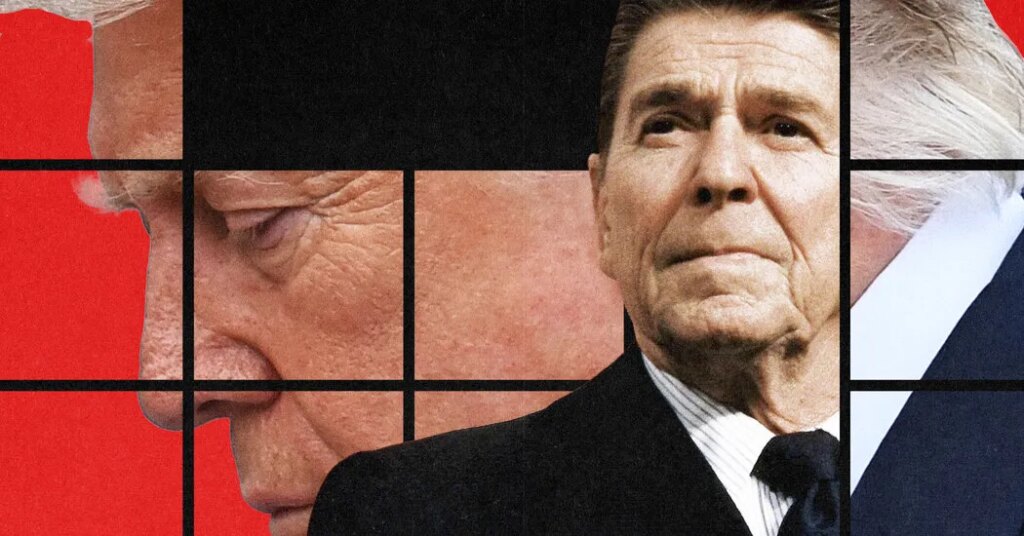
Source photographs by Charles McQuillan and Universal Images Group/Getty Images
The Times is committed to publishing a diversity of letters to the editor. We’d like to hear what you think about this or any of our articles. Here are some tips. And here’s our email: [email protected].
Follow the New York Times Opinion section on Facebook, Instagram, TikTok, Bluesky, WhatsApp and Threads.
The post Disappointed by Trump? There Is a Better Way to Be a Republican. appeared first on New York Times.