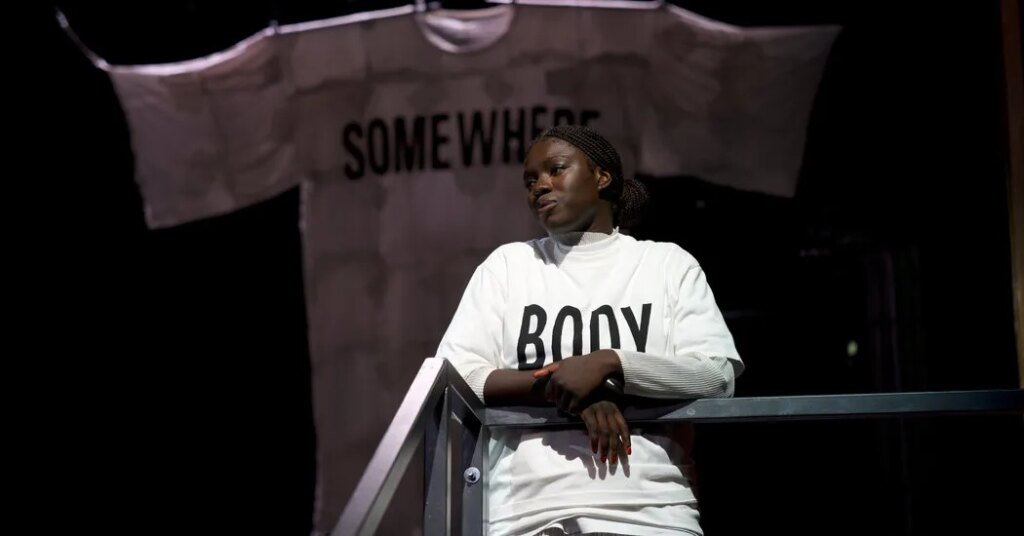
By most standards, Vincenzo Latronico’s novel “Perfection” is a strange candidate for a stage adaptation. The Italian writer’s short novel — which became a sensation when it came out in English translation last year — ostensibly centers on two millennial expatriates living in Berlin in the 2010s, when low rents and costs made the city a magnet for young people.
But the book, which hit a nerve internationally for its incisive critique of lifestyle consumerism and digital-nomad culture, has only thinly sketched characters named Anna and Tom, and no dialogue. It has little plot, and its pages are mostly filled with descriptions of household belongings, social media feeds and banal activities like dinners and art openings.
Last weekend, however, the Volksbühne theater in Berlin premiered an ambitious attempt to reimagine Latronico’s story for a live audience — and to provoke audience members who fit the demographic of its characters.
“All of Berlin hates Anna and Tom,” said Anta Recke, the play’s 37-year-old German Senegalese director, “but all of Berlin also is Anna and Tom.”
Eschewing direct adaptation of the book’s (modest) events, the play features a cast of six actors largely reading out sections of the novel, dressed in T-shirts bearing variations on the words “international nobody.”
The performers slink around the theater, which has been configured like an arena, recounting Anna and Tom’s story in a mix of — frequently broken — German and English. The descriptions of everyday activities and the characters’ online lives are interspersed with more abstract episodes, in which the performers wrestle and sing.
Bright lights are directed at the viewers for most of the performance — so they see themselves as implicated in Latronico’s critique, Recke said. In one extended scene, performers rearrange audience members in the theater to achieve an ideal configuration for the space.
Recke said the performance was meant to be a kind of “forum” for a discussion of the ideas the book raises: class, gentrification, consumerism and democracy. The actors, she said, were both “hosts” and stand-ins for the audience, whom she hoped would reflect on their own similarities to the books’ alienated characters. (The T-shirts, she said, were inspired by a sticker she noticed in a club bathroom.)
As Recke pointed out, the book uncannily captured the atmosphere of Berlin during the last decade of Angela Merkel’s chancellorship, when the city experienced an influx of international expats, many of whom worked online jobs and circulated in English-speaking social bubbles isolated from German-speaking locals.
“I immediately saw the book as political,” Recke said, adding that she viewed it not only as a cautionary tale about the meaninglessness of consumerism, but also of the dangers of social and political disengagement. “This sadness and loneliness is rooted in the unfulfilled promises of democratic participation,” she said.
A Munich native who has spent much of the past two decades in the German capital, Recke said she had encountered many of the “scenes, atmospheres, aesthetics and surfaces” described in the book. But she also argued that the novel had resonated internationally because the aspirational yet isolating relationship with online culture that it depicts is universal.
The book, which is heavily inspired by Georges Perec’s 1965 novel, “Things: A Story of the Sixties,” was first published in Italian to little fanfare in 2022. It did not become a success until it was published in English three years later by Fitzcarraldo Editions, a small British press.
Writing in The New York Times, the critic Ryan Ruby argued that “Perfection” would spur recognition from readers who “belong to the same class and generation” as its protagonists, “whether or not they live in Berlin.” A New Yorker critic wrote that the book’s “magic trick” was to “reveal readers to themselves — gently, in the way a therapist might encourage a patient to arrive at an unflattering truth.”
In an interview before the premiere, Latronico said that he had spoken to several theaters in Italy shortly after the book came out there about adapting it for the stage. The projects fell through in part, he said, because “there’s no immediate way to turn this book into a story where people actually do things.”
He agreed to the Volksbühne adaptation because of the theater’s long history of experimental productions and because he was heartened by Recke’s plans to “formally reinvent” the book. (He has since been approached by two other international theaters about stage adaptations, he said, and is working with producers on a movie version.)
The political context, he noted, had changed since the book first came out. “Perfection,” he said, captured a period in the 2010s when there was still a “naïve optimism” about the future, aside from “big blips” to the liberal order like the election of Donald Trump or Britain’s vote to leave the European Union.
From today’s perspective — with the conflicts in the Middle East and Ukraine — the characters’ “privileged, sheltered, naïve ennui” seems even more jarring, he said. He added that he hoped that a Berlin audience would be able to clearly grasp his book’s political undertones after seeing the live performance.
Rahel Fügener, a 28-year-old architect in the audience who had not read the book, said that she saw “a disturbing amount of overlap” with her own life. “You keep running into the question of meaning,” she said. “Like, why are we even doing this?”
But the fact that much of the play is in German is likely to kept away many members of the city’s English-speaking expat community who most resemble Anna and Tom. Britta Hansen, a TV producer in the audience who has lived in Berlin for decades, said that she was provoked not by the show’s lifestyle critiques but by the fact that it had been staged at all. “To have given this space to such privileged, insular lives,” she said, “that is the provocation.”
The post A Defining Millennial Novel’s Unlikely Journey to the Stage appeared first on New York Times.