Producers of solar panels in the United States say they are on the cusp of a technological breakthrough that could upend the industry and even threaten China’s grip on it.
The manufacturers are racing to develop new kinds of panels that can generate 25 percent more energy than most such devices available today. If they are successful, the advance will allow the world to meet the rapidly rising demand for electricity with less land and roof area.
The new technology, known as tandem solar, involves adding second and third layers of material, like a layer cake, to allow panels to convert more of the sun’s radiance into electricity.
Researchers have been working to perfect tandem panels for many years, but now several companies, including Tandem PV, First Solar and Hanwha Qcells, say they are preparing to sell such panels commercially soon, after successfully testing the devices and obtaining certifications from technical bodies.
“It is the next frontier,” said Mike Carr, executive director of the Solar Energy Manufacturers for America Coalition. He acknowledged that Chinese companies were also working on tandem solar but said their technology “is not better than ours and maybe even behind us.”
But the new tandem panels and their manufacturers will face many challenges. Power producers will be reluctant to buy new devices that are too expensive or until manufacturers can convince them that tandem panels will not degrade more quickly than conventional panels.
U.S. politics could be another barrier. Republicans in Congress and the Trump administration have made it hard for new solar farms to obtain federal permits while trying to increase the use of fossil fuels and nuclear power plants.
Then there is China, which controls about 80 percent of the solar panel market by supplying either panels or their components.
China devastated the U.S. solar panel manufacturing industry by offering devices at prices far lower than companies in the United States, Germany and Japan — which dominated the industry until around 2010.
The Biden and Trump administrations have tried to revive U.S. solar manufacturing with tariffs, subsidies and other policies. Partly as a result, new factories have been built across the country in recent years. Hanwha, a South Korean company that bought the German solar manufacturer Qcells in 2012, has spent billions on production lines in Georgia, including in Cartersville, north of Atlanta.
Energy experts say perfecting tandem panels before the Chinese do would allow the United States, Germany and other countries to reclaim a big share of the global solar industry.
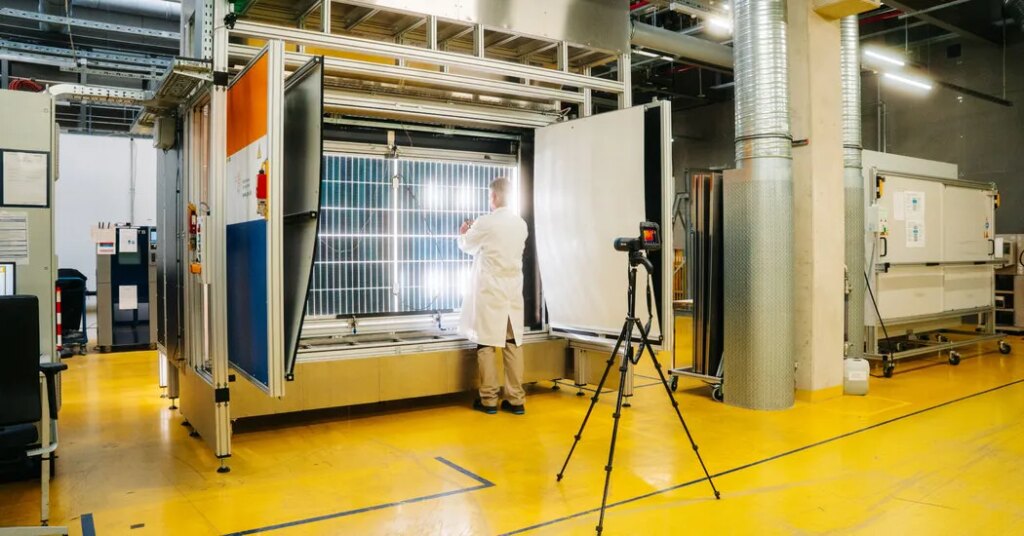
Qcells has been testing its tandem solar panels in its lab in Germany as well as in fields in the United States, Australia, Cyprus and South Korea to show that they are ready. Among other things, the company has been blasting panels with LED light to see how they will perform. It has also been firing balls of ice — some roughly the size of marbles, others as big as or slightly bigger than golf balls — at panels to see how they handle extreme weather.
The tests are designed to reassure energy companies, investors and lenders that the new panels will last 20 to 30 years once they are installed in baking deserts or in fields subject to torrential downpours.
The power industry is “quite conservative in accepting new technologies,” said Fabian Fertig, head of tandem research and development for Qcells, who is based in Leipzig, Germany. “We’ve been focused on stability. We have to convince banks that this new technology can deliver.”
Scientists developed early tandem panels decades ago, but it has taken time to ensure that they could withstand harsh conditions — from heat and humidity to pounding hail.
“There are all these questions around how long they actually last,” said Chetan Krishna, a principal at RMI, a research organization that specializes in sustainability and was previously known as the Rocky Mountain Institute. “Are there degradation issues that we don’t know yet?”
Mr. Krishna and other experts say they believe the tandem solar panels are very close to being ready.
But the technology remains expensive. By some estimates, these panels could cost three to three and a half times as much as conventional devices, which are typically made of one layer of silicon.
The cost of buying and installing conventional panels for solar farms ranges from about 93 cents to $1.06 per watt, according to a report by the Solar Energy Industries Association.
Andrés Gluski, chief executive of AES, a big utility and power company, said price would be crucial to the success of tandem panels because Chinese manufacturers sold solar panels at very low prices. China “could probably supply the world twice over,” he said.
The technology for modern solar panels was created at AT&T’s Bell Labs in 1954. But broad use of it didn’t take off until the 1980s as the devices became more efficient at converting sunshine into electricity. Improvements helped lower costs and have made the technology the cheapest way to generate electricity.
In recent years, energy companies have also figured out how to pair solar panels with batteries to supply energy hours after the sun has set. Solar and batteries accounted for 70 percent of the capacity added to U.S. grids in the first half of this year, according to Wood Mackenzie, an energy research firm.
Solar energy made up nearly 9 percent of the electricity produced in the United States in 2025, up from 3 percent in 2020, according to the Energy Information Administration.
Widespread use of tandem panels could significantly increase solar’s share of the country’s electricity, helping to satisfy the surging demand for power from data centers used to develop artificial intelligence.
Energy analysts evaluate the dependability of different sources of power by measuring their capacity factors. In theory, a power source that can supply electricity 24 hours a day, 365 days a year would have a capacity factor of 100 percent. But no power plants operate at that level because they require maintenance, upgrades, refueling and so on.
Nuclear plants typically offer the highest capacity factors, in the low 90s. Large natural gas power plants generally operate at about 58 percent, while U.S. solar farms average roughly 24 percent, according to the E.I.A. That is primarily because they produce electricity only when the sun is shining and cannot convert all of the light they receive into usable energy.
Solar executives assert that tandem panels could have capacity factors of more than 31 percent. As a result, energy companies would be able to generate the same electricity on less land and with fewer materials.
“If you build a utility field, you need fewer cables,” said Mr. Fertig of Qcells. “If you have a rooftop, you can get the same power out of less of your rooftop.”
Qcells became the first manufacturer to make a tandem panel that has been certified by UL Solutions and the International Electrotechnical Commission, two groups that validate and set standards for various products.
Another company working on such devices — Tandem PV in Fremont, Calif. — says it has been testing panels under various conditions across the country for the last year.
“We’re showing less than 1 percent degradation per year,” Scott Wharton, chief executive of Tandem PV, a name that refers to the photovoltaic technology used to convert sunlight into electricity. He added that tandem solar panels would dominate the industry by the mid-2030s. “There’s no debate in the industry that we will move to tandems.”
The design of tandem panels favors First Solar, one of the few U.S. manufacturers that survived as Chinese producers became dominant. First Solar’s products use a thin film material that other manufactures would most likely need to perfect to make the layers in tandem panels.
“We’ve invested over $2 billion in thin film research and development, including this program,” said Mark Widmar, chief executive of First Solar, in Phoenix.
Some energy companies have bought early versions of the tandem panels to ensure that they do not get left behind, said Wayne Li, a principal at the Electric Power Research Institute, a nonprofit research organization. How dependable and durable the panels are will require extensive third-party testing, he added.
“Manufacturers are not very open to share the details and the data,” Mr. Li said.
The post A New Crop of Solar Panels Is the U.S.’s Best Hope of Catching China appeared first on New York Times.