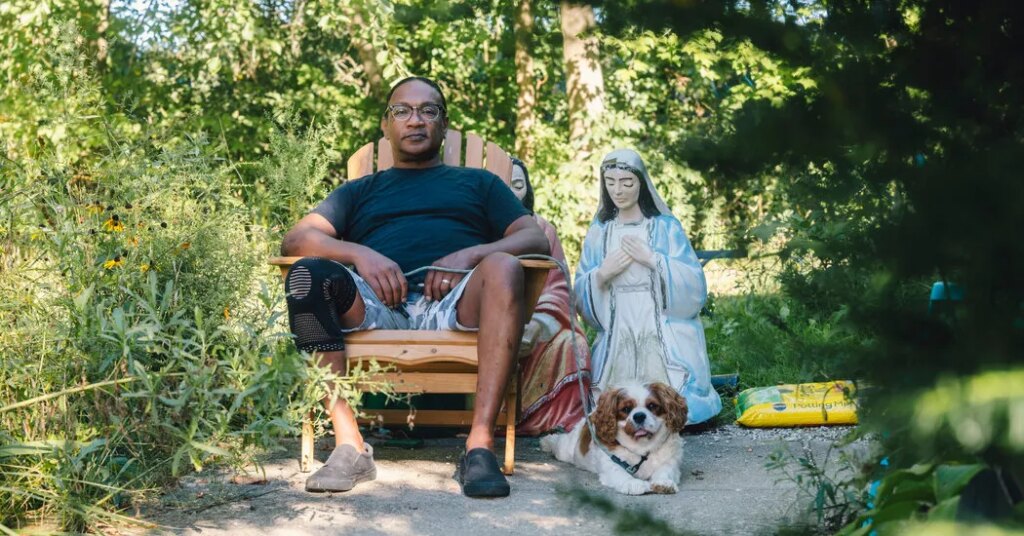
Before any criminal charges were filed, before any weapons were drawn, before anybody mentioned the president, a dog named Bob wanted to go to the park.
Bob’s owner, David Mattai, had the week off from his job as a forklift mechanic. Mr. Mattai, 55, first tried taking Bob on a hiking trail, but the spaniel refused to walk. So Mr. Mattai drove to his favorite dog park in Bainbridge, Ohio.
At a picnic table inside the park that April afternoon was Emmanuel Mathews, 80, and his corgi, Frankie.
Mr. Mathews was retired from a career as a meat distributor, and on the days when his back wasn’t causing him problems he was a regular at the park. He had brought a copy of The Wall Street Journal with headlines that included “Trump Grapples With Fears on War.”
The events that unfolded over the next 20 minutes — pieced together from interviews, records and body camera footage — would be unusual, but hardly unthinkable in a country where political tensions so often combust. Two men, one Black and liberal, one white and conservative, would disagree about President Trump. Their disagreement would become an argument, then a screaming match and then, because both men had guns in their cars, a crime.
What happened at the dog park — and who is to blame — will soon be scrutinized by a judge and a jury, as both men face the possibility of time behind bars and grapple with the lifelong consequences of division turning violent.
Likely to take the stand in both cases is Jamie Jedlinsky, 70, the singular witness to what went down.
Mr. Jedlinsky’s mother had taught him that you didn’t have to tell people who you voted for, so he never did. If someone brought up politics, he would usually change the subject to birding. But on this day, Mr. Jedlinsky and his pit mix, Willow, had walked into the park and greeted Mr. Mathews, with whom he had become somewhat friendly over the years. When he noticed the newspaper in Mr. Mathews’s hands, he decided to gesture to the headline about the Iran war and say, “That sucks, don’t it.”
Mr. Mathews, who goes by Mike, disagreed. In his cardigan, he began to discuss his support for the president’s choices.
Mr. Mattai, who had arrived moments earlier in sweatpants, was listening. He considered himself a democratic socialist before it was trendy. He owned a collection of bumper stickers with messages such as “Trump Is a Felon” and “Hicks Don’t Mix With Politics.” In his solidly Republican patch of Northeast Ohio, he considered it his moral duty to “comfort the afflicted and afflict the comfortable.”
Mr. Mattai, who had struggled with alcoholism for most of his life, would later say he had been drinking that day.
He decided to butt in. “Trump is the worst president in history,” he said, to which Mr. Mathews replied, “Trump is the best president in history.”
The spat quickly grew in intensity and volume. At one point, Mr. Jedlinsky recalled, they were saying, “You shut up!” and “No, you shut up!”
“Just two guys, mad at themselves, mad at the world,” Mr. Jedlinsky said. “They both wanted to just yell at someone, and they ran into the perfect storm, where there’s somebody yelling back.”
Mr. Jedlinsky was relieved when the younger man finally heeded his advice to both of them to let it go. Mr. Mattai leashed Bob, returned to his Hyundai and began to drive toward the park’s exit. But then Bob started to whine.
“Man, you did want to stay at the park,” Mr. Mattai recalled telling his dog. He turned his car around.
Some of the specifics of what happened next remain in dispute. But Mr. Jedlinsky, Mr. Mattai and a lawyer for Mr. Mathews agree upon a certain set of facts. (Mr. Mathews declined to be interviewed.)
Mr. Mattai entered the park again and told Mr. Mathews that he should be the one to leave. Mr. Mathews began to move toward his Cadillac, which was adorned with a corgi sticker. When he made it to the other side of the fence, he turned around.
“Did your mother drop you on your head?” he asked.
“You talking about my mother?” Mr. Mattai responded. He reached across the fence and grabbed Mr. Mathews by his grayish white hair. Mr. Jedlinsky pushed them apart and told them both to go home. While the three men were putting their dogs in their cars, Mr. Jedlinsky heard Mr. Mattai say: “Oh you’ve got one? I’ve got one, too.”
Then Mr. Jedlinsky heard gunshots.
Mr. Mathews had a .45-caliber handgun in his car. He fired first; when he pulled the trigger a second time, no bullet came out. Mr. Mattai had a 9-millimeter pistol in his car. He fired back at least four rounds. The bullets sprayed across Mr. Mathews’s car and into his open window as Mr. Mathews drove away. They pierced his door frame and the driver’s seat, missing him by inches.
Mr. Jedlinsky crouched behind his wheel and called 911.
“It escalated,” he told the dispatcher.
When a police officer arrived, he found Mr. Mattai splayed on the pavement. There was a hole in his lower back where Mr. Mathews’s bullet had entered, and another in his abdomen where it had exited.
The passenger-side door of his Hyundai was open. Bob was in the front seat, unharmed, tongue out.
‘I Shot Him’
Mr. Mathews peeled out of the parking lot and drove toward the Bainbridge police station. In this area of Northeast Ohio, where the Cleveland suburbs begin to meet rural farmland, Mr. Mathews was familiar with law enforcement. Before he retired, his meat company had provided burgers and cutlets for police events.
He had made it about four minutes up the road when he saw a Bainbridge police cruiser, siren on, coming toward him. Mr. Mathews stopped his car and flashed his lights. The officer pulled over.
“You going to the shooting?” Mr. Mathews asked. “I was part of it.”
The officer, whose body camera was rolling throughout their interaction, confiscated Mr. Mathews’s handgun, patted him down and removed a piece of paper from the pocket of his cardigan.
“That was my list for the day,” Mr. Mathews told the officer. “This wasn’t on it.”
He quickly informed the officer of his local connections: the cops he knew, the poker game he used to play with the former police chief, and the fact that he happened to be living with the mother of the county’s top prosecutor. Before long, Mr. Mathews was telling his side of the story from the back of the police cruiser.
He lifted his handcuffed wrists to wipe tears from his eyes. There was a small cut on his cheek. He said the other man had not just grabbed his hair, but also head-butted him before they went to their cars.
He did not say who pulled a gun out first.
“I said, ‘I feel my life is in danger.’ I said that ’cause I know that’s what they say,” Mr. Mathews told the officer. “And he went around the side of his car and started coming at me, and I shot him.”
At the police station, he kept talking as the officer confiscated the cross around his neck, the Greek coin ring on his finger and the $890 in his wallet.
“That’s a bad thing I did, but it really wasn’t,” Mr. Mathews told the officer. “This guy had a gun in his hand.”
In the back of the police car and while being booked, he asked four times about the well-being of his dog, Frankie. He did not ask about the condition of the man he had shot.
‘We’ve Seen This Movie’
At the hospital, Mr. Mattai’s wife, Sally, couldn’t stop crying. The doctors had explained that her husband was in emergency surgery, and they couldn’t say for sure if he would make it through.
When he did, Mr. Mattai learned that the bullet had torn through his intestines and fractured his spine. He had a second surgery the next day.
It didn’t surprise his wife to learn how the confrontation at the dog park had started. It was politics, in part, that had brought her and Mr. Mattai together about a decade earlier, in a Facebook group where they shared memes.
Mr. Mattai had told her how he had immigrated from Guyana at 10, become an American citizen and joined the Marines. He worked as a paramedic in California until his alcohol addiction cost him his job. When the two met, Mr. Mattai had moved in with his father in New York and was trying to start over. He went to welding school.
When he moved to Ohio to be with Sally, they lived on nearly four acres in a rural area. They flew a Kamala Harris flag in 2024, but took it down the morning after the election. One of their neighbors, they said, kept up a cardboard cutout of Mr. Trump showing two middle fingers.
Now, Mr. Mattai’s wife felt certain that what happened to him was a result of Mr. Trump’s disparaging of minorities.
“We’ve seen this movie before, the whole, ‘I feared for my life because it was a Black guy’ crap,” she said.
Her husband agreed. He initially told the police, from his hospital bed, that he had not touched Mr. Mathews and did not speak to him after seeing his gun. Mr. Mattai later told The New York Times that he had grabbed Mr. Mathews by the hair, but said that had been the extent of the physical contact.
“I was in the infantry for 10 years,” Mr. Mattai said. “If I had head-butted him, he would not have driven off anywhere.”
Though Mr. Mattai told The Times that he had served in the Marines for a decade, the Marines said his length of service was less than a year. Asked about the discrepancy, Mr. Mattai apologized, saying he had become accustomed to embellishing his military record because he was embarrassed about his past.
“It’s like the facade I made up for the world,” he said. “I didn’t want to tell them that I just, kind of, had this life of a bum.”
Two weeks after the shooting, Mr. Mattai was released from the hospital. He struggled to walk with a walker and had severe pain down the right side of his body. He needed months of rehab. But first, he had plans.
As soon as he got home, he said, he poured all his vodka down the drain. Then he went to his garage, where he kept his collection of political bumper stickers. He threw them in the trash. From then on, he said, he wasn’t going to drink and he wasn’t going to confront anyone about their political views.
Mr. Mattai concluded that it must have been God who sent Mr. Mathews and his gun to the dog park to teach him a lesson.
“I needed violence done to me to correct the path that I had put myself on,” he said.
But he still wanted to see Mr. Mathews sent to prison.
‘My Own Life Sentence’
Mr. Mathews was charged with felonious assault, a second-degree felony. If convicted, he could face up to eight years in prison and would be required to serve at least three. After posting a $50,000 bond, he was released with a GPS ankle monitor.
His trial is scheduled for February. His lawyer, Ian Friedman, plans to argue that the shooting was justified. Under the “stand your ground law” passed by Ohio Republicans in 2020, someone facing an imminent threat of serious harm does not have to try to escape before using deadly force.
“This case was never about politics or any other motivation, other than Mike being faced with a life or death situation and acting to save his life,” Mr. Friedman said.
In recent years, Mr. Mathews had endured a heart attack, a stroke and two back surgeries. Now at 80, he was reckoning with the possibility of spending what could be his final years in prison.
On the day he was arrested, Mr. Mathews told the police, “I should have been more of a coward, and this wouldn’t have gone this far.”
The local prosecutor — the one whose mother lives with Mr. Mathews — recused himself from the case and brought in the Ohio Attorney General’s Office.
That office was not asked to consider potential charges against Mr. Mattai, according to a spokesman.
But in August, four months after the shooting, Mr. Mattai received a call from his lawyer telling him that there was a warrant out for his arrest. He turned himself in.
The next morning, he learned that a prosecutor from another county had been brought in on the case. The prosecutor was charging Mr. Mattai with misdemeanor assault and disorderly conduct based on Mr. Mathews’s claim that Mr. Mattai had head-butted him. Mr. Mattai faces up to six months in jail.
He said he was willing to plead guilty or no contest when he returned to court in late October, if it meant avoiding jail time. He now walks with a limp and says he can’t return to his forklift mechanic job because he is unable to lift heavy objects.
“I got my own life sentence from this,” Mr. Mattai said. He has not taken Bob back to the dog park.
Mr. Jedlinsky, the man who tried to break up the fight, spent months away from the park, too. He said he was so shaken up in the aftermath that he didn’t sleep.
He didn’t remember seeing a head butt. He couldn’t say what Mr. Mattai was doing when the bullet entered his back. He wasn’t taking sides, in this fight or any other.
“This country is in a big divide right now,” Mr. Jedlinsky lamented. “It’s, ‘You’re either with us or against us.’ You’ve got a pick a side and hate the other side.”
Mr. Jedlinsky had spent months thinking about that day when his life had been put in danger. After everything it had cost the men involved, he was certain of one thing: Nobody’s mind had been changed.
The post They Argued About Trump at a Dog Park. Then They Pulled Their Guns. appeared first on New York Times.