In today’s edition … Things are not going well for Republicans in North Carolina … We ask you about Trump’s latest promised checks from the federal government … but first …
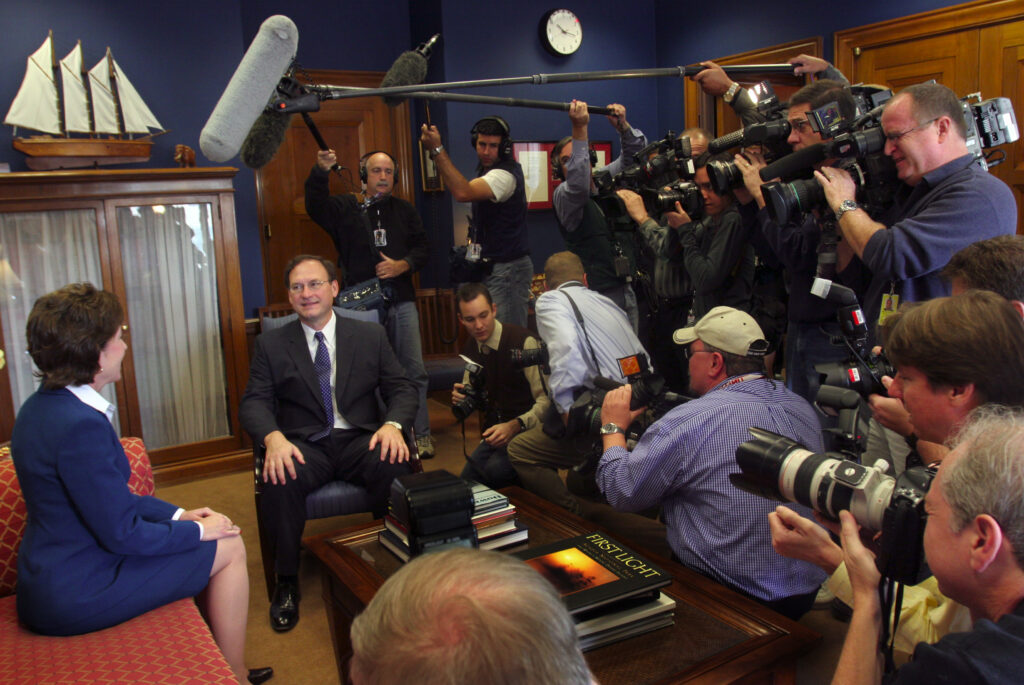
How would Collins approach a new Supreme Court vacancy?
No vote in Maine Sen. Susan Collins’s career has caused her more political trouble than her decision to confirm Brett M. Kavanaugh, a nominee of President Donald Trump, to the Supreme Court in 2018.
It was the main attack against her when she ran for reelection in 2020, a race she won despite vocal voter anger. Six years on, it still resonates with Maine voters.
“The Kavanaugh thing was disgusting,” Michael Luck, a 66-year-old Mainer sitting in a corner booth at Black Moon Public House in Ellsworth, told me this weekend. Luck voted for Collins early in her career, but backed her Democratic rival in 2020. “She’s trying to play both sides, which she’s always done, but she’s really far out of touch as far as I’m concerned.”
In 2020, criticisms of Collins over Kavanaugh focused on allegations of sexual misconduct against the jurist that were central to his confirmation hearing. Collins explained in 2018 that she considered the allegations but argued that the nation would be “ill served in the long run if we abandon the presumption of innocence and fairness, tempting though it may be.”
At the time, Collins told Mainers that Kavanaugh told her that the abortion protections in Roe v. Wade were “settled law,” giving her confidence that he would not overturn the landmark 1973 decision. Two years later, Kavanaugh joined the majority to overturn the decades-old law, reigniting anger at Collins for backing him and giving Troy Jackson, her Democratic opponent this year, a powerful line of attack.
That history is why comments from Supreme Court Justice Samuel Alito, a member of the court’s conservative bloc, were politically relevant to the Maine Senate race.
In excerpts from an interview with CBS, Alito says he has considered retirement, opening the door for Trump to nominate a new Supreme Court justice.
“It’s something that I think that somebody at my age has to think about every term,” Alito, who is 76, said after confirming he considered retirement this year and will again next year. “But I thought that I could still make a valuable contribution, which is why I became a justice and a judge in the first place.”
Alito, who is in the middle of a book tour, also told Fox News in an interview that aired yesterday that he was “amused by the retirement speculation.”
“It’s not too pleasant to look up and see the vultures circling around your head,” he said. “But the speculation is to be expected. It’s what goes with life tenure.” He added that he didn’t “have a calculation” for his decision.
I asked Collins about Alito this weekend, specifically whether she would use the same process to decide her vote on a possible replacement as she used with Kavanaugh and others.
“Yes,” Collins said.
“I do a thorough background review,” she said, describing how she weighs the decision. “I meet personally with the nominee. I talk to people who know the nominee, and I would use that same kind of approach.”
She noted that despite the political blowback she has received for her Supreme Court vote, she is the “only Republican senator” to confirm Sonia Sotomayor, Elena Kagan and Ketanji Brown Jackson, the three most recent justices nominated by Democratic presidents who received a Senate vote.
“The only one,” Collins said. “So, I think that suggests something about the approach that I take.”
Alito is not going to retire before the Nov. 3 election. So the politics of this could be moot whether Collins wins or loses later this year. But the prospect of another Trump pick has some Republican Senate candidates raising the stakes on their own races while Jackson uses it against Collins.
“Should Justice Alito choose to retire next year, a Republican-majority Senate will be needed to vote and hopefully confirm a Supreme Court nominee from President Trump,” Darline Graham, the Republican Senate nominee in South Carolina, wrote on X. “If Democrats control the Senate, they will not even allow a vote.”
“This election will determine who confirms the next Supreme Court justice,” Troy Jackson wrote on X. “She’s no ‘independent’ and she can’t be trusted to decide our Supreme Court justice. Look at her receipts.”
And Collins has not backed away from her vote for Kavanaugh.
“I do not regret that vote,” she told a local outlet earlier this year. “I do disagree with Justice Kavanaugh’s vote,” she added about his decision to overturn Roe.
Trump, on the other hand, has said he regrets all three Supreme Court picks he made in his first term, including Kavanaugh.
“Yeah, what can I do?” Trump said in a recent interview with Time magazine after the court ruled against his tariffs and attempt to restrict mail-in voting, among other topics. “I put them in. They voted against me too often. … I gave them the position of a lifetime, and they vote against me often.”
I will have more coverage from Maine later in the week.
Want this in your inbox?
Start your day with The Washington Post’s flagship political newsletter. Sign up here.
From across the newsroom
- 6 things to watch in the Supreme Court’s new term, from Julian Mark and Justin Jouvenal.
- 4 ways the midterm elections could go, one month away, from Isaac Arnsdorf.
- A Pentagon dispute in Trump’s first war foreshadowed challenges in Iran, Dan Lamothe, Rachel Chason and Suzan Haidamous.
- With threats to midterms, states say Trump administration isn’t helping, from Joshua Yang and Warren P. Strobel.
- Trump’s opponents are planning efforts to reverse his changes to presidency, from Naftali Bendavid.
- An election chief lost. Then he padlocked the ballots and called the FBI, from Patrick Marley.
- Trump launches ‘Super Intelligence Force’ after calls for AI slowdown, from Cat Zakrzewski.
What I’m watching
Less than two weeks ago, I reported with my colleague Natalie Allison that Republicans were deeply worried that Michael Whatley’s Senate campaign in North Carolina, once a reliable state for the party, was slipping off their midterm map.
And in the last two days, the party all but confirmed it.
Natalie reported on Friday that the Senate Leadership Fund — the top Senate super PAC focused on taking back the Senate — was pausing its spending in North Carolina. This the clearest signal yet that the party was giving up even the littlest hope they had that Whatley could defeat Roy Cooper, the state’s former governor and Democratic Senate nominee.
In many ways, Whatley embodies the issues facing the Republican Party right now. He rose to prominence by molding himself in the image of Trump’s Republican Party. He served as chair of the North Carolina Republican Party and cast himself as such a loyal fighter that Trump repaid him by elevating him to chair of the Republican National Committee.
Now, he is running for a statewide office in an environment that is openly hostile to Trump, with polls showing the president’s approval at or near record lows. That has made it nearly impossible for Whatley — even if he wanted to — to create distance.
Still, Cooper has run a notably strong race, reflecting his experience winning statewide office in North Carolina six times.
As my colleague Praveena Somasundaram reported yesterday, Cooper has unexpectedly become the Democrats’ best chance to flip a Senate seat this cycle.
This is what Praveena observed:
“To get to this point, Cooper has pulled from the traditional playbook for a Democrat running in a battleground state. The Tar Heel State mixes urban and suburban centers that have drawn out-of-state residents for technology and banking jobs with more conservative rural areas dependent on agriculture. Cooper summarizes his political résumé as a moderate willing to work with Republicans on anything that would help North Carolinians. He talks frequently about his time leading the state with a GOP-controlled legislature, which at times had Republican supermajorities that could override his vetoes.”
Or, as Cooper put it at a campaign event on Friday, “I’m not a socialist, and I’m not a right-wing Republican, okay. … But I’ll work with anybody to try to make stuff cost less.”
In your local paper
Los Angeles Times: Country artist Zach Bryan wore a “Free Palestine” shirt to a concert at Gillette Stadium this weekend, thumbing his nose at billionaire Robert Kraft, who owns the stadium and the New England Patriots. Kraft has barred another artist, Macklemore, from performing at the stadium for saying the pro-Palestinian phrase at a concert.
Michigan Advance: Sen. Elissa Slotkin joined U.S. Senate nominee Abdul El-Sayed in Michigan’s Macomb County this weekend for an event that targeted the perennial swing county north of Detroit.
Tennessee Lookout: Tennessee’s correction chief stepped down over the weekend after the botched execution of Christa Pike. Frank Strada offered his resignation to Tennessee Gov. Bill Lee, who accepted.
From you
So, there isn’t much support for a government-backed dating app. We asked the question on Friday after Singapore recently launched a government dating app to combat the Asian nation’s plunging birth rates.
“We know why the birth rate is low. Money!” wrote Rick Prescott. “Costs have gone up so much and people have to make rational choices. But to think that this current government could realistically and effectively deal with this issue is ludicrous. We don’t need some MAHA-like government dating site. I couldn’t even begin to imagine how messed up it would be.”
“The cost of having a Child has skyrocketed since my wife and i had ours (Both of us in our 60’s, children born in early 80’s),” wrote Roy Stribling. “And, it really seems like the Loneliness Factor has a lot to do with this. Social Media has killed just going out to meet someone.”
And Norman St. Amour concluded: “I’m sure a lot of people wonder whether they would want to bring a child into the world today. It seems that demand for physical labor is going down. The planet has environmental issues. Global unrest. We could all add to the list.”
Send a reply
Trump said last month that around 1 million Obamacare recipients in 30 states would receive a $500 rebate check. Last week, he said that those checks had been sent out. Simple question: Have any of you received such a check from the federal government? And more broadly, what do you make of Trump’s repeated promises of checks to voters ahead of the midterms? Let me and your fellow Early Brief readers know at [email protected].
Thanks for reading. You can follow me on X at @merica.
The post How would Susan Collins approach a new Supreme Court vacancy? appeared first on Washington Post.