CORMAC McCARTHY: A Legacy Revisited, by Tracy Daugherty
There’s a deep, lonely commitment to work displayed in Tracy Daugherty’s biography of Cormac McCarthy, who died in 2023. McCarthy often wrote in bed, balancing his typewriter on a piece of wood in his lap, and he didn’t like to be disturbed.
He didn’t stay in bed all the time. His life, in this telling, was also packed with cars, cheap hotel rooms, interstates, young women, crazy friends, dive bars, and wives and children left behind, not necessarily in that order. If his life were a stock car, one side would have a dull matte finish and the other would have flames running down the side.
This is the first full-dress biography we’ve had of this reclusive writer, the author of “Blood Meridian,” “All the Pretty Horses,” “No Country for Old Men” and “The Road,” among others, but it won’t be the last. Indeed, Laurence Gonzales’s McCarthy bio, “Isolato,” is scheduled to be published next spring.
Daugherty is a prolific literary biographer (Donald Barthelme, Joan Didion and Larry McMurtry are among his subjects), and his book is good enough, at least for a first crack at McCarthy. It divulges a lot of new information, dispels myths, has strong set pieces and does a bloodhound’s job of tracing the overlaps between the life and the work.
On the downside, it’s hampered by consistent intrusions of flowery language, as if the biographer got too excited and tried to compete with his subject. (Critics used to do this when writing about Tom Wolfe’s books, larding on the dots and exclamation points.) It also imparts the slightly hollow sense that for every person willing to talk with Daugherty, 10 hung up the phone.
If you’re a hard-core McCarthy fan — a Cormackian, in the lingo — you can come to skim off the gossip, which Elizabeth Hardwick preferred to call “character analysis.” McCarthy appears to have dabbled, when broke, in credit card fraud. Back in Knoxville, Tenn., where he grew up, he liked to attend cock fights, for the outlaw atmosphere and for the clashing social milieu: guys in overalls bumping into guys in tuxedos.
He was longtime friends with the actor Stacy Keach (both liked shooting pool) and once played a round of golf with Clint Eastwood. He admired Robert Bly’s “Iron John” (1990), about rescuing masculinity, and bought an audiobook of “Men Are From Mars, Women Are From Venus” (1992), the best-selling self-help book.
He was a dandy. One woman reports that, more than a week into a long river-rafting trip, he would still “emerge from the tent like he was in GQ magazine.” He was a sophisticated man whose friends needled him for his terrible taste in art. At the Santa Fe Institute, the interdisciplinary research center where McCarthy spent a lot of time later in his life, mingling with scientists and naturalists, he’d bring back cheap prints from Hobby Lobby and tack them on the walls.
McCarthy had a pitch-black worldview. It’s never been hard to imagine him as a political conservative, but Daugherty brings the receipts. McCarthy had American flag bumper stickers on his trucks — one also had a nationalistic “Power of Pride” sticker — and watched “Yellowstone,” a TV show that emphasized rugged individualism, property rights and gun ownership. He joined the Republican National Committee and read The Spotlight, a magazine known for promulgating right-wing conspiracy theories.
There’s an interesting detour in which Daugherty, leaning on McCarthy scholarship, argues that Marjorie Kinnan Rawlings’s novel “The Yearling” (1938), about a boy in rural Florida who’s forced to shoot the orphaned pet fawn he’s adopted, is a key that helps unlock many of the themes in McCarthy’s novels.
McCarthy read Rawlings’s book when he was young. Indeed, he auditioned in Knoxville and nearly got the lead role in the 1946 film version of “The Yearling.” He was 11 at the time. Daugherty wonders about the direction McCarthy’s life might have taken if he’d gotten the part.
McCarthy’s family was, for Knoxville, well-to-do. His father, who had been the editor of The Yale Law Journal, worked for the Tennessee Valley Authority. The T.V.A.’s involvement in enriching the uranium used for the Manhattan Project’s nuclear bomb tests haunted the writer. Eccentric son and smooth father clashed their entire lives.
McCarthy had five siblings. He was the outsider from the start. He was charismatic and witty but got poor grades and spent all his time in the woods, as if he were a latter-day Huck Finn. Later he’d loiter on the more disreputable side of town, meeting the kind of hustlers and brainy screw-ups (one was nicknamed Waterbed Fred) who populated his rowdier fiction, novels like “Suttree” (1979), set in Knoxville, and “The Passenger” (2022), set in New Orleans.
He attended the University of Tennessee but barely attended classes and was asked not to return. He enlisted in the Air Force and served in a cold weather station in Alaska. He read a ton of books up there, including a lot of Melville.
A superior officer heard McCarthy’s mellifluous voice on the telephone and helped him, in the early 1950s, became an announcer on Armed Forces Radio. It’s interesting to imagine him there, against a horizon of mute ice, dropping the needle on “Tennessee Waltz,” by Patti Page, or “Rocket 88,” by Ike Turner.
He returned to U.T. on the G.I. Bill. It’s where he met his first wife, Lee Holleman. She was as wild as he was and wanted to be a writer. McCarthy would marry twice more and have two children. He wasn’t built to be a husband or father. He was restless and work took unquestioned precedence over home life. All his relationships ended in separation.
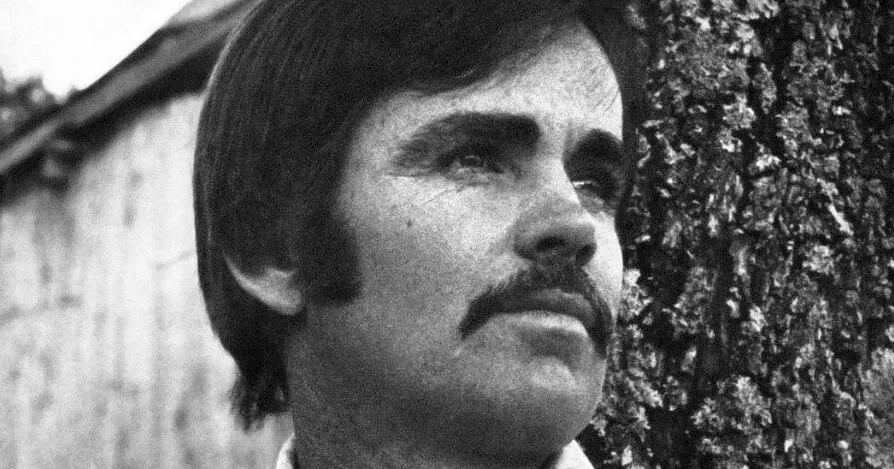
He had overlapping affairs. He was a “hound,” in one acquaintance’s estimation, and his friends’ wives were apparently fair game. He was handsome, magnetic and deeply masculine, and he could hunt, fish, build a house, play the guitar, fix a car and hold a big room with his storytelling. He was catnip to women.
A lot of writers look like Ned Beatty. McCarthy more resembled Warren Beatty. There is a letter from his third wife, Jennifer Winkley, referring to their “huge erotic events.”
He liked his women young. Well into middle age and later, he dated women in their 20s, often Ph.D. or law students. After McCarthy’s death, Vanity Fair published a heavily discussed article divulging McCarthy’s nearly 50-year relationship with a woman named Augusta Britt, whom he’d met when she was 16 and he was 42. Daugherty parses this material carefully.
On the upside, Britt felt that McCarthy had rescued her, and he stayed close to her and helped her financially for the rest of his life. She was his muse, and saw herself, sometimes unhappily, in many of his female characters. But the details are grisly. It’s unclear if, as one woman who knew McCarthy said, he took Augusta to her prom while she was still wearing braces. But he did pay to get her retainer fixed, as Daugherty reports. The Britt relationship has left McCarthy in a kind of reputational limbo.
This book review is about McCarthy’s life, not about his books — those have been chewed over endlessly, and they will be as long as this planet has serious readers. Daugherty is a sensitive reader of the novels, but he’s especially good on the making of them, and on the editors who helped McCarthy along the way.
McCarthy’s early novels didn’t sell at all. He wrote to a friend, at one point, that he’d toiled for 23 years and had never seen a royalty check. His editor at Random House, Albert Erskine, had edited William Faulkner. Erskine’s devotion to McCarthy — keeping him in print, finding money for advances and helping him win early prizes and fellowships — is as moving a story of editorial devotion as I’ve ever read.
Erskine often couldn’t find McCarthy for months at a time, because he moved around and almost never picked up his mail. They battled in a friendly way over McCarthy’s punctuation, and his arcane vocabulary.
Fascinating, too, are the scenes in which Gary Fisketjon, McCarthy’s new editor at Knopf, and Binky Urban, his new agent, work to convince him to come slightly out of his rabbit hole (McCarthy hated to do any form of P.R.) in the 1990s to publicize the Border Trilogy, novels that became worldwide best sellers.
McCarthy wrote screenplays in his later years and visited the sets of the movies made from his films. He became friends with Tommy Lee Jones, who nearly convinced Jack Nicholson to play Judge Holden, the brutal, scalp-hunting antagonist of “Blood Meridian,” in a film version that Jones hoped to shoot.
McCarthy told friends he’d “dated” Penélope Cruz, one of the stars of “The Counselor” (2013), a crime thriller for which he’d written the script, and found her boring. Josh Brolin, one of the leads in the Coen brothers’ film of “No Country for Old Men,” visited him on his deathbed.
Extreme reticence is often a cover for extreme egotism. That seems true here. Is this kind of single-mindedness and arrogance what’s required to write great fiction? A woman friend said of McCarthy: “He lived his life on his own terms — more so than anyone I have ever known.”
CORMAC McCARTHY: A Legacy Revisited | By Tracy Daugherty | St. Martin’s | 514 pp. | $35
The post Does Greatness Require an Ego and a Work Ethic Like Cormac McCarthy’s? appeared first on New York Times.