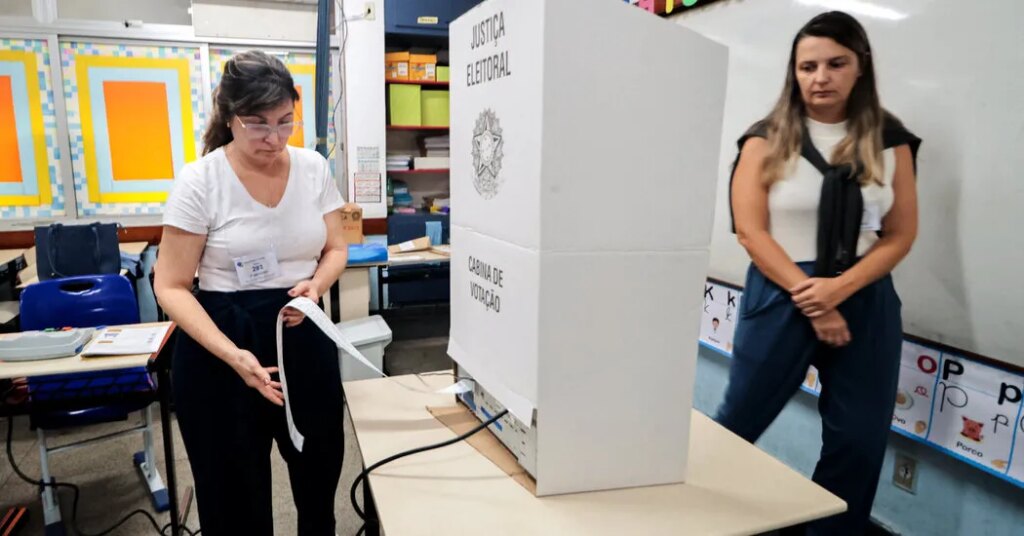
Brazil’s heated presidential election was forced into a runoff on Sunday, according to election officials, with the right-wing challenger leading over the leftist incumbent in a narrow race that may have sweeping consequences far beyond the country.
The challenger, Flávio Bolsonaro, received 47 percent of the vote, compared with 45 percent for President Luiz Inácio Lula da Silva. With all of the ballots counted, neither succeeded in capturing the more than the 50 percent needed for outright victory.
The two candidates will now face each other head-on in an Oct. 25 runoff. But Mr. Bolsonaro, son of a former president imprisoned for attempting a coup after losing the last election, appeared to be closing in on his goal.
When the younger Mr. Bolsonaro addressed his supporters, he declared a victory was imminent in the next round of voting. “The word is change,” he said. “It’s the end of the era of the Workers’ Party,” referring to the party founded by Mr. Lula.
On the streets of major cities across Brazil, there were scenes of celebration and mourning on Sunday night.
In São Paulo, Mr. Bolsonaro’s supporters chanted, honked horns and set off fireworks to celebrate his performance, while Rafaela Rogel, a 44-year-old therapist, broke down in tears.
“It’s going to be hard to win now because the votes are so entrenched,” she said at a gathering of Mr. Lula’s supporters.
Mr. Lula was quick to dismiss his defeat, vowing to double down in the runoff on his attempts to secure another term. “The second round is the ultimate test,” he said. “Starting tomorrow, we begin a new campaign.”
If Mr. Bolsonaro ousts Mr. Lula in the runoff, it will mark the biggest win yet for Latin America’s ascendant right. It will also usher in to power an enthusiastic Trump ally who has signaled that he is willing to help Washington advance its goal of dominance in the region.
Candidates aligned with President Trump on issues like fighting drug gangs and “woke ideology” have won the last seven elections in the region, with Brazil the biggest remaining prize. Mr. Bolsonaro has vowed to forge closer trade ties with the United States.
If Mr. Lula succeeds in rebounding from Sunday’s setback, it may been seen as a rebuke to the Latin American right. As many other Latin American leaders fall into line, Mr. Lula has repeatedly defied Mr. Trump, warning him not to meddle in his country’s affairs.
With the runoff just weeks away, Mr. Lula and Mr. Bolsonaro must now race to capture the millions of more votes needed to claim an absolute majority. Key to that will be the roughly 8 percent of voters who backed a range of other candidates on Sunday. Those candidates, many of whom were on the right of the political spectrum, drew only single-digit support.
Analysts expect a majority of those voters to now shift their support to Mr. Bolsonaro, giving him the upper hand going into the runoff.
The first-round results offered “the clearest sign something has changed deeply in Brazilian society,” said Guilherme Casarões, professor of Brazilian studies at the Florida International University in Miami. “Even if Flávio couldn’t win the first round, he’s most likely to win in the second.” (Many Brazilians use his first name to distinguish him from his father, Jair Bolsonaro.)
For Mr. Lula to turn the race around, he will have to now win over another group of voters: the millions who stayed home or spoiled their ballots. About 20 percent of voters abstained from casting a ballot on Sunday.
Lula versus Bolsonaro 2.0
The vote presented Brazilian voters with a familiar choice: Mr. Lula pitted against a Bolsonaro.
Mr. Lula has framed his candidacy as a vote for democracy and the only way to bar the return of the Bolsonaro family to power, four years after Jair Bolsonaro tried to cling to office after losing the last election.
The younger Mr. Bolsonaro has said that, if elected, he would seek amnesty for his father and supporters who were handed jail sentences for storming government buildings in January 2023, in an episode reminiscent of the attack on the U.S. Capitol. His father was sentenced to 27 years in prison.
Pledging revenge against the institutions that convicted his father, Mr. Bolsonaro has also vowed to impeach Supreme Court justices and overhaul the judiciary, which his movement accuses of censoring conservative voices.
At the same time, his links to a corruption scandal have dampened enthusiasm around his candidacy. Mr. Bolsonaro was placed under investigation after raising millions of dollars for a biopic about his father from a disgraced banker at the center of the scandal.
The path forward
The choice for Brazilian voters could hardly be starker.
Mr. Lula, 80, is a stalwart of leftist Brazilian politics seeking his fourth term in office. Mr. Bolsonaro, a 45-year-old senator, is running in the shadow of his father.
Mr. Lula is popular with women, Catholics and lower-income voters who credit him with reducing poverty and inequality. Mr. Bolsonaro enjoys fervent support among evangelicals and higher-income Brazilians.
On public security, which is a top concern among Brazilians, Mr. Bolsonaro has vowed hard-line policies similar to those of Latin America’s other right-wing leaders. He has promised to label drug gangs as terrorist groups and to build five maximum security prisons modeled on El Salvador’s.
Mr. Lula has argued that the key to dismantling the gangs is a less-muscular approach of targeting their weapons and finances, but many voters blame him for the advance of criminal groups across the country.
Mr. Lula has also struggled to clean up his image. Before returning to the presidency in 2022, he was convicted of corruption by a court, though the rulings were later tossed out on the grounds that the judge in the case was politically biased.
Both candidates still face challenges in the runoff. Mr. Bolsonaro may have to win over moderate voters less enamored with his hard-line positions, while Mr. Lula will have to convince voters that he can best tackle domestic challenges that also include rising debt, eroding affordability and deteriorating faith in the judiciary.
Mr. Lula tried to do this before the election by promising a judicial overhaul, spending heavily on welfare and expanding a debt-relief program. He also banned online betting, which has accelerated Brazil’s debt crisis, and promised to push forward a proposal to cut back a six-day workweek.
An American hand
Mr. Trump’s shadow has loomed over the election.
Many expected that the American president might try to influence the vote in Brazil, as he has in other regional elections. While he did not endorse Mr. Bolsonaro, his administration did appear to lift him in more subtle ways.
The candidate’s association with Mr. Trump appealed to voters like Carolina Varella Tim, who arrived to cast her vote in the southern city of Porto Alegre wearing a MAGA hat. “I vote against Lula, regardless of who the candidate is,” she said.
Yet, in a nation where pride in sovereignty runs deep, Mr. Lula’s promise to defend Brazil’s interests has also won over voters worried about meddling. “We are afraid Flávio will deliver Brazil to Trump,” said Camila Oliveira, a 35-year-old telemarketer voting in Mauá, a city outside of São Paulo.
In urging voters to reject Mr. Bolsonaro, Mr. Lula painted him as a puppet of the United States. And he accused the Trump administration of trying to sway the vote so that it can seize Brazil’s vast natural resources. “Brazil is nobody’s backyard,” he told supporters on the campaign trail.
Right-wing candidates also won most of the legislative races held on Sunday, demonstrating their movement’s grip on Brazilian politics.
“What we would have called a wave in 2018 has become part of the social fabric,” said Carolina Botelho, a political scientist and researcher at the National Institutes of Science and Technology. There is “a very large part of the population that wants the extreme right in power.”
Thayz Guimarães and Alice Maciel contributed reporting from Brasília, Silvia Ribeiro, Lis Moriconi, Leonardo Coelho and Isabela Cruz contributed reporting from Rio de Janeiro. Seth Kugel and Giovana Sanchez contributed reporting from Sao Paulo. Naira Hofmeister contributed reporting from Porto Alegre.
The post Lula and Bolsonaro Head to Runoff for Brazil’s Presidency appeared first on New York Times.