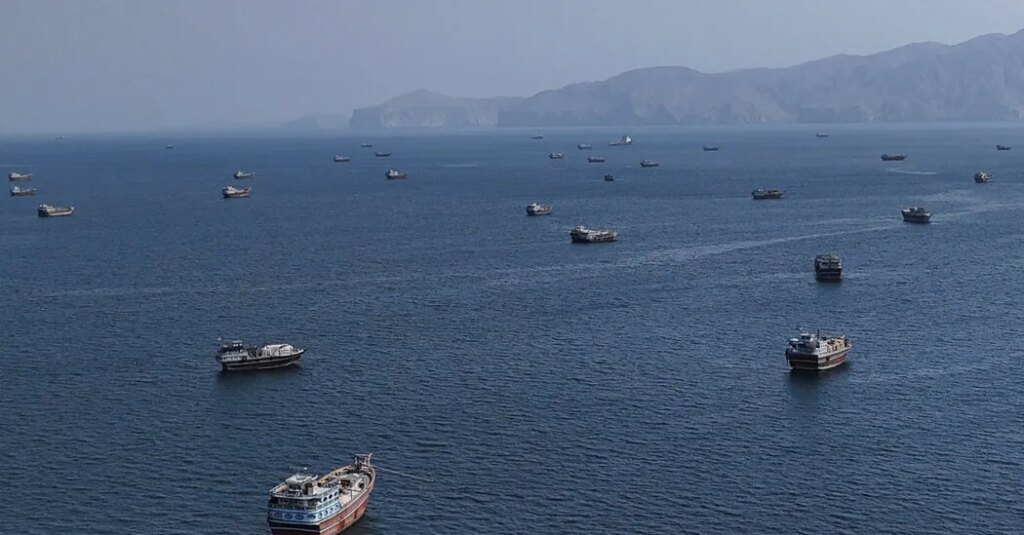
The U.S. war with Iran has revealed the full extent of the power Iran possesses to hold the global economy to ransom by closing the Strait of Hormuz. For months, the U.S. struggled to open it up again, to little avail.
Then last month, we got a surprise. Data for September shows more oil is flowing from the Middle East than at any point since the start of the war — and most of it is coming through the Strait of Hormuz.
Today, I write about what that tells us about Iran’s leverage and the state of the war.
Has Iran lost control of the Strait of Hormuz?
Before the war, some 19 million barrels of crude oil were exported from the Middle East every day. That number slowed to a trickle after Iran closed the Strait of Hormuz, the main route through which this oil traveled. The result was a crippling global energy crisis felt as far away as the Philippines.
But last month, according to Kpler, a firm that tracks oil tankers, the numbers climbed back up to an average of 16 million barrels a day — not back to prewar levels, but not so far off either. Some 6 million barrels of that oil is coming through land pipelines and ports on the Red Sea or the Gulf of Oman that bypass the Strait of Hormuz. But 10 million are making it through the strait itself.
How did this happen?
The story of the Iran war has in many ways become the story of Iran closing the strait, and the U.S. trying to reopen it — and so the fact that oil is moving again feels like a big deal. And in some ways, it is. The U.S. has clearly reduced Iran’s leverage over this critical waterway.
But that doesn’t mean that the price of oil is going down any time soon. And it doesn’t mean the U.S. is on the verge of winning the war either. It could even make Iran more dangerous.
Oil is flowing again
I spoke to my colleague Peter Eavis, who has been monitoring oil flows since the start of the war. He told me that Iran is still attacking ships in the strait practically every day. But oil is making it out simply because more tankers are now willing to take the risk of trying to cross. And a combination of two things helps explain why.
Since the spring, the U.S. military has been offering air protection to tankers willing to take their chances through the strait. Initially, there were few takers.
But as the war has dragged on, countries like Saudi Arabia and the United Arab Emirates have become increasingly desperate to get their oil out. They’re now offering huge amounts of money — ten times more than prewar fees in some cases, Peter said — to tanker operators. Enough that many are now are saying yes.
The upshot is that oil is flowing again, but at a huge cost — to the U.S. military, to oil-exporting Gulf nations and in human lives. About two dozen crew members have died in Iranian and American strikes in the past month, Peter said.
Iran still has leverage
Every barrel of oil that leaves the Middle East in theory reduces Iran’s ability to inflict pain. And this comes at a time when Iran itself is hurting. It’s been under years of sanctions and months of war, and its own seaborne oil exports have now been reduced to zero by the U.S. blockade, the same Kpler report shows, leaving its economy weaker than ever.
Many interpreted Iran’s proposal to the U.S. last month — a seven-day plan to cease hostilities, reopen the Strait of Hormuz and then begin comprehensive talks on its nuclear program — as a sign that the Islamic Republic was eager to end the war. Trump said he rejected the plan outright, which could be read as a sign that the administration thinks it’s gaining the upper hand.
But the resources the U.S. has dedicated to increasing oil flows out of the Middle East — which involve fighter jets and missile systems with drone interceptors — are not sustainable in the long-term, analysts say.
The recent increase in oil flows has also done almost nothing so far to bring down oilprices. Those high tanker operator fees along with higher insurance premiums have driven up the cost of shipping. There’s still not enough oil to meet demand around the world. China and other countries are drawing down the energy reserves that helped stabilize prices earlier in the conflict. And winter, along with its accompanying demands for heating fuel, is coming.
In that sense, Iran’s grip on the strait may be loosening, but its overall strategy — to keep oil prices high enough that the world, and particularly the U.S., feels it — is still working, said Hamidreza Azizi, a senior Iran analyst at the International Crisis Group.
And should that start to change, Iran still has other cards to play.
Iran’s allies, the Houthis in Yemen, still have control over the Bab al-Mandab Strait on the Red Sea, another crucial oil route. And Iran could, if it felt under enough pressure, begin targeting oil at the source, by bombing energy infrastructure in the Gulf again, Azizi said.
“The Iranians see this as a battle of endurance,” he said. “They could escalate if the oil price were to fall or if they believe the Americans will attack again. Escalation is the primary leverage they have over the U.S.”
The Strait of Hormuz is just one piece of that leverage.
MORE TOP NEWS
-
The Saudi-backed government in Yemen declared war against the Houthis, a day after the militia claimed an attack on a Saudi oil refinery.
-
Brazilians voted in a presidential race that could define the future of Latin America.
-
Ethiopia’s military marched into the main city of the northern region of Tigray after the authorities there retreated. The new hostilities have raised global alarm.
-
Japan lodged a rare protest against the U.S. after the arrest of an American Marine accused of killing a woman in Okinawa.
-
Here’s how an air base in a quiet corner of England became a U.S.-Iran flashpoint, setting off a huge counterterrorism response.
-
In a rare admission, Iran’s top security official warned that economic crisis has plunged the country into one of the most difficult periods in its history.
-
Israeli agencies traded blame over the failure to flag an Omani co-pilot said to hold extremist Islamist views now accused of trying to crash a FlyDubai plane to Tel Aviv. Here’s what we know about the pilots.
-
Biljana Plavsic, a former Bosnian Serb ultranationalist political leader who was the only woman charged with war crimes in the Balkan wars, died at 96.
TOP OF THE WORLD
The most clicked link in your newsletter on Friday was about whether A.I. will make your brain lazy.
COSTUME IDEA OF THE DAY
Erling Haaland and raccoon
With Halloween approaching, our Styles desk compiled a list of the zeitgeistiest, most 2026-iest costumes. Among them: the internet’s favorite Norwegian football star, returning home from the World Cup with a taxidermied raccoon in tow. Also on the list: a Bad Bunny sugar-cane bush.
MORNING READ
It may sound like science fiction, but the world’s major powers are racing to put nuclear reactors on the moon. The U.S. wants one near the lunar south pole by 2030, while Russia, in a secretive partnership with China, is aiming for 2036. The reactors are considered key to the very future of space exploration: They could power future moon bases, enabling access to resources like frozen water and the launch of missions deeper into the solar system.
But some leading scientists caution that governments are moving too quickly. In recent years, multiple Chinese, American and Russian rockets have failed and exploded. Space junk regularly tumbles to Earth. Adding nuclear power could take the space race in “a potentially more dangerous” direction, one expert said. Read more.
FASHION DISPATCH
In an age of naked dressing, what does sexy look like?
It’s the question that was top of mind for our chief fashion critic, Vanessa Friedman, at a recent Tom Ford runway show at Paris Fashion Week. In a parade of looks that left less and less to the imagination, the ensembles that teased the promise of skin rather than bared it were the ones that actually felt the most titillating, Vanessa said. See the looks and hear her take.
RECOMMENDATIONS
Watch: Artists share films set in Hong Kong that have shaped or reflected their visions of the city.
Unplug: You can listen to your favorite music on your phone, even without internet access.
Escape: From a restored Renaissance convent in Italy to a London hideaway, these new hotels are perfect for autumn.
Read: In a new cookbook, the chef from the famed restaurant Le Bernardin says Buddhism can make you better (and happier) in the kitchen.
RECIPE
This twist on fish Creole delivers perfectly cooked, flavor-packed fish with a hands-off method. The sauce celebrates the foundational flavors of Creole cuisine, using the “holy trinity” of onion, celery and bell pepper.
WHERE IS THIS?
Where are these colorful buildings?
TIME TO PLAY
Here are today’s Spelling Bee, Mini Crossword, Wordle and Sudoku. Find all our games here.
That’s it for today. See you tomorrow! — Katrin
We welcome your feedback. Send us your suggestions at [email protected].
The post The Return of Middle East Oil appeared first on New York Times.