The Amish family thought the chills and fever that had hammered their second oldest son was strep throat. Then a ringing came from the phone shack in the yard: A friend was calling to say the measles had been lurking at a horse auction in Lancaster, Pa.
The 15-year-old boy and his father, an Amish horse breaker, had been there just a few days before.
“We knew it was the measles,” Emma Miller, the boy’s mother, said.
Measles cases have been reported in 45 states in 2026. In Pennsylvania — where state officials say five have died in connection with the outbreak — and Ohio, the Amish people are bearing the brunt of the sickness. They are also taking a share of the blame from outsiders, owing to a lifestyle that tends toward shutting out modern medicine, along with other aspects of contemporary life.
But two days of traveling with a health practitioner through the pastoral Amish country of northeastern Ohio found that despite the stereotype, the Amish are not anti-vaccine. Their reasons for rejecting vaccination are more nuanced.
Like most other Americans, many had never seen a case of measles before, and were not aware of how dangerous the virus could be, leading to deafness, brain swelling and even death. They thought measles would not find them, and it did.
The contagion, officially declared vanquished by vaccination, ripped through the Miller family over the summer, sickening six of the seven children and their mother. It skipped only their father, Marvin Miller, and one daughter, Mary Ann. Both had been vaccinated.
Through the fog of her own illness Mrs. Miller struggled to nurse the sick children, including the baby, as she dispensed Tylenol to battle the fever that accompanies measles. It was left to 12-year-old Mary Ann to sweep the floors and do the baking. Neighbors left food at the door.
The family stayed home from church to protect the congregation. But for all their precautions, the sickness jumped to their cousins, who had visited before there was any thought of measles.
“I didn’t imagine it would be so bad,” Mrs. Miller said.
The Amish are sometimes depicted as objecting to vaccination on religious grounds, but getting vaccinated was a matter of personal preference, families said, again and again. Often it came down to a matter of family practice, or tradition. If their parents or grandparents had been vaccinated, they probably would be, too.
Vaccinations rates are also low because the Amish generally do not have commercial health insurance or credit cards. They pay for medical appointments in cash. In an emergency, they turn to their mutual aid fund.
The measles vaccine came into use in 1963, when the virus was killing 400 to 500 people a year in the United States.
In 2000, measles was declared eliminated, but not eradicated, a subtlety of terminology that allows for a recurrence of the disease. That status is now in jeopardy. There have been more outbreaks in recent years, as hesitancy over vaccines has been fueled by Robert F. Kennedy Jr., the secretary of health and human services, who has long been a skeptic of their efficacy.
“The memory of the vaccination coming in and immediately dropping the death count across the country is for some people two to three generations away,” Cleveland’s director of public health, Dr. David Margolius, said. “That, coupled with more vocal people in positions of power saying, ‘Hey, you don’t need these vaccinations anymore.’”
Pennsylvania’s measles outbreak has sickened 977 people as of Oct. 2, with Lancaster County and its large Amish population accounting for about 40 percent of cases.
It has hospitalized 195 people and been associated with five deaths, according to the state’s public health department. The Centers for Disease Control and Prevention lists just two deaths, disputing the state’s tally.
Ohio has logged 206 cases this year, with the highest numbers in three Amish-heavy counties: Geauga, with 49; Wayne, 44; and Ashtabula, 32. Last year there were 46 measles cases statewide. The state has shipped about 7,100 doses of outbreak-related vaccine to providers this year, up from just over 1,000 last year.
The Pennsylvania and Ohio contagions are most likely linked. Health investigators say some of the Ohio contagion began just as the Miller family’s did, with exposure at horse sales in Lancaster, Pa., and in Bloomfield and Sugarcreek, Ohio. From there, it spread to weddings, funerals, parties and church services.
* * *
During the lockdowns of the Covid years, Stephanie Truckey, a registered nurse based in northeast Ohio, noticed that the Amish had become even more distanced from medical care because they shied away from technology like telehealth.
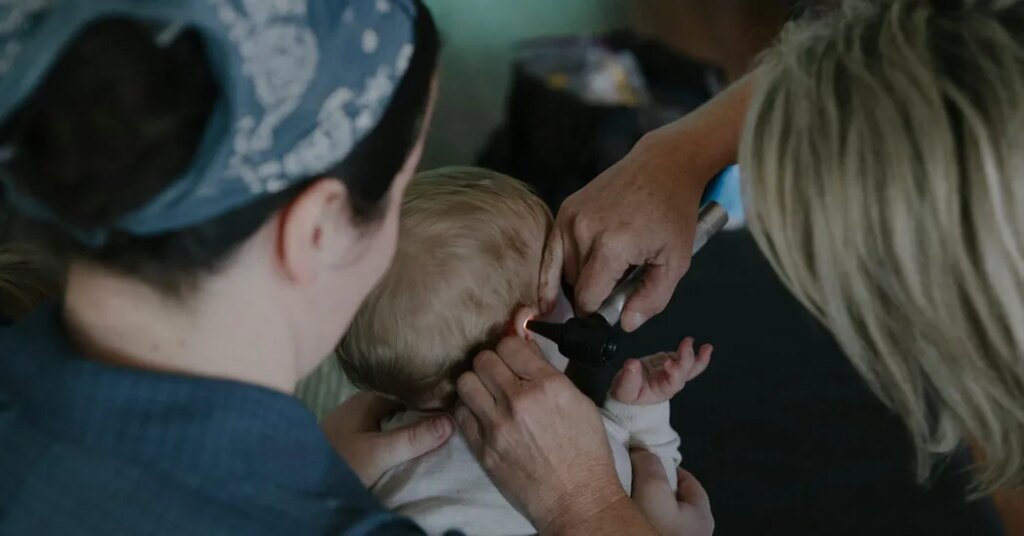
Ms. Truckey formed a service called Angels to Amish to make house calls and provide basic medical care to patients in parts of Ohio, Pennsylvania and Indiana. She does not administer measles shots. But patients often ask about them, and she connects them with providers.
On a recent Thursday morning, she was driving along streets dotted with scooters and horse-and-buggies, answering calls from Amish people with ailments ranging from a persistent cough to anxiety or depression. After visiting their homes and doing the initial intake, she would set up a video conference on her laptop with a nurse practitioner, who was able to make a diagnosis and write a prescription.
She could spot the Amish houses, she said, because they are painted white, as befitting the “Plain People,” as they call themselves. The family laundry usually flapped on a line in the yard.
Her first patient, Lorene, complained of congestion that kept her up at night. She was 30 years old and living at home with four of her seven siblings. Amish children live with their parents until they marry, she said.
Lorene’s mother, who had called Ms. Truckey, stood by. All her children have been vaccinated, she said. Within the community, “there’s a lot that do, and there’s a lot that don’t,” she said. “It’s each individual choice.”
The nurse practitioner detected a brewing sinus infection, and Lorene’s mother handed over a check for $140. (Most patients asked to be identified by first names or to be anonymous to protect their privacy.)
The next patient, Rosanna, was covered in an itchy red rash — not measles. She had vaccinated all six of her children.
“I didn’t want my children to get measles and suffer,” she said. “I heard how sick they can get.”
But they did not get the Covid vaccine. “Some people have their doubts,” she said.
The evidence that Rosanna might be too busy for doctor’s appointments was everywhere: a pile of freshly dug potatoes on a table, tomatoes ripening on the porch, an ancient Maytag washing machine with a hand-wringer. She does laundry every day but Sunday.
At the Hickory Grove School, an Amish school, a teacher in her early 20s came out barefoot to chat. She was vaccinated as a child, she said, and so was her mother. There was no requirement for the students to be vaccinated in order to enroll in the school, unlike in a public school, she said.
Apart from the usual head colds, none of the 26 students in the school have been sick, she said. The children could be heard inside the school singing old-timey songs — “I’ll Fly Away” and “This Land Is Your Land.”
The Amish housewives, for the most part, seemed distant from the wars over whether vaccines caused more harm than good. They didn’t seem to know of Mr. Kennedy. They said they were largely sheltered from such debates because they did not read newspapers or watch television.
“Who?” said Nancy Miller, a 24-year-old mother of two young boys, when asked about Mr. Kennedy. She said she got her news primarily by word of mouth. (Miller is a common name among the Geauga County Amish.)
She and her husband decided to vaccinate their boys when measles “started getting around,” she said. Her husband had been vaccinated as a child. She could not be vaccinated because she was pregnant.
For Emma Miller, whose family were among the first to get measles in their community, it was a difficult summer.
Her husband, being immunized, had encouraged her to get early childhood shots for her children, who are 9 months to 17 years old. But until last summer, she had never heard of anyone having measles, so it did not seem like a priority, she said.
But being sick with measles had been grueling, and the experience had motivated her to get the children their shots.
“We’re getting them all,” she said.
The post Measles Outbreak in Amish Country Forces Some to Rethink Vaccines appeared first on New York Times.