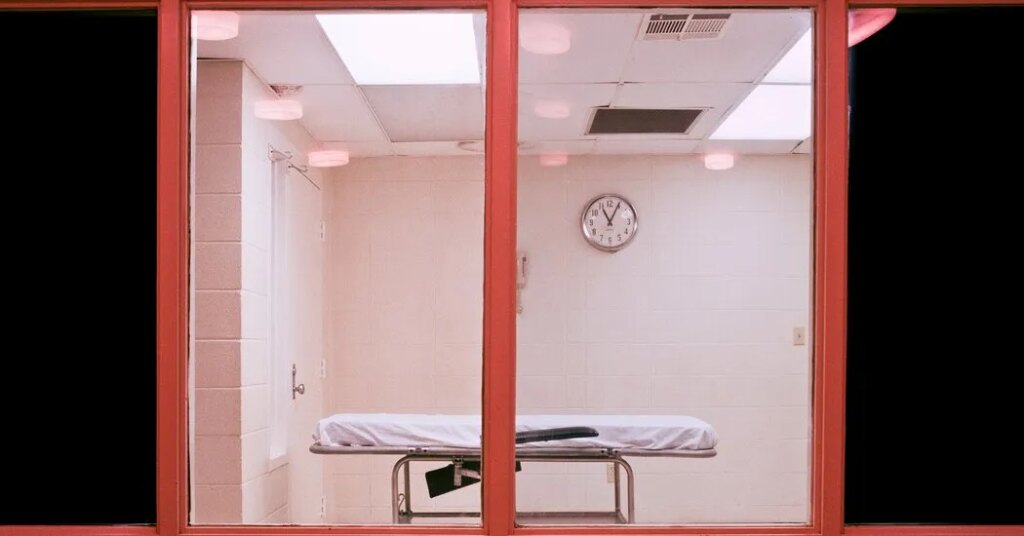
On Wednesday night, Christa Pike lay strapped to a gurney at Riverbend Maximum Security Institution in Nashville while the State of Tennessee injected pentobarbital, a sedative that is lethal in high doses, into her veins. When the first dose did not kill her, the execution team gave her a second. At one point, she told the room her arm felt as if it were about to burst. She was nearly correct. More than an hour after the procedure began, an ambulance was called. She was severely injured, but still alive.
By Thursday, Ms. Pike was in critical condition, receiving what her lawyers called lifesaving care. In a matter of hours, she had gone from a prisoner the state was trying to kill to a patient doctors were trying to save. As of this writing, she is unconscious. She is intubated and cannot breathe without a mechanical ventilator.
I am an anesthesiologist and intensive care physician. I have studied pulmonary complications and respiratory distress caused by lethal injection, and I know of no other case in which a person was given lethal injection drugs and then carried from the execution chamber to a hospital bed.
Ms. Pike’s lawyers retained me as a medical expert in the months leading up to her execution. I reviewed her medical records and warned her team that she had medical conditions that could lead to a painful and cruel death by lethal injection.
Tennessee has not explained what went wrong on Wednesday night, but the evidence so far points in one direction. Ms. Pike has small veins, which make it more difficult to insert an intravenous line. After the pentobarbital was administered, her arms turned purple. Her lawyers report blistering and burning at the injection sites. This suggests that at least some of the pentobarbital entered the tissue of her arms rather than her bloodstream because the intravenous lines failed.
Gov. Bill Lee has said that as far as he knows, the Department of Correction followed its protocol exactly. I take him at his word. That is the problem. Lethal injection failures are not glitches; they are features of the process.
In 1995, at 18, Ms. Pike and two others tortured and killed Colleen Slemmer, a fellow student in a job-training program. Nothing I write here asks anyone to forget that. My focus is on the cruelty that the state subjected Ms. Pike to on Wednesday and the pattern of botched executions that has plagued this country’s death chambers for decades.
Pentobarbital is highly alkaline, like bleach, and when injected into tissue, it causes a severe chemical burn. In Ms. Pike’s case, it appears that enough of the drug reached her brain to sedate her deeply, but not enough to stop her breathing. I cannot rule out that the drug itself was degraded, because Tennessee, like other death penalty states, does not disclose how it buys and prepares it. This is a state whose own independent review found that none of the drugs prepared for the seven people it executed between 2018 and 2022 had been fully tested.
Ever since Oklahoma became the first state to adopt lethal injection in 1977, prison officials have tried to make executions appear like medicine: There are gurneys, IV lines and heart monitors. But lethal injection is a sinister impersonation of the medical profession. There is no patient, no consent and no healing purpose. Even the drug is miscast. In the hands of the physician, pentobarbital is a medicine. I use drugs like it regularly in my intensive care unit to sedate critically ill patients. In the hands of the state, pentobarbital is a poison. Pentobarbital is not a painkiller, and when it is injected by the state, no one can say when a prisoner stops feeling pain.
This medical impersonation hides a great deal. I have reviewed the autopsies of more than 200 people executed by lethal injection. In most of them, the prisoners’ lungs were heavy with fluid, often with froth in the airways. These are signs of pulmonary edema, which suggests that the prisoners could have felt as if they were drowning, even if some looked peaceful as they were dying.
After Tennessee executed Byron Black last year, his autopsy found the same thing. Witnesses reported that he moaned and said, “It’s hurting so bad,” during the execution. In May, Tennessee’s execution team spent about an hour trying and failing to place an intravenous line in Tony Carruthers. In desperation, and because the state’s execution protocol said they could, they tried to insert a central line in Mr. Carruthers’s chest. That failed too, leaving Mr. Carruthers deeply shaken and bleeding from multiple puncture wounds. While aspects of Ms. Pike’s case are unique, the cruelty she experienced in the execution chamber is not an aberration.
Consider what a hospital team faces when a patient like Ms. Pike arrives. In my intensive care unit, a massive overdose is a familiar emergency. We secure the airway, support the blood pressure and monitor the brain. We watch an arm swollen by drug use to check for dying tissue and for pressure that can choke off its blood supply. Dying muscle cells leach poison into the bloodstream and deliver it into the kidneys. We count the minutes that passed before anyone called for help, because the brain keeps that count too.
It may take months to fully understand the extent of the damage that has been done to Ms. Pike’s body. Given that Ms. Pike was taken to the hospital over an hour after the lethal drug was administered, it is very possible that she sustained permanent brain injury. She most likely faces a very long road to recovery.
No one in the hospital where Ms. Pike is being treated would call what happened to her a medical procedure. To them it is a poisoning, and she is now a patient entitled to health care. Same body, same drug, same night: In one room it was called an execution; in the next it was treated as an injury. The doctors caring for Ms. Pike now owe her everything medicine can give. If they succeed, they will hand her back to the state that may try to kill her again.
The Supreme Court has ruled that the Constitution does not guarantee a painless execution, a decision states such as Tennessee cite to defend their lethal injection protocols. Very well. Then states should stop telling the public that lethal injection is clinical and not cruel. The illusion does not fool death row prisoners. I was a medical expert in three separate execution cases in Tennessee over the past 10 years. In each instance, the prisoner elected to die by the electric chair instead of by lethal injection.
Some states have already turned to nitrogen gas and firing squads. Christa Pike asked to be hanged. I do not endorse those methods. But they, at least, do not pretend to be medicine.
The deeper question is whether a state that executes its citizens is willing to look at what it is doing. Lethal injection was designed so that it would not have to. It puts the violence behind a sheet and a saline drip, and behind curtains that close the moment something goes wrong. After the pentobarbital failed to stop Ms. Pike’s heart, prison staff closed the curtains separating the execution chamber from witnesses for nearly an hour. The blinds could not conceal what had happened. A woman left the death chamber in an ambulance, and the only people who could help her were doctors.
Dr. Joel Zivot is a professor of anesthesiology and surgery. He is a practicing intensive care physician in Atlanta, Georgia.
The Times is committed to publishing a diversity of letters to the editor. We’d like to hear what you think about this or any of our articles. Here are some tips. And here’s our email: [email protected].
Follow the New York Times Opinion section on Facebook, Instagram, TikTok, Bluesky, WhatsApp and Threads.
The post I Know Christa Pike’s Medical History. What Tennessee Did Is Unforgivable. appeared first on New York Times.