As a funeral director, Richard Ables Sr. guided generations of Washingtonians through the wrenching ritual of burying loved ones, helping families choose cemetery plots and caskets and dressing the dead for a last milestone.
Ables, as it turns out, was no less meticulous about his own passing.
After his death Sept. 13, at the age of 84, his children knew what their father wanted: to be dressed in a smoking jacket and silky pants as he lay in repose, a band playing renditions of jazz greats like Thelonious Monk and Duke Ellington.
The casket, too, had to be just so.
“He’d say, ‘Send me home in a mahogany casket,’” his daughter, Geneita Russell, said as she prepared for his funeral. “That was my dad. He wanted it classy.”
For four decades, Ables presided at Hall Brothers Funeral Home on Florida Avenue, a business his uncles, Ocy and Macy Hall, founded in the early 1940s and he eventually took over before shutting down seven years ago.
Across from the Howard Theatre, Hall Brothers for generations was a fixture in D.C.’s Black community, a place that blue collar and middle-class families relied on to orchestrate the most delicate of life’s rituals.
By 2019, when it was the last of the Black-owned funeral parlors still on the U Street and Florida Avenue corridor, Hall Brothers’s financial demise symbolized Washington’s demographic transformation.
Chocolate City, as D.C. was once known, was no more.
“They moved out or died out,” Ables told The Washington Post that year, referring to his vanishing customer base. “I’m sitting in here, dying with the business. It’s time to go.”
The changes were not without benefits. After closing Hall Brothers headquarters — an 1892 rowhouse for which his uncle had paid $10,000 — Ables sold the property for nearly $2 million.
A developer turned the building into condominiums and named it — yes, really — “Washington’s Farewell Address.”
Ables, though, may have had the last laugh. In retirement, he used the money to travel to Cuba, Italy, Spain and Monaco and bought a Maserati to tool around D.C.
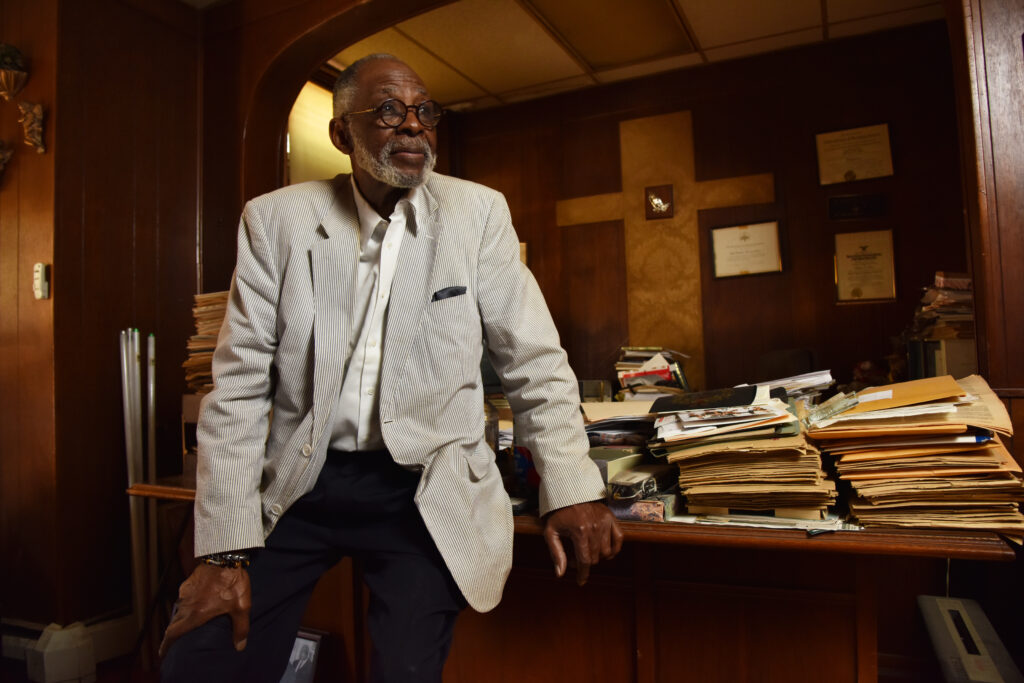
Elegant in an ever-present blazer, slacks and round tortoiseshell glasses, he liked to find humor in a business that could be dreary on the best days and crushing on the worst.
“Trying to stay on top of the ground,” he liked to joke when someone asked how he was faring.
“Dead,” he’d say when asked about business, his crescent smile framed by a gray beard.
Ables took his work seriously. He referred to burials as “cases” and meetings with prospective clients as “conferences.” When someone died, he said they had “expired.” He spent hours alone with the dead, classical music playing in his embalming room, as he used tools to ensure that he “put that smile back on their face.”
“It’s an art, man,” Ables said. “We’re practicing an art.”
Derrick McArthur, who worked at Hall Brothers during the business’ last decade, said Ables saw himself as a source of comfort for mourners burying mothers, fathers, sisters, brothers, spouses, grandparents and, most painful of all, young children.
“He was that shoulder to cry on,” said McArthur, now the manager of Mount Olivet Cemetery in Northeast Washington.
Ables also saw himself as a repository of essential D.C. history. When his uncles owned Hall Brothers, they began recording every funeral they managed in thick ledger books, a handwritten log that included the name of the deceased, their occupation, the date of death and cause.
Lawrence Monroe Ryles, as noted in one entry, died Sept. 13, 1947, after being “run over by a train.” Melvin Bailey, age 6, died that same year of meningitis. Sarah Lee Rush, 37, died in 1981 from a “gun shot wound to the chest.” Clyde Gossett died of complications with AIDS in 1989.
By the time Hall Brothers closed, Ables had 18 dusty volumes chronicling the deaths of thousands of Black Washingtonians. His inclination was to toss the books in the trash, but McArthur said he advised him that “they should be preserved for genealogical purposes.”
“There might be families that want to come back and do deep dives into their history,” McArthur said. “It didn’t make sense to throw away history if we were the history keepers.”
Ables agreed to offer the ledgers and other Hall Brothers ephemera to the D.C. Public Library, which made the records part of its People’s Archive collection.
In a sense, he was preserving his own family’s history, as well.
The Hall brothers, after migrating to D.C. from Mississippi in the 1930s, went into the funeral business at a time when aspiring Black professionals, unable to enter fields like medicine, could find careers in the mortuary sciences.
From their rowhouse near Seventh Street and Florida Avenue NW, the brothers started their business, handing out business cards that read, “In the event of my death, please notify: Hall Bros. Funeral Home.”
When mourners assembled for wakes, Hall Brothers distributed hand fans, one of them featuring the visage of gospel legend Mahalia Jackson and another that offered advice on “how to get along with people” (“Keep skid chains on your tongue” was one recommendation; “make promises sparingly and keep them faithfully,” was another).
Ables, who grew up in D.C., spent many childhood hours at the funeral home, where one of his uncles lived upstairs. During hide-and-seek games, his cousins liked to tuck themselves into any one of the parlor’s array of caskets. The caskets were also useful on Halloween, when the kids liked to jump out of them to greet trick-or-treaters.
In those years, and through the 1970s and 80s, the neighborhood was a cultural hub for Black Washingtonians. Howard Theatre drew stars like Smokey Robinson, James Brown and Aretha Franklin. Ables, who started helping out at Hall Brothers in the late 1970s, would walk across the street after work to catch the acts.
“If we saw a White person, we’d ask, ‘What are you doing here?’” Ables told The Post in 2019. “Now it’s the opposite.”
In those years, the city’s Black-owned funeral homes would gather for annual crab feasts and holiday celebrations. Everyone in the business, it seemed, knew each other.
“It was a nice, lovely community,” said Jerome Austin, 82, a friend of Ables who still operates a body removal business, Mortuary Transportation Services. “Everyone knew and liked Richard. He was always soft-spoken and always had that little smile on his face. He was just so gentle.”
Many of Ables’s contemporaries from the funeral world have died off. His wake on Friday night, at a funeral home in Maryland, drew old friends and family, everyone greeted by his daughters, Geneita and Ashley.
There was also a cousin, Macy Hall Jr., with whom Ables used to hide out in those caskets when they were kids, and Robert Smith, who worked at Hall Brothers for over 40 years. He tilted his head back and laughed at the idea that the old funeral parlor had been turned into condos.
“I don’t think I could live there knowing what I know,” he said.
Manny Moore, 78, a friend of 45 years who drove down from Baltimore, said Ables had been like a brother to him. “It’s hard to replace something that’s real,” he said. “He was real. We could trust each other. I could talk to him.”
The gathering had a low-key, wine-and-cheese vibe, the way Ables had wanted it, everyone chatting and laughing and pausing before his mahogany casket, where he lay, stylish as always, in a white ascot, a matching white handkerchief tucked into the breast pocket of his blue smoking jacket.
The post He buried generations of Black Washingtonians. Now it’s time for his send-off. appeared first on Washington Post.