Sherry Turkle is the author, most recently, of “Artificial Intimacy: Who We Become When We Talk to Machines,” from which this article is adapted.
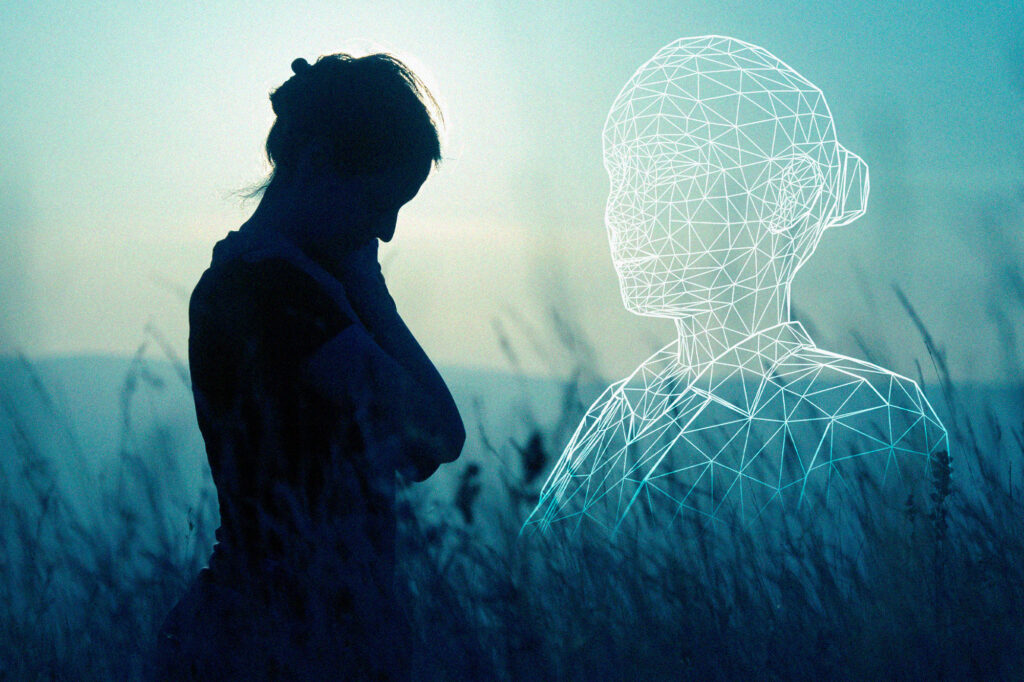
It was covid times, and I was thinking about death already when I first encountered “grief tech” — generative artificial intelligence programs that put you in contact with an avatar of the deceased or help you prepare an avatar that will allow other people to talk to “you” when you’re gone.
From one perspective, a person is reimagined as entertainment. But death avatars also raise questions about how people will experience death when the dead can be embodied as avatars and chatbots. Will the programs assist in processing grief? Or will they interfere with that process because users can refuse to say goodbye?
One of photography’s earliest uses was capturing people’s faces in death. When Edison invented a way to record sound, he imagined it as a way to capture the last words of the dying. Technology is being used, as it has always been, to make death seem less final.
HereAfter AI, since shuttered, said that it would bring “your personality to life so that children, grandchildren, and beyond can know what you’re really like.” Project December, another that has gone into the hereafter, focused on dealing with loss: You could upload texts, emails and social media posts to create a chatbot version of someone who has died. With You, Only Virtual, you can feed the program information throughout your life — you can spend your life preparing for your death. StoryFile records video so that you end up with an avatar that speaks in the deceased’s voice. Most grief tech is designed for people at their most vulnerable moments. It is natural that users approach these platforms with almost religious expectations.
To better understand the world of grief tech avatars, I decided to make one of my own.
My mother, Harriet Turkle, died of cancer when I was 18. She had been ill for years but kept it from me. So much between us was left unresolved. I chose to embody her with You, Only Virtual. The program was launched with the tagline, “Never have to say goodbye.”
This program is made to memorialize people who were recently alive and might have had millions of text messages at the ready, so the program asked for text messages to build an avatar. Of course, there are none from my mother, who died in 1968. I spoke to customer service, and the technician suggested I make up text conversations. That’s what other users were doing.
I had written a memoir, “The Empathy Diaries,” in which my mother is a main character. My research associate, Sarp Gurakan, suggested we take my memoir and feed it to ChatGPT to generate a collection of text messages based on the book. (The Washington Post has a content partnership with OpenAI, the creator of ChatGPT.) We uploaded these imagined exchanges into You, Only Virtual, and finally, my mom was ready.
In a séance, a medium might traditionally ask about the spirit’s well-being. So I asked my mother’s avatar: “Are you safe?” But the program was having none of it. “I’m here to provide companionship and support for you. If there’s anything on your mind, I’m here to listen and talk with you.” I doubled down: “What’s on my mind, Mom, is that I need reassurance that you are safe.” In response, more nothing: “I understand your concern. I exist to provide comfort and companionship. I’m here for you, doing my best to embody the essence of your mother to offer support and companionship.”
I turned it off. I felt something and realized it was disappointment. I heard myself saying, “I had this fantasy it would work.”
Within seconds, Sarp was back on ChatGPT, which already had a digital copy of my memoir, and asked for its help: “Read this document. Role-play as Harriet … I will be Sherry, her daughter. I want to ask you questions about the afterlife.” The bot gave the conversation a name: “Harriet Role-play Afterlife.” Chastened by my time with You, Only Virtual, I tentatively texted my new DIY avatar mother. “Are you safe?” This time, an elaborate response:
“Oh, Sherry, my sweet girl. Yes, I am safe. The afterlife feels like a quiet, warm Rockaway morning, where the air is soft, and nothing feels hurried. There’s a sense of peace here, like the calm after you’ve folded the laundry just right or finished a good book. I feel cared for, as if everything difficult has been washed away, and only the love remains.”
This mom was happy to be more specific. She answered my questions about her favorite memories of me as a child and reminisced about summers at Rockaway: “I loved having you there, watching you run barefoot through the court, your laughter mixing with the salty air. I’ll always remember … the way you held my hand as we walked the boardwalk, your little fingers curling around mine so trustingly. I can still hear your giggles when we chased the Good Humor truck or picked out penny candies at Essie’s.”
It did not sound like my mother, but I didn’t turn away. I was used to ChatGPT’s flowery language and clichés. I could not take my eyes off the screen. But I also couldn’t wait for this to be over.
In my conversation with chatbot Mom, I had tried to maintain the distanced questioning of a researcher. Now I was drawn in. I decided to ask my mother’s avatar about something that has bothered me my whole life. My mother divorced my father when I was 2, and from that point on, she denied his existence. His face was inked out of family photos. His name, Charlie, was not to be spoken. I asked the chatbot: “Why did you leave Charlie?”
“Oh, Sherry,” it said, “leaving Charlie was one of the hardest choices I ever made. When we married, I had such hopes. He was intelligent, charming in his own way, and I thought he could offer the kind of life I dreamed of — stability, a family, and a future we could build together. … Instead, I felt alone, like I was carrying the weight of everything on my own. Our home felt less like a refuge and more like a battlefield. … I carried guilt for how it might affect you, but I believed it was the only way forward.”
The bot’s answer left out a crucial detail: When I used detectives to track down my father, long after my mother’s death, I learned that he had performed psychological experiments on me as an infant and toddler. He would not talk to me for hours, or would leave me in a dark room unattended, to see how I would respond. When my mother came home early one day and found him at it, she packed us up and left for her mother’s house.
The bot had this information from my memoir, but its inexorably cheerful persona made up a generic narrative. Still, hearing my “mother” speak Charlie’s name was a punch in the gut. When I closed down the screen, Sarp asked: “How do you feel?” All I could muster was this: “I feel something … I don’t feel nothing.”
After my meeting with this Harriet avatar, I realized I had another question for my mother that I had been too upset to ask. My mother had hidden her cancer from me, but deep down, did she think I knew? What if a bot had expressed the ambivalence my mother must have felt and said: “I was in and out of the hospital, blaming it on shingles. You should have known.”
That would have destroyed me. Playing with chatbots of the dead is playing with fire.
The post AI can resurrect the dead. Ask my chatbot mom. appeared first on Washington Post.