Featured among the glass cases in Procter & Gamble’s Heritage Center are household brands like Tide detergent, Pampers diapers and Gillette razors. There’s also an Emmy statuette.
That was for the company’s role in creating one of the most enduring television formats: soap operas. In the early 20th century, a P.&G. executive had the idea for a radio program that could both entertain and push the company’s cleaning supplies.
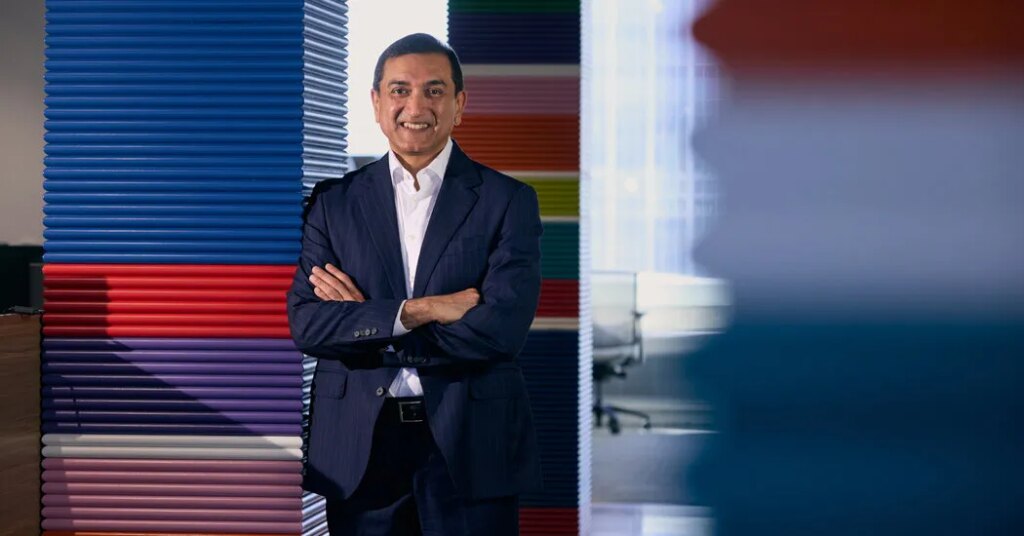
Reaching consumers today is more complicated, Shailesh Jejurikar, a P.&G. lifer who became chief executive in January, said in a recent interview at the company’s headquarters in Cincinnati.
Years of inflation, economic jitters and a changing media landscape have made it challenging to persuade customers to buy the consumer giant’s brand-name products. Sales growth at P.&G. has slowed for years as households with lower incomes are increasingly turning to store brands, which are usually priced lower than P.&G.’s products.
At the same time, tariffs and rising energy costs caused by geopolitical conflicts have added costs to P.&G.’s operations and its sprawling global supply chain. In response, the company has raised prices and laid off workers. Last year, it said it was cutting 7,000 jobs, or 6 percent of its work force, over the next two years as it looked to reorganize amid the changing dynamics.
Mr. Jerjurikar, 59, said that the company must focus on innovation to create products that customers “feel it’s worth paying the price for.” Innovation includes using A.I. to help the company more quickly find and develop new molecules and formulas for products like detergents and hair care. And he’s trying to adapt the company’s Emmy-winning brand-building machine to a fragmented TikTok age.
This interview was edited and condensed for clarity and length.
What are the biggest changes you’ve seen since becoming C.E.O.?
These are three big changes we see in the landscape: the media fragmentation and how you engage with consumers, the retailer landscape evolving, and inflation and how consumers see value.
Should consumers expect higher prices from P.&G. in the near term?
The answer to that question is very nuanced. We’ll go brand by brand, item by item. Where are the costs we cannot handle, then how do we do the pricing in a way that still protects the value for the consumer? So it won’t be just price broadly.
My experience from emerging markets is sometimes we think the lower-income consumer is not willing to pay for performance. Actually sometimes they are more willing to pay for performance because for them, failure is not an option. If I don’t have tons of clothes, I absolutely need those clothes to come out clean.
I’m curious the role loyalty plays here. “My mom used Tide, so I’ll buy Tide” kind of thing. At a time when Americans are really thinking about their budget, is loyalty enough?
Tide liquids is more expensive than many brands in the market. To earn the loyalty, we need to make sure consumers feel that performance is something that we would never trade. But we have to earn it, and we have to earn it every day.
Are there costs you think your company should absorb instead of passing them on to the consumer?
We always start with, can we generate the right level of productivity to ensure minimal cost is passed to the consumer?
Can we run truck routes a different way? Can we run our manufacturing lines with more efficiency? Can we automate parts of our manufacturing operation that make it more cost effective? Can we do better assessment of our media spending to find out if it is effective?
Where is there waste? You do the analysis and get rid of that. When you start looking at oil over $100, the pressure becomes pretty significant.
What does running a company feel like in this kind of environment?
We have become better scenario planners and creative problem solvers. Oil could be $70, oil could $110. What do I do in either scenario? And I need a real plan because it really could be either of those.
Last year, P.&G. announced it was cutting 7,000 jobs. Do you feel good about the number of people who are still there, given where you want to take the business?
There is going be a lot more technology deployed, a lot more capabilities available, a lot more autonomous. Moving forward, we should be able to operate with the same size of organization and still grow.
There’s an interesting conversation in corporate America about how many layers is too many. Were you trying to eliminate layers?
Yes, both horizontal and vertical. Horizontal would be two people doing similar work. Vertical is what’s traditional hierarchy.
So for horizontal, I have a brand person and a market research person. Do I need both if you can really generate a lot of the core statistical methods out of gen A.I.?
As we reduce duplication in work and simplify work, it causes the people to be reduced. Part of the logic there is to become way more effective and much more externally focused.
Are more layoffs coming?
No, we’re on track to complete layoffs by the end of the fiscal year next June.
Are you going to slow down hiring in the future?
The worst thing we can do to ourselves is stop hiring. We are largely a promote-from-within company, which means we hire at entry level.
How are you talking to your employees about A.I. and how it could affect their job security?
We’ve done a fair amount of studies, including some with Harvard and M.I.T., where we’ve tried to study the effectiveness of human alone or human plus A.I. We’ve concluded the best is a combination.
We’re seeing about three or four broad areas of application where we see a financial payout. One is in our manufacturing and supply planning. The other one is in R&D and innovation when you think about how quickly we can discover new molecules and solve new consumer problems with products. We see great usage in brand content development, in both generating that content and assessing that content.
We talked about internal work, how do you simplify it using things like Copilot [Microsoft’s A.I. tool]? We gave all of the employees Copilot licenses and it’s really cool when I hear how they’re using it.
All of these things need to ladder up to better meet the consumer need. That’s really why we are in business, so if all of this doesn’t do that then there’s no use.
What kind of work do you see A.I. eliminating?
We find certain work can completely go away, but certain work suddenly pops up. I’ll give you a simple example. I can move a lot of my manufacturing lines to autonomous manufacturing. In those cases, we are actually redeploying more of those people on innovation.
There’s another case where, on brand building, the number of people we now need to generate the stuff is dramatically increased. The brand building space is where we are adding the most number of people right now.
What’s the new job that’s being created in brand building?
You need to do social listening every day. What are people saying on social media? What does it mean? Are you getting any insights out of that? Do you need to respond to that? Do you need to adjust your creative content based on that?
In a world where you made a few ads a year, it was important. Now where content is in the thousands, branding is even more important to be sharp. The brand idea has to be crystal clear.
A human is doing that?
Correct, and deciding what we need to do.
You spent the start of your career at P.&G. abroad, first in India and then in Kenya. What did you learn from that?
It taught me pragmatism. In a large company, you always assume someone else is going to do something. It could be as basic as my boss asking me, “Where is that ship of stuff that was going to come?” I’m like, “Let me check with the product supply folks.” And he said, “Why do you need to do that?” He took me to his office, opened the newspaper, showed me where the ships’ arrival dates are and said “Just look at that.” It gave a sense of getting things done.
It’s time for the lightning round. P.&G. products have detailed instructions, but are they necessary? Do I really need to brush my teeth for two minutes?
Yes. That’s real. Two minutes. Twice a day.
No pre-rinse if you’re using Cascade?
It’s real.
What happens if you pre-rinse?
You’ve wasted water. Your time. Just scrape the big stuff off, put it in the dishwasher. You are saving both energy and water.
What’s the last question you asked A.I.?
I needed some data about a competitive company.
If you were not the C.E.O. of P.&G., what would you be doing?
I love history. Maybe I would have taught history. But I’m not sure I would’ve made a good teacher.
What’s the last book you read?
A book called “Undaunted Courage.” It’s on the Lewis and Clark expedition.
What’s the most revealing interview question you like to ask?
If it’s a consumer, I just keep asking, “Why?”
What about for a job interview?
I like to understand what they’ve done and why they chose what they did. I like to understand what their passion is because I truly believe that if people enjoy what they do and are passionate about what they do, they will succeed.
How many is too many direct reports?
I don’t think there is too many anymore.
How many do you manage?
I think it’s about 20.
And that feels manageable?
I think technology enables it. You can have a lot more direct and it cuts the hierarchy as well.
What’s your biggest pet peeve as C.E.O.?
I don’t get to talk to people informally as much as I used to. So after lunch, I go for a walk around the office. I just go down the corridor when everyone’s at lunchtime, walking back and forth. I can at least talk to people at random versus planned.
What’s your most contrarian take?
I believe there was never a better time for a large company to leverage the changes in the landscape and create a bigger moat.
I would agree with that actually.
That means I’m not being contrarian? Or maybe we’re the two smartest people.
The post P.&G.’s Chief on Whether Brand Loyalty Is Enough When Prices Keep Climbing appeared first on New York Times.