“Welcome to my brain,” Christopher Myers said as he swung open the door to his chockablock studio in an industrial building on a busy corner in Brooklyn.
Behind him was a cavernous room packed floor to ceiling with art and ephemera: quilts, bird cages, brass instruments, a taxidermy vervet monkey, a Black pirate skeleton’s hand from the 1600s and a wall of embroidered panels inspired by Lil Wayne.
Myers, 51, a fine artist and children’s author, wore a self-made jumpsuit that gave him the air of a very tall toddler welcoming a visitor to the best playroom ever.
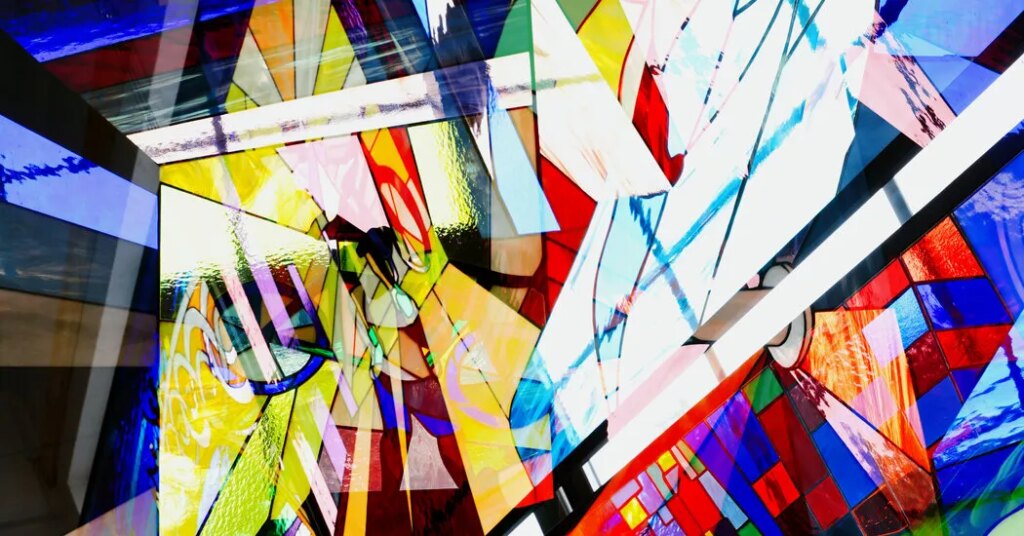
Except instead of slime or Legos, I was there to check out the stained glass he made for his new picture book, “Night Ride,” published last week by Kokila, an imprint of Penguin Random House.
Myers was more than happy to show off.
“I love things that are both really, really old and the future,” he said, taking long strides past a bust of Persephone, wrapped in gold wire studded with faux pomegranate seeds imported from Bulgaria. (Bear with me, I’m trying to give you a sense of the idiosyncratic specificity of Myers’s work space, where he sometimes sleeps on a pallet made from steel and seatbelt webbing. Yes, he built it himself.)
Myers stopped in front of a 4-by-6-foot stained-glass panel showing a father and daughter rowing beneath Bow Bridge in Central Park. The image, a homage to his daughter, Kaze, 7, shows up in “Night Ride” and will soon join an exhibit of Myers’s work at the central branch of the Brooklyn Public Library.
The colors are Chagall-like, the glass pebbly in some places and smooth in others.
“I love forms — like stained glass, like quilts — where when you see them, you know how they’re made,” Myers said. “It’s not like the hand of God came down. We see every stitch in the quilt. You’ve seen glass before.”
According to Myers and his publisher, “Night Ride” is the first picture book done entirely in stained glass. It consists of 20 large panels sketched and mapped in Myers’s studio, assembled by a family of artisans in Guadalajara, Mexico, then shipped back to Brooklyn to be framed, lit and photographed. The resulting volume is a small work of art that follows five young people as they explore New York City by bike in the dark.
Myers’s textiles, sculptures and metalwork have appeared at the Guggenheim and the National Gallery. He has written and/or illustrated many picture books, including the Caldecott honoree “Harlem” and “We Are America,” both created with his father, Walter Dean Myers, who wrote so many books for young people that his son hasn’t even read them all. But “Night Ride” is the first book the younger Myers has created that doesn’t have words.
“My editor said, you need to let this book be the quiet place that it is,” Myers said.
His editor, Namrata Tripathi, noted in an interview that beneath the dust jacket is a black-and-white design inviting readers to color their own panel. “It’s an encouragement to be your own storyteller,” she said.
The message of the book is as clear as the material it’s built from: This is a celebration of exploration and freedom. Even as an adult turning pages beneath fluorescent lights in a Midtown office cubicle, I could feel the wind on my face.
Growing up, Myers tended to be extremely bored during church on Sundays, and he credits those long hours with his appreciation for both stained glass and peace.
He flipped through a series of panels leaning against a wall and pointed out the Nuyorican Poets Cafe, the Studio Museum in Harlem and the Cathedral of St. John the Divine.
“All holy places,” Myers said. “All places where I find quiet.”
His characters make their way from Times Square to Chinatown and over the Brooklyn Bridge, not locations the average tourist would associate with tranquillity. But Myers, who very much identifies as a New Yorker despite spending a formative decade in Jersey City, is bullish on the city’s potential for calm, especially at night.
“When you meet people who aren’t from New York, they say, it’s so loud, it’s so much,” Myers said. “But if you’re from here, you know how to find quiet. I’m not waiting for the trees to give me quiet. I have the streets that I walk on. The book is about discovering those moments.”
He added: “So much of children’s media is neon and ‘smash bang’ and ‘bang pow.’ We forget the beauty of a lullaby.”
In addition to beloved landmarks, the book includes everyday fixtures — traffic lights, park benches and a bodega toy dispenser of the sort that never coughs up anything worth your quarter but still holds so much hope.
Myers said he regrets not including a stop in Queens, where he was born, but a pack of young people can travel only so far.
“My life is like a knife fight in a phone booth. I have, like, 47 projects all happening at once,” he said, laughing, as he introduced other treasures in his studio.
Brown glass eyeballs made by a Philadelphia ophthalmologist in the 1900s. A shackle once worn by an enslaved person — truly chilling — sitting on a shelf above a box of vintage Spirographs. An astrology book from 1834. Adrian pith helmets worn by American soldiers during World War I, bearing French insignia because the U.S. military didn’t want Black soldiers to wear the uniform.
Speaking of helmets: The kids in “Night Ride” aren’t wearing any.
“It was a conversation,” Myers said of this decision. “But the book is a fantasy. The kids are 57 times taller than the buildings. It’s a dreamscape of what it means to truly own your own space. I also don’t recommend that people ride with their arms outstretched across the Brooklyn Bridge.”
Myers bikes everywhere he can. When he travels with his daughter, to whom “Night Ride” is dedicated, they listen to music on a portable speaker.
We traveled by car from his studio to the Brooklyn Public Library, where images from “Night Ride” fill the windows facing Grand Army Plaza. On the north side of the building, beneath an inscription that reads, “The spoken word perishes but the written word endures,” a boy rides a tricycle trailing a stream of yellow light.
Technically, this part of the exhibit, on view until Jan. 15, is done in vinyl adhesive, not stained glass. Cora Fisher, a library curator, said in a phone interview that the library has never staged a show of this magnitude before.
“People of all ages, from 2-year-olds to elders, have been engaging with it,” she said.
From the library, Myers and I hopped on CitiBikes and pedaled down Eastern Parkway to the Church Avenue subway station to see another of his projects: newly installed mosaics that celebrate the theatrical history of the Flatbush neighborhood.
It was peak summer, with throngs of people streaming in and out of Prospect Park and the sun baking everything to a pleasant crisp. Myers got going at a brisk clip while I obsessed about my unprotected head. Still, I couldn’t stop smiling. Despite car horns, sirens and a distant subway screech, the bike lane was a quiet place.
The post His Ode to N.Y.C.’s Magic Starts With Stained Glass appeared first on New York Times.