NASHVILLE — Behind a luxury high-rise, Carter Stevens inspected his favorite dumpster.
Dresses on plastic hangers dangled over its rusty edge. A 65-inch flat-screen television jutted through cardboard boxes. A marble side table, wedged between trash bags, gleamed under the lunchtime sun.
“Jackpot,” the 31-year-old muttered.
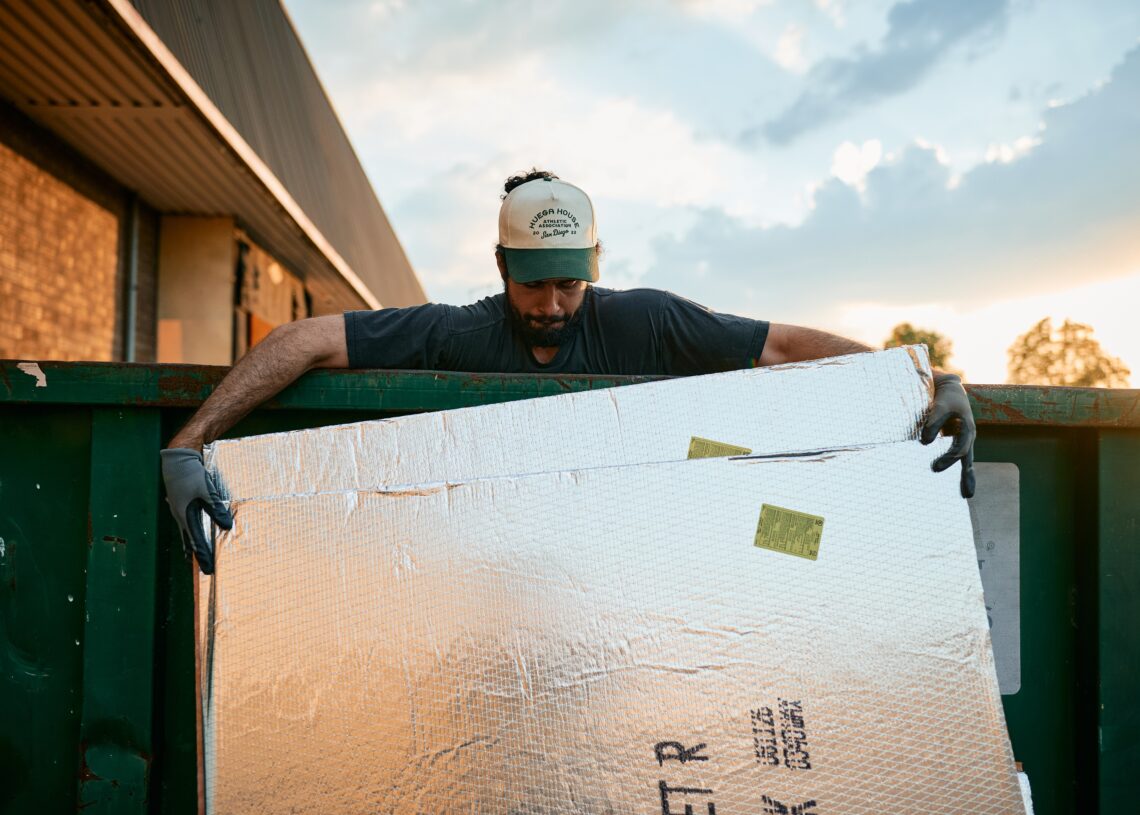
Sweating in the 95-degree heat, Carter tied his curly black hair into a bun and strode up to the steel bin the size of a U-Haul truck, ignoring the sticker that read “KEEP OFF!” He stepped onto a support rail and rose to his tiptoes, scanning inside for cockroaches. Nothing rustled.
“Easy does it,” he said, hoisting himself into the garbage.
Carter abhorred insects and was allergic to cat dander, but rummaging through dumpsters, he’d found a Gucci bag. BAPE sneakers. A Louis Vuitton button-up. “All the stuff we use to fill the void,” he said.
Overconsumption had nearly ruined him before he learned how to exploit it. In two years, he’d gone from homeless and in debt to earning six figures from selling what others threw away.
Americans buy and discard more stuff than anyone else, and in Tennessee’s booming capital — the Music City, the bachelorette destination, the influencer hub of the South — junk struck Carter as astonishingly valuable. People came here chasing stardom or a fresh identity; 86 new residents arrived each day, per the local government’s last count. Carter imagined some crash-landed, like he had, leaving wreckage for him to sift through when Everything Must Go. Or they acquired upgrades they associated with success, shedding whatever hadn’t satisfied them.
Carter had salvaged stuff in unopened boxes. Stuff that he’d seen models praise on TikTok. Stuff that reminded him of what he’d once maxed out his credit cards to wear. Stuff that he’d had to offload, quickly, when he couldn’t cover the rent for his three-bedroom house in the summer of 2024 and moved into a $30-per-day Zipcar.
“Still has the tag on it,” he said, yanking a lacy white Simply Southern frock from the heap. Someone had spent $59.99 on what he called a “grandma dress” before chucking it unworn. Carter popped the trunk of his cherry red Lexus ES and tossed it in.
“Might be worth something,” he said.
Probably not enough for him to risk a bug crawling up his pantleg. Yet it could help fund his next venture, one Carter hoped would set up the rest of his life.
Damp and itchy and distressingly close to what smelled like spoiled yogurt, he tried to apply that optimism to his own recovery. If Carter could repurpose rubbish, he figured, maybe he could repurpose himself.
THE LONGING THAT GOT HIM into this mess started with light-up sneakers. As a first-grader, Carter ached for a pair, but his parents didn’t cave. They taught him to work for what he wanted.
His father was a successful music producer, so Carter grew up around wealth, which intensified his fixation on flashy shoes and Ed Hardy rhinestone shirts and souped-up Mustangs. Sophomore year, he applied for a job at McDonald’s and began saving for what he coveted. “Nice sh–,” Carter said.
The appetite for more and better was baked into American culture long before he was born. Spending was patriotic in the nation that invented mass marketing. Spending kept the factories running. Spending became so excessive, the historian who coined the term “American dream” advised his countrymen in 1931 not to mistake prosperity for “material plenty.” But over the last century, federal statistics show, the amount of clothes and shoes that Americans scrapped each year shot up almost tenfold.
Carter found a silk Christian Dior windbreaker at Goodwill for $1 in 2018, shortly after he’d dropped out of college. He’d never felt comfortable in a classroom, but for much of the next six years, he excelled at sourcing vintage pieces from donation bins and estate sales for a second-hand market near Vanderbilt University. “I made it,” he thought when a friend told him the young woman browsing his clothing racks was country star Kacey Musgraves.
Carter could have stashed away money. “But I screwed myself,” he said. First, he started taking too much Adderall. Then too many other drugs. In 2021, he spent a week in rehab and eased off the narcotics. But Carter still struggled with his addiction to spending.
He bought Christian Dior Birkenstocks for $1,200. A camping van for $10,000. A Mercedes-AMG that cost $3,100 monthly, including insurance. “I just woke up itching for stuff,” he recalled. His monthly outflow, at its highest, surpassed $15,000.
When the celebrity interest moved on and business dwindled and Carter owed more than he was making, he slept in his storage unit until an attendant warned he’d get kicked out. Crashing with his parents hadn’t worked, either. They’d argued. He’d wanted to be alone.
Cramped in a Nissan Sentra for three weeks, Carter vowed to control his cravings.
A cousin loaned him cash to get into a one-bedroom apartment, and he hawked just enough shirts to cover the $1,000 monthly rent. His rebound started one November afternoon last year, when, emerging from Goodwill, Carter noticed men behind the warehouse next door plopping dozens of office chairs next to a dumpster.
“Those are trash?” he’d walked over to ask. Yes, replied one man, who introduced himself as a trucker for a moving company. And more were coming, he said, thanks to a corporate office shuttering.
Carter crouched over the swivel seats and Googled the brand. Steelcase. They were going for hundreds of dollars each online.
He returned with a trailer and grabbed 190 chairs. All but 40 sold in six weeks to liquidators he’d emailed. The $17,000 profit allowed Carter to pay off his credit cards and pay back his cousin.
His foraging expanded to other warehouses, hotels, apartment buildings and the mall. Eager for leads on personal clutter, too, he printed lawn signs: “JUNK AWAY JUNK REMOVAL. TEXT OR CALL.” Carter retrieved couches, standing desks, industrial lamps and iPads. After six weeks, his eBay sales hit $30,000. Once, a security guard confronted him with a gun drawn. Mostly, though, nobody seemed to care.
Carter wondered what his parents would think. They’d refused to lend him money when he’d felt most vulnerable, and for two weeks, he’d been too angry to speak to them.
Still, he wanted to make them proud.
“I’m providing a service,” he told them.
THE GRANDMA DRESS was a bust.
“Nobody’s buying these,” Carter said, scrolling through his phone. The eBay app showed 189 other sellers had listed the same one. Nineteen had sold.
“That’s a 10 percent sell-through rate,” he said, dropping it onto a mound of others that he would not try to sell.
With his savings nearing $12,000, Carter didn’t have to clean, photograph and post every item. He lit a French vanilla-scented candle on his West Elm coffee table — both acquired from a junk removal gig — as pot roast simmered in the Crock-Pot he’d splurged on at Goodwill for $8.
Someone else could have the Simply Southern frock, Carter thought — like his buddy, another thrifter, who sent second-hand dresses back home to Ghana. Another stack of vintage shirts would go to a friend who’d agreed to pay $150 for 11 pieces. Carter could have doubled that profit on eBay, he estimated. What he wanted now, though, was time to focus on his new business idea.
The American Dream at 250
Desire for privacy is slowly killing this symbol of the American Dream
What I learned about the American Dream from Europeans pretending to live in Ohio
He raged against the American Dream. His audience wanted more.
The skin on his arms was red from brushing against insulation panels. His back was sore from all the lifting. He sensed the jackpots couldn’t last forever.
Carter sat at the white Ikea desk he’d bought in college, opened his old laptop and played a YouTube video titled, “How to Wholesale Real Estate Step By Step.”
“If you are looking for a way to make a lot of money that is low risk, easy to learn, that you can do from anywhere,” a male voice gushed as hundred-dollar bills proliferated on the screen, “then nothing beats wholesale real estate.”
That guy was wrong about “easy to learn,” Carter thought. After watching at least a dozen similar tutorials, he was still stuck at Step 1: Find a list of pre-foreclosure properties. Clicking through Nashville.gov, he’d located zero of those supposedly public records. That held him back from calling people who’d defaulted on their mortgages and asking, “Would you like to sell your house?”
Step 2 was offering to connect them with a home-flipping investor who’d give a cut of the sale to Carter. All from the comfort of his Steelcase chair.
“This is going to take a lot more work,” he said.
His attention veered to another browser tab: a digital car auction. Carter had sworn off new models, but the familiar yearning surged back when he scanned the selection of repossessed clunkers.
He’d bought three used vehicles, including the cherry red Lexus, since becoming what his younger brother wryly described as an “acquisition technician.” His rule was: Purchase only what you can sell for more … if the need ever arises.
“Goin’ once, goin’ twice …” an auctioneer warbled on the live stream.
The one he wanted was almost up.
Carter paused at the 1993 Ford Ranger pickup truck he’d gone to inspect at the lot. Nice engine, nice transmission. He’d pay up to $1,600.
A user named Coming2SeeYou had offered $850.
Carter clicked the auto-bid button, putting him in the lead with $950.
Coming2SeeYou responded with $1,000.
“I’m not going to get it,” Carter said, clicking the auto-bid button again.
INJURY LAWYER BILLBOARDS and payday loan banners gave way to gated mansions as Carter drove to his parents’ house in the upscale suburb of Brentwood.
He admired the golden-hour clouds. After quitting drugs, Carter had trouble feeling anything except the dopamine boost from clicking “add to bag.” Now he talked about the skyline and choked up.
“More beautiful than a $10 million painting,” he said.
It was pizza night at the brick Colonial with the newly remodeled kitchen. His parents had swapped their stove for a six-burner cooktop that Carter had procured on Facebook Marketplace.
“Awesome!” his dad exclaimed as Carter greeted him with another gift, a faded blue T-shirt emblazoned with “ARIZONA.”
“Because of the house,” Carter said, meaning his parents’ other one, the vacation ranch in Sedona.
Chris Stevens, 58, realized he might be the only five-time Grammy winner whose son dug through trash. Picturing what Carter encountered out there unnerved him. There could be dirty needles. Trigger-happy security guards. Chemical burns. Trespassing charges if Carter irked the wrong property owner.
But Chris told his son that he was proud of him. His own dad used to return greasy from 4 a.m. shifts at the Southern Pacific Railroad, where he labored under trains for five decades. The machinist cycled to work because he couldn’t afford a car while raising six children, but when Chris was 13 and transfixed by a keyboard at Radio Shack, his father scraped together the $250.
That’s how Chris got into music, which drew him from Eugene, Oregon, to Nashville, which led to him writing songs for Kenny Chesney and Carrie Underwood and buying a house that Zillow now valued at $1.3 million.
He liked being generous with his four kids, but not always in the way they wanted. “I don’t ever want to rob you of the feeling of working your way to success,” he’d told them.
When Carter’s old car broke down while he was still frequenting Goodwill to cover rent, though, Chris gave him $3,000 for the truck that towed the trailer full of office chairs.
“Got a new one today,” Carter said as they sat down for pepperoni pizza.
“You got a new truck today?” asked his mom, Nancy.
“I got a good deal!” he assured her, “but…”
“Where is it right now?” she pressed.
“At my apartment with my other two cars,” Carter deadpanned.
He’d wanted to drive it there, he explained, but when he filled it up with gas, the fuel leaked onto the pavement.
“Corroded pipe?” his dad guessed.
“Pretty simple repair,” Carter replied.
Unless he had to replace the tank, which could cost twice the $1,300 he’d paid at the auction lot. Whatever the case, he worried the Ranger wasn’t the good investment he’d bet it was.
“I’ve been thinking more about real estate,” he announced.
THE YOUTUBERS AND TIKTOKERS and Redditers suggested their own version of a cold-call script, but Carter didn’t want to repackage someone else’s words. How many competitors, he wondered, were reading from the same prompt?
On a notepad he’d snagged from a dumpster, Carter jotted down the start of a pitch he hoped would come to sound like himself.
Hello, is this …?
Are you the owner of …?
I’m reaching out to see if you’d be looking to sell that property anytime soon?
Driving through neighborhoods near his apartment, he’d counted five houses with overgrown lawns and mail piling on the concrete stoops. Probably abandoned. Several others looked shabby but had the lights on.
Were those people open to a deal? Carter had considered knocking on doors, but he didn’t want to scare anyone. “Not trying to get shot,” he said.
Another option was hiring a business coach who could teach him how to access hundreds of addresses and phone numbers. Or finding a mentor at a real estate meet-up who’d do that for free. Successful wholesalers became investors, he’d read, and investors benefited from what Carter aspired to become: a go-getter bringing them leads. One Redditer on the advice page he’d skimmed was seeking “a killer willing to grind every waking hour.”
“I can outwork anyone,” he thought.
Or Carter could pay for online marketing and paper fliers. The first round would cost $2,000, he estimated.
Was that a good investment or another risky clunker? A luxury builder who’d been a regular at his vintage stall had started in wholesaling. Carter had seen him posing on Instagram with his Lamborghini. Another Redditer, though, had posted: “My phone is glued to my ear. And nobody picks up.”
Stuck in that Zipcar, Carter would have answered such a call. He’d wanted to sell his designer wares as soon as possible — to free himself from the crush of stuff he couldn’t afford. His buyers had gotten a bargain, he knew, and Carter had received money for food and half of a security deposit. He’d been glad to have the option.
Carter didn’t have to write down the next thing he’d say to whoever was defaulting on their mortgage.
He’d thought about it in the dumpsters, and when he cooked dinner in his apartment, and when he visited his parents, and when he studied for the career he hoped would stick. He thought about it while repainting his new truck — which just needed a $30 fuel filler neck replacement, thank God — and when he paused to watch the sunset.
I know what it’s like to lose everything.
The post He lost everything. Then he found riches in a dumpster. appeared first on Washington Post.