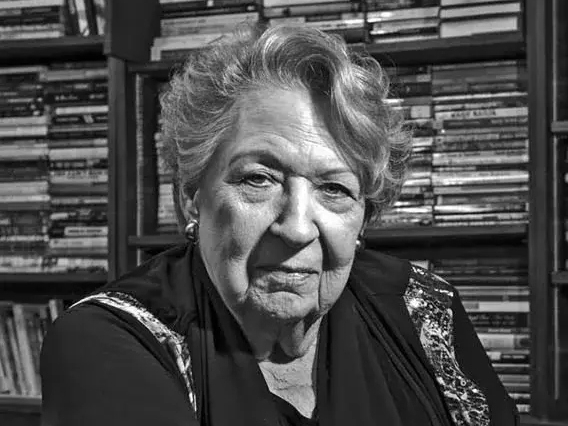
Harriet Hancock, who has died at 89, was a leading force for the gay rights movement in South Carolina, where she spent more than four decades fighting on behalf of equality and dignity for LGBTQ+ people like her son Greg, who came out to her in the early 1980s.
“Is that all?” Ms. Hancock recalled saying, after he nervously told her he was gay. “I thought you wrecked the car or got caught smoking pot!”
At a time when gay men and lesbians faced widespread persecution, with many worried that coming out would threaten their jobs, families and safety, Ms. Hancock became an outspoken ally, emerging as a fixture of the LGBTQ+ community in her hometown of Columbia, the state capital.
“We always joke that my brother came out of the closet, but my mom kicked the door down,” her daughter Jennifer Tague told The Washington Post. “She came out fighting for his rights.”
In 1982, Ms. Hancock founded the state’s first chapter of PFLAG, a national organization then known as Parents and Friends of Lesbians and Gays. She had been listening to public radio as one of the organization’s New York co-founders, Amy Ashworth, was berated by listeners who called in to say that Ashworth and her family were “going to hell.”
Ms. Hancock, listening to the broadcast in the car, rushed home to call in herself, so that she could ask how to start her own branch of the organization in a conservative state known for hewing to tradition.
“People thought I was just a little bit crazy,” Ms. Hancock later told the Columbia newspaper the State. Initially, she said, she worried that “someone was going to burn a cross on my lawn.”
But aside from a few angry phone calls, the reaction was largely positive. Families, social workers and ministers sought her out for guidance, asking how they could support friends and loved ones who had recently come out.
A Notable Life
This article is part of A Notable Life, an obituary feature telling the stories of remarkable people every Saturday. Read more from the series here:
Breaking into the boys’ club of talk radio, she became a beloved Chicago broadcaster
Photographing Miles Davis and ordinary New Yorkers, ‘he saw things nobody else did’
Over the next decade, Ms. Hancock broadened her work by co-founding an HIV/AIDS support group in Columbia; speaking out against homophobia in lectures and interviews; and helping to organize South Carolina’s inaugural Pride march in 1990, which drew an estimated 2,000 people to the steps of the capitol.
In her early 50s, she also launched a new career as an attorney, taking on LGBTQ+ clients whom she sometimes advised and represented at no cost. Her efforts brought her a nickname: “Mama Harriet.”
“She was kind of a north star, for not only the LGBTQ community but also its allies,” said Matthew Butler, board president of the Harriet Hancock Center, which provides support and services for LGBTQ+ people in Columbia. The center was established with help from Ms. Hancock in 1993, and renamed in her honor in 2005.
“Our kids aren’t broken, and they don’t need fixing,” Ms. Hancock said in 1990, speaking on behalf of other parents of LGBTQ+ children. “Society’s attitudes are broken, and they do need fixing.”
An early start
The second of four children, she was born Harriet Sybil Daniels in Columbia on Sept. 25, 1936. Her father worked for a tire company, and her mother was a hosiery buyer at a Belk’s department store.
Ms. Hancock was educated at segregated public schools, although she said her parents taught her that she was no better than anyone else. As a young girl, she found small ways to rebel against Jim Crow: drinking from the water fountain set aside for African Americans, sitting at the back of the bus instead of the front.
When it came to activism, “I started early on, I guess,” she said in an interview for the South Carolina Progressive Network.
Ms. Hancock briefly trained to become a nurse before dropping out in 1954 to get married at age 18. Her husband, Marion Hancock, was an electrical engineer whose career took the family to New Jersey, Florida and the Washington area, where he worked for the government while Ms. Hancock raised three children.
The marriage collapsed, she said, as her husband became an alcoholic. She left him in 1978, returning to South Carolina with her two younger children while the oldest was in college. Her husband died the next year.
“I had done all I could to help him,” she said. “I left and came back home to Columbia a broken person. I had to save myself and my kids.”
While looking for work, Ms. Hancock enrolled at a local technical college, thinking she might become a legal secretary. One of her professors suggested she dream bigger: As she put it, “He thought that was the wrong side of the desk for me.”
Ms. Hancock went on to attend the University of South Carolina, where she received a bachelor’s degree in sociology in 1984 (at one point, she was attending the same classes as her son) and graduated from the university’s law school in 1988.
By then, she was increasingly active in the gay rights movement. She was in her first month of law school when she co-founded Palmetto AIDS Life Support Services, now known simply as PALSS. The group grew out of visits Ms. Hancock and other volunteers made to local hospitals, to comfort men and women with AIDS who were scorned or stigmatized by their families and caretakers.
“The first thing I was determined to do when I walked in that room was to walk over and touch this person,” Ms. Hancock recalled in a 2019 oral history interview, noting how some hospital workers refused to touch patients without gloves and protective gear.
Ms. Hancock later took on AIDS patients as legal clients, including men who had lost their jobs and were denied insurance coverage as a result of their diagnosis. Long before same-sex marriage was legalized, other LGBTQ+ clients turned to her for help navigating cases involving wills, adoption, child custody and powers of attorney.
In 1989, Ms. Hancock began laying the groundwork for the state’s first Pride parade, at a time when gay men and lesbians in Columbia celebrated in private, gathering at an annual picnic on Dreher Island outside of town.
With prodding from a fellow activist, Jim Blanton, Ms. Hancock pushed for a more public event, taking down names on a clipboard to gauge support for a march. She ultimately joined fellow organizers in campaigning for nine demands as part of the parade, including equal opportunity in employment and the repeal of the state’s sodomy laws. The laws remain on the books, though they were invalidated by a U.S. Supreme Court ruling in 2003.
“Sleepy little old Columbia didn’t think it had any gay people till it saw them in the streets,” Ms. Hancock later said in an interview for the South Carolina Pride Movement, a nonprofit organization that grew out of the event.
Some participants marched with oversize hats and sunglasses, or wore makeup — applied by one of Ms. Hancock’s sisters — to disguise their appearance. A post-parade party was held in private, the State later reported, “because the Ku Klux Klan had threatened to interfere with the pride celebration.”
Ms. Hancock credited the march with spurring changes to Columbia’s nondiscrimination employment policy, which was broadened to include sexual orientation. She continued to attend South Carolina Pride events late in life, riding along instead of marching, and often marveled at the progress that had been made, including through the legalization of same-sex marriage nationwide in 2015.
“She never thought she’d see it in her lifetime,” said Tague, her younger daughter. “She always said, ‘I figure marijuana will be legalized before gay marriage.’”
In 2024, she officiated her son’s wedding.
Ms. Hancock died Sept. 23 while in hospice in Lexington, a Columbia suburb. Survivors include her three children, Jennifer Tague, Greg Hancock and Karen Klocko; a brother and a sister; six grandchildren; and 11 great-grandchildren.
With the advent of marriage equality, Ms. Hancock’s focus shifted to advocacy on behalf of transgender people, whom she described as “the most maligned, most misunderstood group of people that I know of.” There was much work to be done, she said, but she hoped that her great-grandchildren would reflect on her LGBTQ+ activism and wonder why it had been necessary in the first place.
“I think they’re going to look back,” she told the State in 2005, “and think how bizarre that was.”
Grieving a loved one? Tell us what made them special.
The Post is publishing reader-submitted obituaries as part of a weekly feature, What We Remember.
The post After her son came out, she helped propel South Carolina’s gay rights movement appeared first on Washington Post.